

Electric vehicles are usually discussed through the lens of cleaner transport, lower running costs and charging infrastructure. The less glamorous question is what happens when the battery reaches the end of its useful life.
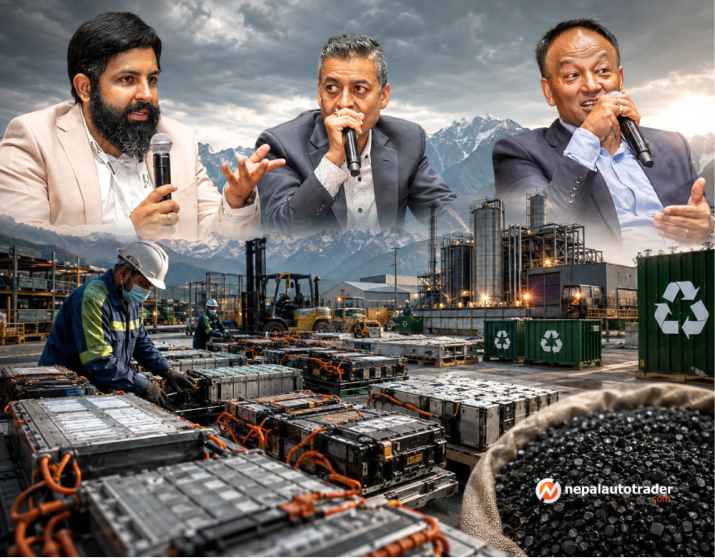
That question is now moving into the center of Nepal’s automotive debate. At a recent NAIMA dialogue on battery recycling and ethanol blending, several industry voices offered sharply different views on how Nepal should handle the batteries coming out of EVs, along with those from phones, laptops and other equipment.
The disagreement is not really about whether a system is needed. Everyone appears to agree on that. The difficult part is deciding who pays, who collects, who tracks the batteries and who carries responsibility when one is damaged, abandoned or moved across the open Nepal-India border.
That makes this less of a recycling story and more of a policy design problem.
Akash Golchha, an automobile businessman and NAIMA founder, argues that importers alone cannot realistically operate the recycling system. He points to the absence of a structured system in Nepal and says responsibility should be shared among government, consumers, importers and other stakeholders.
His concern is especially relevant for damaged EV batteries. Under the current situation, batteries may return to importers under warranty, but a battery damaged in an accident may remain with the vehicle owner. That creates an awkward legal gap. Who is responsible if it is later discarded improperly?
Indian battery recycling executive Karan Khurana takes the argument further. He says asking automobile businesses to become recyclers may not be practical because recycling is outside their core business. His preferred direction is a dedicated industry with clear rules, licensed operators and official collection points, particularly along highways.
Then comes Sagar Gurung, former president of the Automobile Journalists Association, Nepal, with a different emphasis. He argues that EV importers should be required to invest in a battery management company, with contributions linked to the number of vehicles each company sells. He also suggests Nepal should begin with collection, testing and second-life applications rather than immediately building a full-scale recycling plant.
| Perspective | Main Responsibility | Immediate Priority |
|---|---|---|
| Akash Golchha | Shared responsibility | Clear law, licensed recyclers and better incentives |
| Karan Khurana | Specialist recycling companies | Collection centres and defined recycling rules |
| Sagar Gurung | Importer-backed investment | Collection, testing and second-life use |
Put together, the three positions actually point toward a workable compromise.
Nepal does not yet have a complete lithium-ion battery recycling ecosystem. That matters because recycling is only one part of the chain. Before a battery can be recycled, someone has to identify it, collect it safely, test its condition, decide whether it still has useful life and then route it toward recycling or another approved use.
The open border with India adds another layer. Khurana highlighted the movement of batteries across the border and the difficulty of tracking them. Golchha also raised concerns about batteries entering informal channels, while pointing to the absence of a clear system for determining their value when they leave Nepal.
This is where a battery registration and tracking system becomes important. Every EV battery could have a record tied to the vehicle, importer and eventual disposal route. The system would not need to begin with sophisticated recycling technology. It needs traceability first.
That would close one of the biggest gaps in the current system: nobody should have to guess where an EV battery went.
There is a temptation to think Nepal needs a giant recycling plant immediately. The sources suggest otherwise. Gurung specifically argues that current volumes may not yet justify a full-scale battery management industry, while recommending collection, testing and second-life applications as the starting point.
That is probably the more realistic path. A phased system could look like this:
The second-life opportunity is particularly interesting. Gurung suggested battery storage could be used to capture electricity that would otherwise be wasted at night and make it available during peak periods.
Meanwhile, where domestic recycling technology is unavailable, the sources point to separating materials such as plastic, copper and aluminium and potentially exporting black mass for further processing.
This is where the three arguments can be reconciled. Nepal does not necessarily need to choose between making importers responsible and creating independent recyclers.
A stronger model would make importers financially responsible for the batteries they introduce into the market, while leaving physical collection, testing and recycling to licensed specialist companies.
| Policy Tool | Who Handles It | Why It Matters |
|---|---|---|
| Battery registration | Government and importers | Creates traceability from vehicle sale to end of life |
| Management contribution | Importers | Creates funding without forcing dealers to become recyclers |
| Collection | Licensed operators | Keeps damaged and used batteries inside a formal system |
| Testing and second life | Specialist companies | Extracts additional value before recycling |
| Final recycling or export | Licensed recyclers | Creates accountability for the final destination |
Importers could contribute according to sales volume, as Gurung proposes, while independent companies do the technical work advocated by Khurana and Golchha. Government would set the rules, license operators and monitor the chain.
For consumers, that matters too. An owner should know what to do with a damaged battery after an accident, rather than being left with an expensive and potentially hazardous object and no clear disposal route.
The strongest warning from these three perspectives is that Nepal should not wait until large numbers of EV batteries become waste. Gurung cited a study projecting that 150 to 180 GWh of batteries could enter second-life use by 2043 after completing their first life.
That projection does not mean Nepal needs a massive recycling factory tomorrow. It means the country has a window to build the rules, logistics and business incentives before the volume becomes difficult to manage.
The next step should therefore be practical rather than dramatic: establish registration, create official collection points, license specialist operators, require importer contributions and make second-life testing part of the system.
The consequences are already being felt across the industry. EV adoption has moved faster than battery end-of-life policy. Nepal now has a chance to catch up without building an unnecessarily expensive system too early.
The best solution may not belong entirely to importers, recyclers or government. It belongs in the space between them.
Q: Who should be responsible for EV battery recycling in Nepal?
A: The three perspectives suggest shared responsibility. Importers can fund the system, while licensed specialist companies handle collection, testing and recycling under government rules.
Q: Does Nepal currently have a full lithium-ion battery recycling industry?
A: The sources state that Nepal does not currently have full recycling infrastructure for lithium-ion batteries. They suggest beginning with collection, testing and material separation, with black mass potentially processed outside Nepal.
Q: Should EV importers be forced to recycle batteries themselves?
A: One proposal calls for mandatory importer investment, but the other perspectives argue that importers should not necessarily become recyclers. A funded specialist system could combine both positions.
Q: What happens to an EV battery that is still usable after leaving the vehicle?
A: It can potentially be tested for second-life applications, including stationary energy storage. This could delay recycling while extracting more useful service from the battery.
Q: Why is battery tracking important in Nepal?
A: Tracking can establish where a battery enters the country, who holds it, when it is replaced or damaged and where it ultimately goes. It could also help reduce movement into informal or uncontrolled channels.
Q: What should Nepal do first?
A: The most practical starting point is a formal collection and tracking network, supported by importer funding and licensed specialist operators. Full-scale domestic recycling can follow when battery volumes justify the investment.

Nepal Auto-Trader is one-stop platform for all automotive needs. We provide unbiased and unparalleled news/reviews of all auto-motives being launched in Nepalese Auto-Industry. Find recent updates and price of bikes/cars, compare and review recently launched bikes/cars, buy/sell/trade reconditioned cars/bikes and all government news about changing rules and regulation, road safety by subscribing us.

Subscribe to our Newsletter
© Copyright 2026, Nepal Autotrader


.png)
.png)