

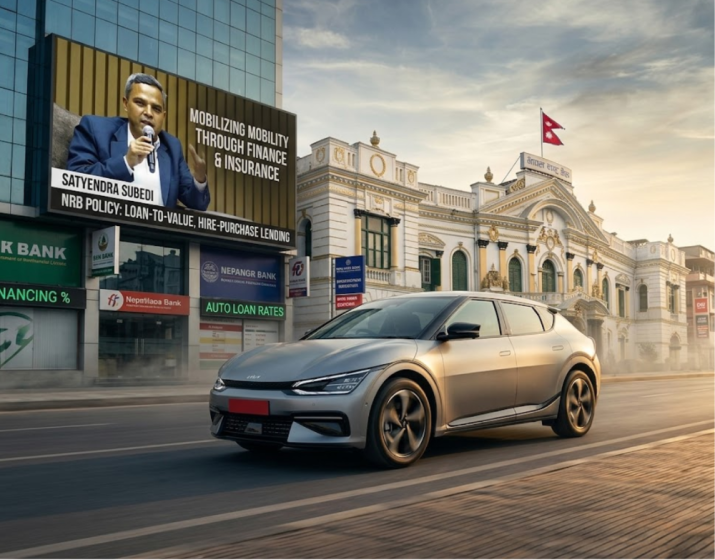
Vehicle finance is becoming a more important part of Nepal's automotive story. As more buyers depend on loans to get behind the wheel, the health of that lending market matters almost as much as vehicle sales themselves.
That was the backdrop at the Mobilizing Mobility Through Finance and Insurance event organized by the Nepal Automobile Importers and Manufacturers Association, or NAIMA. Speaking at the event, Nepal Rastra Bank director Satyendra Subedi addressed one of the industry's biggest concerns, whether rapid growth in vehicle-related lending could eventually turn into a wider credit problem.
His answer was relatively reassuring. Subedi said he does not currently see an auto-loan credit bubble developing, although the central bank remains alert because problems in one sector can eventually affect others.
That distinction matters. The message is not that vehicle lending carries no risk. It is that the existing framework is intended to keep that risk contained.
Subedi linked today's lending rules directly to lessons from the 2007/08 global financial crisis. He said bank capital alone was not enough to deal with financial shocks, which is why loan-to-value controls became an important part of the lending framework.
For vehicle buyers, LTV is a simple idea with a real-world effect. It determines how much of a vehicle's value can be financed through borrowing, leaving the customer responsible for the remaining portion.
| Vehicle category | Current LTV ratio | Policy rationale stated by NRB |
|---|---|---|
| Electric vehicles | 80 percent | Greater flexibility under green financing |
| Internal-combustion vehicles | 60 percent | Higher borrower equity requirement |
The current difference between EVs and combustion vehicles is deliberate. Subedi said EV lending receives some flexibility because it falls under green financing. The result is a higher LTV allowance for electric vehicles.
But the central bank's logic is not simply about encouraging or discouraging a particular drivetrain. It is about keeping borrowers and lenders from becoming too exposed when vehicle values, interest rates or household finances move in the wrong direction.
There is another pressure point that buyers may feel more immediately than any regulatory change, interest rates.
Subedi specifically warned that rising interest rates can create problems for borrowers. A vehicle loan that looks comfortable when rates are low can become much harder to manage when monthly financing costs rise.
That is where the LTV requirement becomes more than a banking rule. A larger borrower contribution provides a buffer if the loan later runs into trouble. Without that protection, defaults could create problems across the chain.
The implications extend far beyond the company itself. A vehicle purchase often connects a customer, bank or hire-purchase company, insurer and importer in one financial transaction.
The scale of the market helps explain why the central bank is paying attention. According to Subedi, total credit in the financial system stands at Rs 60 trillion, while hire-purchase lending accounts for Rs 1.42 trillion.
| Metric | Current figure | Change or context |
|---|---|---|
| Total credit | Rs 60 trillion | Overall credit figure cited by NRB director |
| Hire-purchase lending | Rs 1.42 trillion | Part of total credit |
| Hire-purchase growth | 10 percent | Increase from the previous year |
Subedi also said bad loans in the segment remain low. That, combined with lenders' willingness to provide credit with relatively small margins, suggests that financial institutions do not currently view the sector as unusually dangerous.
Still, growth deserves attention. A 10 percent annual increase is meaningful when applied to a lending pool already measured in trillions of rupees.
One point Subedi stressed was the need to distinguish auto loans from hire-purchase lending. The two terms are often used interchangeably in everyday conversation, but they are not identical in the regulatory context.
Hire-purchase companies exist partly because some customers may find borrowing directly from banks cumbersome. Subedi said these companies were established so customers could access financing under simpler regulatory arrangements when banks were unable or unwilling to provide smaller loans.
The distinction becomes more important because hire-purchase financing is not limited to cars. Subedi said such lending also covers products including mobile phones and household goods.
That makes headline lending figures less useful if they are treated as pure passenger-car finance. The category is broader, and its risk profile reflects that.
The current LTV ratios are not necessarily permanent. Subedi said changes depend on the state and its policy direction, meaning the framework can be revised as financial and economic conditions evolve.
That flexibility is important for the automotive industry. A tighter lending framework could reduce the number of buyers able to finance a vehicle, while a more relaxed approach could make purchases easier but increase exposure if lending grows too quickly.
EVs are an especially interesting part of this equation. Their 80 percent LTV allowance reflects the central bank's green-financing approach, giving electric vehicles an advantage in the financing structure. Whether that remains unchanged will depend on future policy decisions rather than industry expectations.
For now, the central bank appears comfortable with the direction of the market. That does not mean it is taking its eyes off the numbers.
The real test will come if interest rates rise, defaults increase or vehicle lending starts expanding much faster than the wider credit market. Until then, Subedi's message is clear: the system has safeguards, and the central bank believes they are doing their job.
For buyers, the practical lesson is simpler. A loan may make a vehicle affordable today, but the strength of that decision depends on how comfortably the repayment still fits when conditions change.
Q: What is the current LTV ratio for EV loans in Nepal?
A: The current loan-to-value ratio cited by Nepal Rastra Bank director Satyendra Subedi is 80 percent for EVs. The higher limit is linked to green financing.
Q: What is the LTV ratio for internal-combustion vehicles?
A: The current LTV ratio cited for internal-combustion vehicles is 60 percent. The remaining portion has to be covered outside the loan.
Q: How large is Nepal's hire-purchase lending market?
A: Subedi said hire-purchase lending currently stands at Rs 1.42 trillion, against total credit of Rs 60 trillion. He also said the segment has grown 10 percent from the previous year.
Q: Does Nepal Rastra Bank see an auto-loan credit bubble developing?
A: Subedi said he does not currently believe an auto-loan credit bubble or major associated risk is developing. However, the central bank remains alert to problems that could spread from one sector to the wider financial system.
Q: Why does the loan-to-value ratio matter to vehicle buyers?
A: LTV determines how much of a vehicle's value can be financed through borrowing. A lower ratio generally requires a larger contribution from the buyer and provides more protection if loan repayments later become difficult.
Q: Can Nepal's vehicle-loan rules change in the future?
A: Yes. Subedi said changes to the LTV framework depend on the state's policy direction and could be revised as conditions change.

Nepal Auto-Trader is one-stop platform for all automotive needs. We provide unbiased and unparalleled news/reviews of all auto-motives being launched in Nepalese Auto-Industry. Find recent updates and price of bikes/cars, compare and review recently launched bikes/cars, buy/sell/trade reconditioned cars/bikes and all government news about changing rules and regulation, road safety by subscribing us.

Subscribe to our Newsletter
© Copyright 2026, Nepal Autotrader


.png)
.png)