

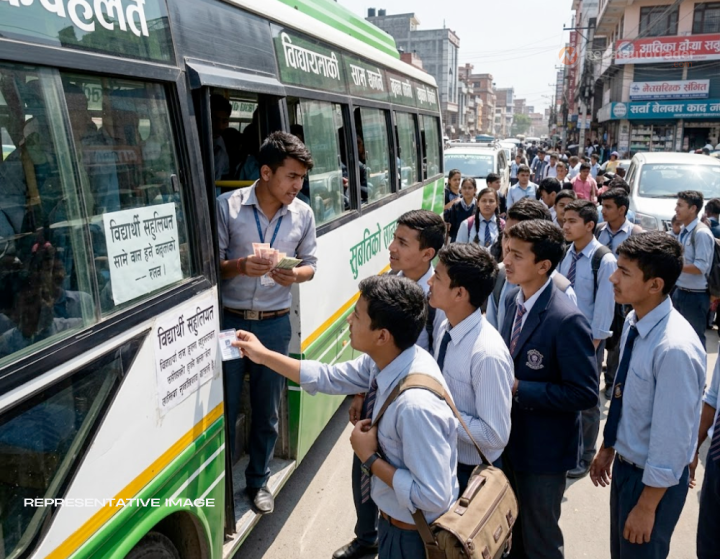
The rule is clear on paper. Students in Nepal are entitled to a 45% discount on public transport fares. It is not a suggestion, it is a directive. Yet, step into a bus during peak hours, and the situation tells a very different story.
Transporters, particularly in urban corridors, are reportedly not honoring the mandated student concession. Students say they are often forced to pay full fare, or negotiate with conductors who refuse to recognize student identity cards. This gap between policy and execution is no longer occasional. It is routine.
That matters. Because for thousands of students, daily transport is not optional, it is essential.
The issue is not the absence of regulation. The government has already established provisions ensuring discounted travel for students. The breakdown lies in implementation and enforcement.
Transport entrepreneurs argue rising operational costs, fuel price fluctuations, and maintenance expenses make it difficult to comply fully. Students, on the other hand, see it as a clear violation of their rights.
The result is a fragmented system where compliance depends on the route, the operator, or even the individual conductor. That unpredictability erodes trust.
| Aspect | Official Provision | Ground Reality |
|---|---|---|
| Student Discount | 45% fare reduction | Often not provided |
| ID Verification | Valid student card accepted | Frequently rejected or ignored |
| Government Monitoring | Regulated and enforced | Weak enforcement reported |
| Fare Consistency | Standardized | Varies by route and operator |
The contrast is stark. The system exists, but the compliance is inconsistent at best.
For students commuting daily, this is not just a policy debate. It is a financial strain that accumulates over time. Paying full fare instead of receiving a 45% concession significantly increases monthly expenses, especially for those traveling long distances.
Some students report being forced into uncomfortable choices. Skip classes to save money, or pay more than they can afford just to attend. That is the real-world impact.
This changes things. Because access to education is directly tied to affordability, and transport plays a critical role in that equation.
Transport operators are not silent in this debate. Many argue that the current fare structure is already under pressure. Rising fuel costs, vehicle maintenance, and operational overheads have squeezed margins.
From their perspective, offering a 45% discount without compensation mechanisms creates financial imbalance. Some operators claim the policy lacks practical support measures, making full compliance difficult.
The tension is clear. Policy expectations versus economic realities. Both sides have arguments, but only one side is absorbing the immediate cost.
The situation now demands intervention. Without stronger monitoring and enforcement, the student fare discount policy risks becoming symbolic rather than functional.
Authorities may need to step in with stricter checks, clearer accountability mechanisms, or even financial models that support transport operators while protecting student rights. Until then, the inconsistency will persist.
And the daily commute will remain uncertain for students. That uncertainty, over time, becomes the bigger issue.
Q: What is the official student discount on public transport in Nepal?
A: Students are entitled to a 45% discount on fares as per government provisions. However, implementation varies widely across routes and operators.
Q: Why are transporters not providing the discount?
A: Transport operators cite rising operational costs and lack of compensation as key reasons for not fully complying with the discount policy.
Q: Are student ID cards valid for fare discounts?
A: Yes, valid student ID cards should be accepted, but many students report rejection or disputes during travel.
Q: Is the government monitoring fare compliance?
A: Monitoring exists in principle, but enforcement is reportedly weak, leading to inconsistent application of the rule.
Q: How does this affect students daily?
A: Students often end up paying full fares, increasing their monthly commuting expenses and affecting access to education.
PREVIOUS NEWS

Nepal Auto-Trader is one-stop platform for all automotive needs. We provide unbiased and unparalleled news/reviews of all auto-motives being launched in Nepalese Auto-Industry. Find recent updates and price of bikes/cars, compare and review recently launched bikes/cars, buy/sell/trade reconditioned cars/bikes and all government news about changing rules and regulation, road safety by subscribing us.

Subscribe to our Newsletter
© Copyright 2026, Nepal Autotrader


.png)
.png)