

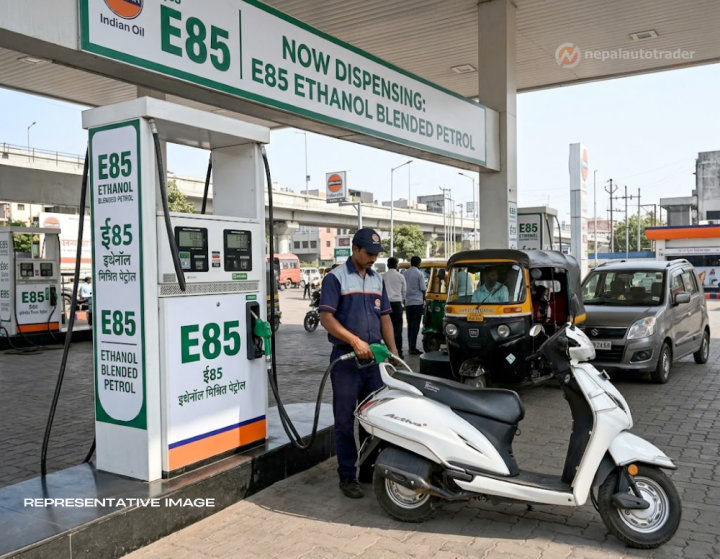
India is stepping harder on the accelerator, this time not with horsepower but with chemistry. The government is now targeting a dramatic shift in fuel composition, aiming to mix up to 85 percent ethanol with petrol. That is not a marginal tweak. It is a structural rewrite of how fuel is produced, distributed, and consumed across one of the world’s largest automotive markets.
The move builds on India’s ongoing ethanol blending programme, which has already seen incremental increases over the past few years. Now, the scale is different. The ambition is bigger, sharper, and more disruptive. That matters.
At its core, this strategy is about reducing dependency on imported fossil fuels while strengthening domestic agriculture and biofuel production. But it also sends a clear signal to automakers, fuel suppliers, and infrastructure players. Adapt, or fall behind.
The shift toward high ethanol blends is not happening overnight, but the direction is unmistakable. India has steadily increased ethanol blending levels, and this new push toward E85 fuel represents a significant escalation.
Here is how the transition is broadly evolving:
This is not just about fuel. It is about ecosystem alignment. Every stakeholder needs to move in sync. That is where the challenge lies.
An 85 percent ethanol blend is not something conventional petrol engines can simply adapt to without modification. Ethanol has different combustion characteristics, energy density, and material compatibility requirements. That means vehicles need to evolve.
Automakers operating in India are now expected to accelerate development of flex-fuel engines. These engines are designed to run on varying ethanol-petrol blends, including high concentrations like E85.
Key implications for the automotive industry:
This changes things. It forces a rethink not just at the engineering level, but across product planning and long-term investment strategies.
The rationale behind India’s ethanol push is layered. It is not just about emissions. It is about economics, energy security, and rural development.
| Factor | Impact | Significance |
|---|---|---|
| Fuel imports | Reduction in crude oil dependency | Improves trade balance |
| Agriculture | Increased demand for ethanol feedstock | Supports farmers and rural economy |
| Emissions | Lower carbon footprint compared to petrol | Aligns with climate goals |
| Energy security | Diversified fuel sources | Reduces geopolitical risk |
The environmental angle is important, but the economic angle is decisive. Countries do not make such aggressive shifts without financial logic. That logic is clear here.
Ambition is one thing. Execution is another. Scaling up to 85 percent ethanol blending requires a massive overhaul of infrastructure.
Critical areas that need attention:
This is where timelines often stretch. Infrastructure rarely moves at the pace of policy announcements. That tension will define how quickly India can realize its E85 vision.
India’s fuel policies rarely stay within its borders. The ripple effect often extends to neighboring markets, including Nepal. Fuel imports, vehicle specifications, and regulatory alignment tend to follow India’s lead.
Potential implications for Nepal:
This is not immediate, but it is inevitable. Regional automotive ecosystems are interconnected. What India does at scale tends to reshape the playing field.
India’s push toward E85 fuel is bold, no question. It signals intent, urgency, and a willingness to disrupt entrenched systems. But ambition alone does not guarantee execution.
The coming years will test how effectively policy, industry, and infrastructure can align. Automakers must respond. Fuel suppliers must scale. Consumers must adapt.
And the timeline will tell the real story. Because in mobility, transformation is never just announced. It is built, step by step.
That is where this journey becomes interesting.
Q: What is E85 fuel in India’s context?
A: E85 fuel refers to a blend consisting of up to 85 percent ethanol and 15 percent petrol. India is pushing toward higher ethanol blending as part of its energy and environmental strategy.
Q: Can current vehicles run on 85 percent ethanol blend?
A: Most conventional vehicles are not designed for such high ethanol content. Flex-fuel vehicles are required to safely operate on E85 blends.
Q: Why is India increasing ethanol blending in petrol?
A: The move aims to reduce dependence on imported crude oil, support domestic agriculture, and lower carbon emissions.
Q: Will Nepal be affected by India’s ethanol blending policy?
A: Yes, Nepal could see indirect impacts through fuel imports and vehicle compatibility trends, given its reliance on Indian fuel supply chains.
Q: What challenges does E85 adoption face?
A: Key challenges include infrastructure readiness, vehicle compatibility, ethanol production capacity, and supply chain adjustments.

Nepal Auto-Trader is one-stop platform for all automotive needs. We provide unbiased and unparalleled news/reviews of all auto-motives being launched in Nepalese Auto-Industry. Find recent updates and price of bikes/cars, compare and review recently launched bikes/cars, buy/sell/trade reconditioned cars/bikes and all government news about changing rules and regulation, road safety by subscribing us.

Subscribe to our Newsletter
© Copyright 2026, Nepal Autotrader


.png)
.png)