

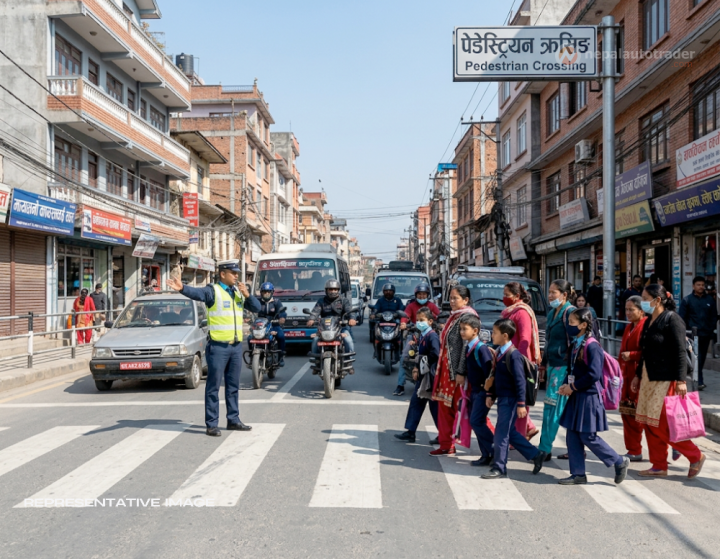
The shift is subtle. But it cuts deep into how road behavior is understood in Nepal. Under a proposed update to the Motor Vehicles and Transport Management framework, pedestrians are no longer outside the enforcement net. They can now be fined. On the spot.
This is not theoretical. The draft provision allows transport inspectors to impose fines of up to Rs 500 on pedestrians who violate traffic rules or disrupt road discipline. That matters. Because for decades, enforcement conversations focused almost entirely on drivers.
The message is clear, roads are shared spaces, and accountability is no longer one-sided. This changes things.
The proposal does not list every micro offense in isolation, but the direction is unmistakable. Any act that violates traffic rules or basic road discipline can attract a penalty.
That includes behavior commonly seen in urban Nepal:
Until now, such actions carried little immediate consequence. Enforcement leaned toward drivers, even when pedestrians contributed to chaos. This provision rebalances that equation.
And it does so bluntly. No warnings required, just a fine.
This isn’t an isolated tweak. It sits inside a much broader attempt to tighten discipline across Nepal’s roads. The same legislative draft expands enforcement power and increases penalties across the board.
| Provision | Current System | Proposed Change |
|---|---|---|
| Pedestrian fines | Not enforced | Up to Rs 500 on the spot |
| Traffic offenses | 20 categories | 34 categories |
| Fine range | Rs 500 to Rs 5,000 | Rs 100 to Rs 50,000 |
Those numbers matter. Expanding the offense list from 20 to 34 categories signals a system preparing for tighter control. Increasing penalties up to Rs 50,000 raises the stakes dramatically.
Pedestrians entering this framework is not accidental. It’s deliberate. It aligns with a broader enforcement philosophy, everyone on the road is accountable.
The logic is rooted in reality. Urban traffic in Nepal has become increasingly unpredictable. Vehicles, bikes, and pedestrians operate in overlapping, often chaotic spaces.
Authorities believe low penalties, or no penalties, have encouraged risky behavior. The result, rising violations and accidents.
Key drivers behind the move include:
This isn’t about punishing pedestrians. It’s about enforcing predictability. Because unpredictability on the road is what causes collisions. That matters.
One detail stands out, enforcement authority shifts directly to transport inspectors. That means fines can be issued instantly, without lengthy procedures.
In practical terms:
This approach mirrors the broader push toward quicker, more visible enforcement. It is designed to change behavior in real time, not months later.
The implication is simple, if you break the rule, you pay immediately. No delays. No ambiguity.
This is where the real impact lies. Not in the Rs 500 fine, but in what it represents.
For years, pedestrian behavior operated in a gray zone. Legally governed, yes, but rarely enforced. That gap created habits. Habits that now face correction.
The new rule signals three things:
Expect resistance. Expect confusion. But also expect gradual behavioral change.
Because once enforcement begins, consistently, habits tend to follow.
This isn’t just about pedestrians being fined. It’s about redefining how Nepal’s roads function. And that’s the bigger story.
Q: How much can pedestrians be fined under the new rule?
A: The proposed provision allows fines of up to Rs 500 for pedestrians who violate traffic rules or road discipline.
Q: Who will issue fines to pedestrians?
A: Transport inspectors will have the authority to impose on-the-spot fines without lengthy procedures.
Q: What kind of pedestrian behavior could lead to fines?
A: Violations may include unsafe road crossing, ignoring signals, or obstructing traffic flow, though exact offenses depend on enforcement interpretation.
Q: Is this part of a larger traffic reform?
A: Yes, it is included in a broader proposal that expands offenses from 20 to 34 categories and increases fines up to Rs 50,000.
Q: Are these rules already in effect?
A: The provisions are part of a draft bill and will be enforced once officially approved and implemented.

Nepal Auto-Trader is one-stop platform for all automotive needs. We provide unbiased and unparalleled news/reviews of all auto-motives being launched in Nepalese Auto-Industry. Find recent updates and price of bikes/cars, compare and review recently launched bikes/cars, buy/sell/trade reconditioned cars/bikes and all government news about changing rules and regulation, road safety by subscribing us.

Subscribe to our Newsletter
© Copyright 2026, Nepal Autotrader


.png)
.png)