

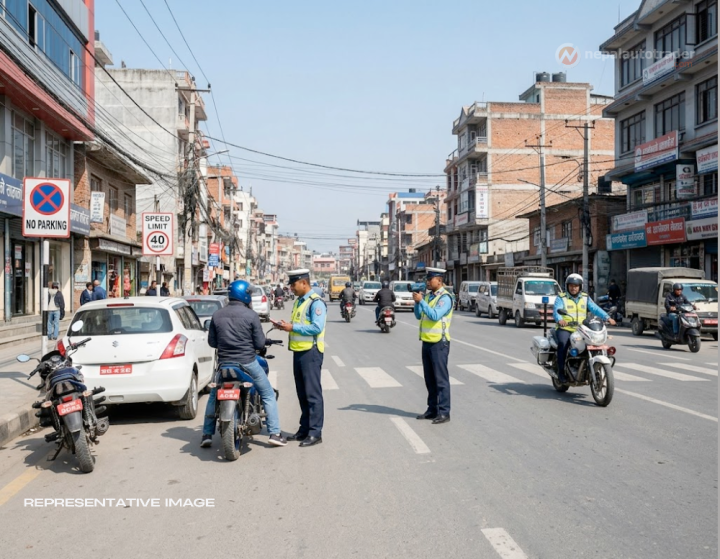
Nepal’s road safety conversation has taken a sharper turn. A fresh proposal to increase traffic fines is now on the table, and it is not subtle. Authorities are considering penalties that could reach up to Rs 1 lakh, a figure that instantly changes the tone of enforcement across the country.
This is not just a routine update to outdated penalties. It signals intent. A push to reset driver behavior, to force accountability where warnings have failed. That matters.
The proposal, currently under discussion, is part of a broader effort to address rising concerns around traffic violations and road safety. The existing system, long criticized for being too lenient, is now under scrutiny. The idea is simple, make violations hurt financially enough to discourage repeat offenses.
While the full breakdown of penalties has not been formally enacted, the direction is clear. The government is exploring a revised fine structure that dramatically raises the ceiling for serious violations.
| Category | Current Approach | Proposed Direction |
|---|---|---|
| Penalty Limit | Lower fine range | Up to Rs 1 lakh |
| Violation Scope | General enforcement | Targeted high-risk offenses |
| Objective | Compliance | Deterrence and discipline |
Key areas expected to fall under stricter penalties include:
The message is not hidden. The system is moving from symbolic punishment to financial consequence. This changes things.
The logic behind the proposal is rooted in a persistent issue, lack of enforcement impact. Current fines, in many cases, are seen as manageable inconveniences rather than serious penalties. Drivers pay, move on, repeat.
Authorities believe that increasing fines will directly influence behavior. A higher financial risk introduces hesitation. It forces a pause before a violation. That matters.
There is also a broader institutional angle. Stronger penalties can:
This is not just about punishment. It is about reshaping the culture around driving.
If implemented, the proposed fines will have an immediate psychological effect on drivers. The stakes go up. Suddenly, minor lapses carry major consequences.
For everyday commuters, this could mean:
| Area | Expected Impact |
|---|---|
| Driving Behavior | More cautious, rule-focused driving |
| Violation Frequency | Potential reduction |
| Financial Risk | Significantly higher for offenders |
There is also a flip side. Enforcement consistency will become critical. High penalties without uniform enforcement risk creating friction. Drivers will expect fairness if the cost of violation rises sharply.
This is where execution becomes everything. Not just the rule, but how it is applied.
It is important to underline one point, the proposal is not yet law. Discussions are ongoing, and the framework is still being shaped. No official rollout date has been confirmed.
That leaves room for refinement. Stakeholders, including enforcement agencies and policymakers, are expected to weigh in before final approval.
What comes next will likely involve:
The direction, however, is already visible. Nepal is preparing for stricter roads, sharper penalties, and a system that demands compliance rather than suggests it. That shift, if executed well, could redefine everyday driving behavior.
And if it fails, it will be felt just as strongly.
This proposal sits at the intersection of policy and public behavior. For the automotive ecosystem, including importers, dealerships, and vehicle owners, it introduces a new layer of responsibility.
Dealerships and importers may find themselves emphasizing driver education alongside vehicle sales. Ownership will carry more accountability. Buyers will think beyond features and price, and consider compliance and risk.
In a market where road discipline has long been a challenge, this move stands out. Not as a quick fix, but as a structural shift.
Whether it delivers results depends on one thing, consistency. Because high fines alone do not change behavior. Enforcement does.
Q: What is the maximum traffic fine proposed in Nepal?
A: The proposal suggests fines could go up to Rs 1 lakh for certain traffic violations. The final structure is still under discussion.
Q: Has the new traffic fine rule been implemented?
A: No, the proposal is currently under review and has not been officially implemented yet.
Q: Which violations will attract higher fines?
A: The focus is expected to be on serious offenses like reckless driving, signal violations, and repeat offenses, though final details are pending.
Q: Why is the government increasing traffic fines?
A: The aim is to improve road safety and create stronger deterrence against violations, as current fines are seen as too low to influence behavior.
Q: How will higher fines affect drivers?
A: Drivers may adopt more cautious behavior due to increased financial risk, but effectiveness will depend on consistent enforcement.
PREVIOUS NEWS

Nepal Auto-Trader is one-stop platform for all automotive needs. We provide unbiased and unparalleled news/reviews of all auto-motives being launched in Nepalese Auto-Industry. Find recent updates and price of bikes/cars, compare and review recently launched bikes/cars, buy/sell/trade reconditioned cars/bikes and all government news about changing rules and regulation, road safety by subscribing us.

Subscribe to our Newsletter
© Copyright 2026, Nepal Autotrader


.png)
.png)