

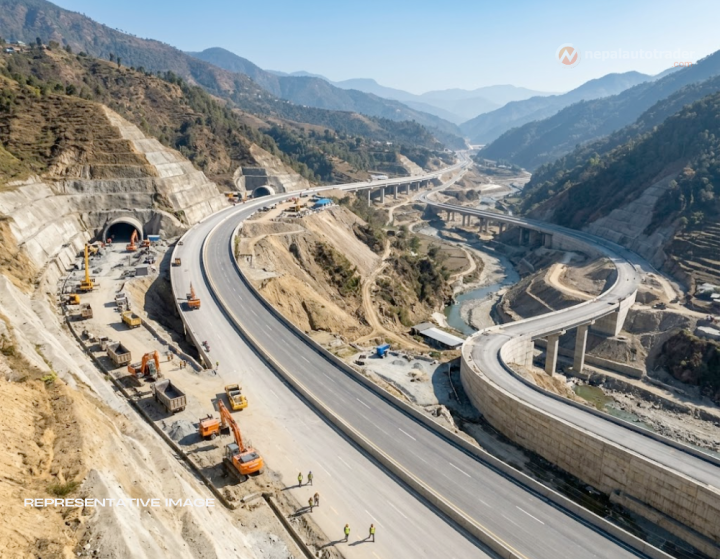
The long-anticipated Fast Track project is finally showing visible signs of acceleration. After years of measured progress, activity on the ground has intensified, particularly across sections involving tunnel excavation and structural groundwork. This is not incremental anymore, it is deliberate, coordinated movement.
The Nepal Army, entrusted with execution, has stepped up mobilization. Equipment deployment has increased. Workforce density is higher. Sections that once appeared static now show synchronized activity. That matters.
This acceleration is not cosmetic. It reflects a shift in operational tempo. A project once criticized for delays is now entering a phase where tangible outputs are beginning to stack up.
The focus has clearly narrowed to technically demanding segments. Tunnels, bridges, and structural foundations dominate the current workload. These are the components that define project timelines, not surface roadwork.
| Section | Work Type | Current Status |
|---|---|---|
| Tunnel Sections | Excavation and reinforcement | Active progress |
| Bridge Structures | Foundation and support systems | Ongoing |
| Road Alignment | Earthwork and leveling | Advancing |
These elements are not interchangeable. Tunnel delays stall everything. Bridge delays disrupt continuity. Seeing simultaneous movement across these fronts signals improved planning discipline.
It also suggests better resource allocation, something the project has struggled with in the past. This changes things.
The Nepal Army remains central to the project’s execution model. Unlike conventional contractor-driven projects, this approach blends military discipline with civil engineering execution.
Recent developments indicate stronger coordination between technical teams and field units. Decision-making appears faster. Bottlenecks, at least for now, are being addressed more proactively.
This is not just about speed. It is about sequencing. Infrastructure projects fail when priorities scatter. Right now, the focus looks sharp.
And that focus is visible on the ground.
The Fast Track is not just another road. It is a strategic corridor designed to reshape connectivity, particularly linking key economic zones with greater efficiency.
Once completed, the route is expected to significantly reduce travel time. Logistics chains will tighten. Transport costs could shift. That ripple effect touches everything from trade to daily commuting.
| Impact Area | Current State | Expected Change |
|---|---|---|
| Travel Time | Long, indirect routes | Reduced significantly |
| Logistics Efficiency | Fragmented movement | Streamlined transport |
| Economic Activity | Regionally limited | Expanded connectivity |
This is why acceleration matters. Delays here are not just construction delays, they are economic delays.
And every month gained shifts that equation.
Despite visible progress, the project is not out of the woods. Infrastructure of this scale carries inherent risks. Geological surprises, weather disruptions, and coordination complexities remain real threats.
Tunnel construction, in particular, is unpredictable. Even with advanced planning, ground conditions can change rapidly. That uncertainty never fully disappears.
Acceleration must be sustained, not just initiated. Short bursts of progress mean little if momentum drops again.
The current phase feels different, but consistency will decide the outcome.
The immediate focus will remain on maintaining this pace. Completing tunnel segments and structural links will define the next milestones.
There is no single finish line here. Instead, the project will move through phases, each unlocking the next layer of progress. That is how complex infrastructure evolves.
For now, the shift is clear. Work is faster. Coordination is tighter. The intent is visible.
And for a project of this scale, that alone signals a turning point.
It finally feels like movement with purpose.
Q: What is the Fast Track project?
A: The Fast Track is a major road infrastructure project aimed at improving connectivity and reducing travel time between Kathmandu and Terai. It is considered a strategic national priority.
Q: Who is responsible for constructing the Fast Track?
A: The Nepal Army is leading the construction, managing execution, coordination, and on-ground operations.
Q: What parts of the project are currently progressing?
A: Work is actively progressing on tunnels, bridges, and road alignment sections, which are critical to overall completion.
Q: Why is tunnel construction important in this project?
A: Tunnels are among the most complex and time-sensitive components. Delays in tunnel work can significantly impact the entire project timeline.
Q: How will the Fast Track impact transportation?
A: It is expected to reduce travel time, improve logistics efficiency, and enhance regional economic connectivity once completed.
Q: Is the project facing any challenges?
A: Yes, challenges include geological risks, weather conditions, and logistical coordination, especially in technically demanding sections like tunnels.
PREVIOUS NEWS

Nepal Auto-Trader is one-stop platform for all automotive needs. We provide unbiased and unparalleled news/reviews of all auto-motives being launched in Nepalese Auto-Industry. Find recent updates and price of bikes/cars, compare and review recently launched bikes/cars, buy/sell/trade reconditioned cars/bikes and all government news about changing rules and regulation, road safety by subscribing us.

Subscribe to our Newsletter
© Copyright 2026, Nepal Autotrader


.png)
.png)