

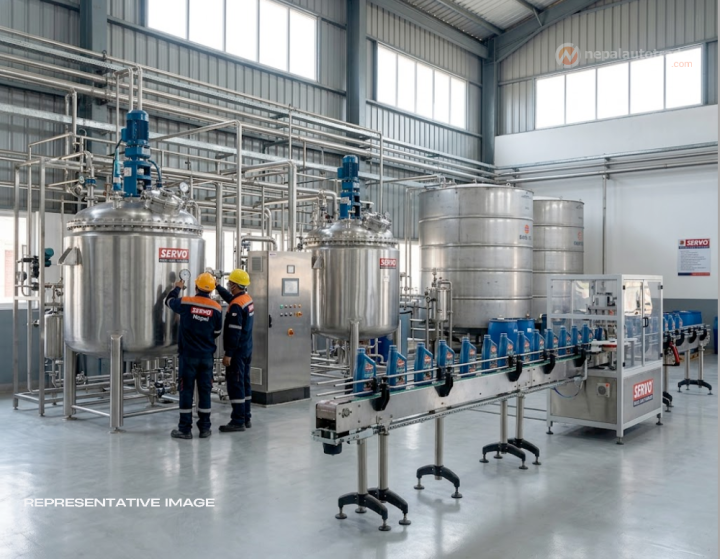
Servo lubricant, the flagship oil brand from Indian Oil Corporation, is now being produced in Nepal. Not imported. Not repackaged. Produced locally. That matters.
This development, tied closely to the operational network of Nepal Oil Corporation, signals something bigger than just oil in a bottle. It is about control. Supply control, pricing stability, and a stronger domestic value chain.
For years, Nepal’s lubricant market has leaned heavily on imports. Brands came in finished, priced externally, and distributed internally. Now, with local Servo production, that equation begins to shift.
This changes things.
The move comes with the backing of Indian Oil Corporation, one of the largest energy companies in the region and Nepal’s primary fuel supplier. Through its long-standing relationship with Nepal Oil Corporation, the groundwork was already in place. Infrastructure. Logistics. Market familiarity.
Now it goes deeper.
This is not a sudden move. It feels like a calculated extension of an already tight partnership. One that now enters manufacturing.
At its core, Servo is a lubricant portfolio that spans across multiple sectors. Automotive. Industrial. Commercial transport. The local production setup is expected to cater to a broad spectrum of needs rather than a niche segment.
| Segment | Application | Relevance in Nepal |
|---|---|---|
| Automotive Lubricants | Passenger vehicles, motorcycles | High demand due to growing vehicle population |
| Commercial Vehicle Oils | Trucks, buses | Critical for logistics and transport economy |
| Industrial Lubricants | Machinery, factories | Supports expanding industrial base |
The logic is simple. Produce where demand exists. And Nepal’s demand is not small anymore.
This is not just about convenience. It is about resilience. Nepal’s automotive sector is expanding, and with it, the demand for reliable consumables like engine oil, transmission fluids, and industrial lubricants.
Local production addresses several pressure points at once:
It also aligns with broader industrial ambitions. Nepal is slowly pushing toward localized value creation. This fits that narrative neatly.
That matters.
The lubricant market in Nepal is already competitive, with multiple international and regional brands operating across segments. The entry of locally produced Servo adds a new dimension, not necessarily a new player, but a stronger version of an existing one.
Expect pressure on:
Servo already carries brand recall due to its presence via imports. Local production sharpens that advantage. It becomes more accessible. More consistent.
This changes things.
For context, Nepal’s broader automotive ecosystem is evolving rapidly, from electric vehicle adoption seen in models like the BYD Atto 3 to expanding two-wheeler markets highlighted by the Yamaha MT-15. Lubricants remain foundational, regardless of powertrain shifts.
The start of production is only the first step. The real test lies in scale. Can production meet national demand. Can distribution remain seamless. Can quality remain consistent with global standards.
| Phase | Focus Area | Expected Direction |
|---|---|---|
| Initial Production | Market entry | Stabilize supply and availability |
| Expansion | Volume scaling | Wider reach across Nepal |
| Integration | Aftermarket alignment | Stronger workshop and dealer networks |
If executed right, this could evolve into a benchmark for other automotive consumables to follow. Localize production. Strengthen supply. Build resilience.
It starts with oil. It rarely ends there.
Q: Who started Servo lubricant production in Nepal?
A: The production is backed by Indian Oil Corporation in collaboration with Nepal Oil Corporation, leveraging their long-standing energy partnership.
Q: Is Servo lubricant now fully produced in Nepal?
A: Production has started locally, but the scale and full portfolio coverage will depend on how operations expand over time.
Q: Will locally produced Servo lubricants be cheaper?
A: While exact pricing details are not specified, local production can potentially improve cost stability by reducing import-related expenses.
Q: What types of lubricants are being produced?
A: The production is expected to cover automotive, commercial, and industrial lubricants under the Servo brand.
Q: Why is this important for Nepal’s automotive market?
A: It reduces dependency on imports, improves supply reliability, and strengthens the aftersales ecosystem for vehicles.
Q: Does this impact electric vehicles?
A: While EVs require fewer lubricants than traditional vehicles, industrial and ancillary lubrication demand remains relevant across sectors.

Nepal Auto-Trader is one-stop platform for all automotive needs. We provide unbiased and unparalleled news/reviews of all auto-motives being launched in Nepalese Auto-Industry. Find recent updates and price of bikes/cars, compare and review recently launched bikes/cars, buy/sell/trade reconditioned cars/bikes and all government news about changing rules and regulation, road safety by subscribing us.

Subscribe to our Newsletter
© Copyright 2026, Nepal Autotrader


.png)
.png)