

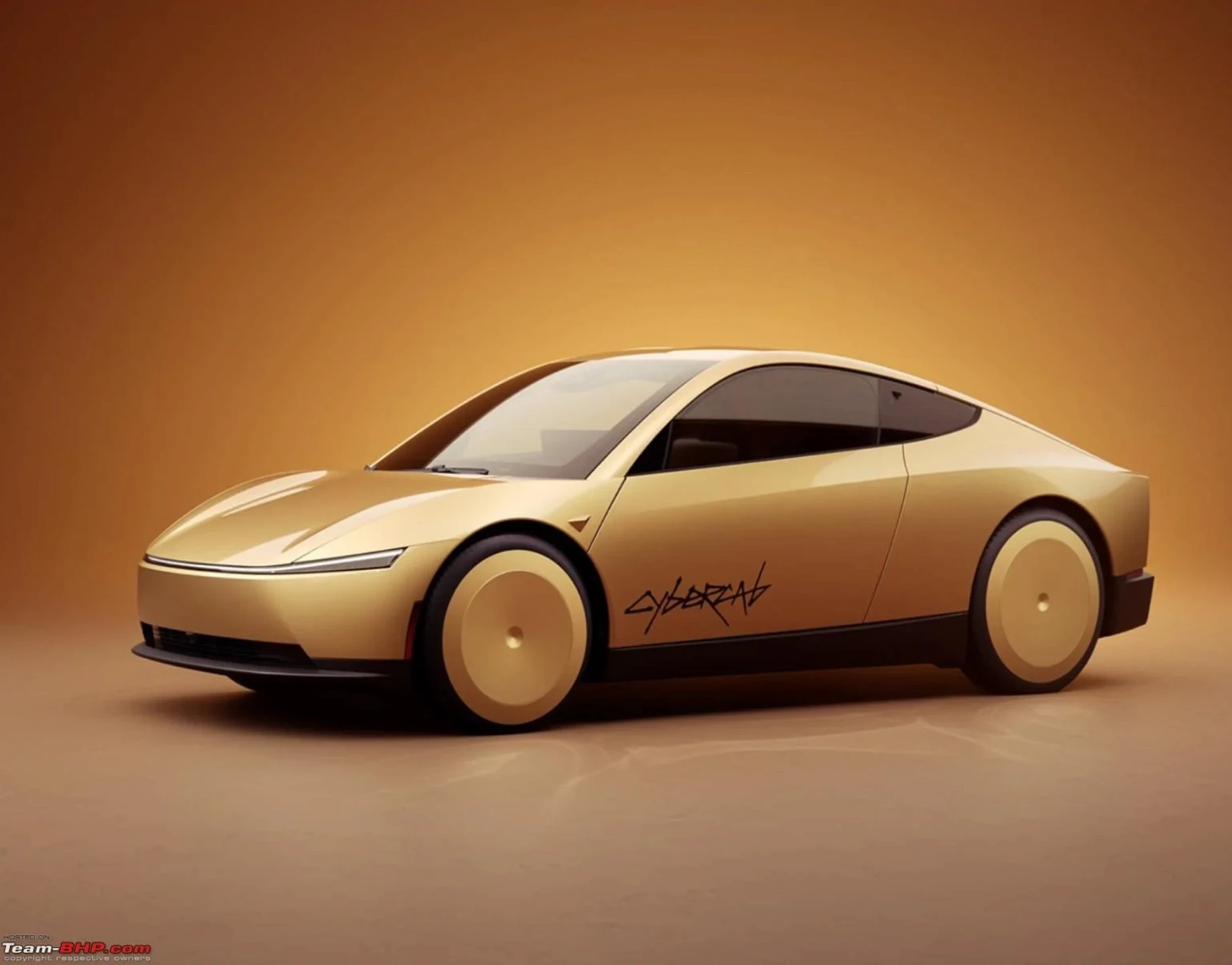
Tesla has finally attached a retail price to one of its most unusual electric vehicle projects. The Cybercab, originally presented as a purpose-built autonomous taxi, is now being offered to selected customers for personal ownership. The headline figure looks remarkably straightforward, sitting just below the $30,000 mark promised by Elon Musk during the vehicle's 2024 unveiling.
But there is a substantial catch. Buying the vehicle does not give customers unrestricted access to its driving capabilities. Tesla also requires a monthly autonomy subscription, and the car can operate only inside supported Robotaxi service areas. For buyers imagining a conventional electric car with autonomous driving built in, that distinction changes the entire proposition.
Tesla's official Robotaxi account announced the invitation-based ordering programme on Friday, November 13, sharing screenshots of the order page and customer invitation email. The offer is currently directed at select customers, rather than being presented as an unrestricted public order programme.
The ordering information lists the vehicle at $29,990 before taxes. Customers must also submit a $1,000 deposit, which is explicitly described as non-refundable. For the first announced deliveries, Tesla estimates December 2026 in Austin, Texas.
That purchase price is only part of the financial commitment. The order page includes a pre-selected $299 monthly Autonomy Subscription. The first month is included, but the subscription is mandatory for operating the vehicle. Tesla's accompanying terms also state that regular vehicle maintenance is required.
| Purchase detail | Published information |
|---|---|
| Vehicle | Tesla Cybercab |
| Listed price | $29,990 before taxes |
| Order deposit | $1,000, non-refundable |
| Autonomy subscription | $299 per month |
| Included subscription | One month |
| Estimated first delivery | December 2026 |
| Initial delivery location | Austin, Texas |
There is an important difference between the advertised purchase price and the cost of actually using the vehicle. Tesla has technically stayed below Musk's original $30,000 price promise. However, the recurring subscription makes ownership considerably more expensive than that headline suggests.
The Cybercab is not simply another Tesla with a different body style. Its design is built around autonomous operation, and the absence of conventional driving controls makes that clear immediately. There is no steering wheel and no accelerator or brake pedal for a person to operate.
Instead, Tesla says owners will manage their journeys through the app. The cabin has two seats and a 21-inch central touchscreen, while the luggage area offers 20.1 cubic feet of cargo capacity.
These details suggest a vehicle designed around a specific kind of personal mobility. It is a compact two-person transport solution rather than a conventional family car. That could appeal to buyers who primarily travel alone or with one passenger, but the lack of manual controls leaves very little room for conventional driving when the autonomous system cannot complete a journey.
Tesla has not provided a complete powertrain specification or detailed battery information in the order details covered by Electrek. Motor output, torque, battery capacity, driving range and charging performance should therefore not be treated as confirmed figures. For a vehicle being sold to private customers, those omissions leave important questions unanswered.
The monthly payment is significant, but the geographical restriction may prove even more frustrating. Tesla's order information says the Cybercab is available only in supported service areas. According to Electrek, those areas correspond to Tesla's Robotaxi operations in Texas and Florida.
The reported service cities are:
Even within these cities, the usable operating areas may be smaller than the boundaries advertised by Tesla. Electrek cites independent tracking work by Koby Pierce, who tested thousands of addresses through the Robotaxi app. In the six cities examined, the app reportedly accepted pickup and drop-off locations across only 59% to 78% of the advertised geofences.
Austin, the first announced delivery location, reportedly recorded approximately 59%. That is a particularly important detail. A vehicle can be technically available in a city while still being unable to complete journeys across substantial parts of that city.
Railroad crossings are another reported complication. Electrek describes an example in Houston where the Robotaxi app quoted approximately 40 minutes for a journey of two downtown blocks, apparently because the vehicle was routing around railway crossings. The publication also reports that San Antonio's airport appears inside Tesla's service-area polygon despite not being served.
For an ordinary car, a road closure or difficult crossing is an inconvenience. For a vehicle without manual controls, a restricted route can become a hard limit on where its owner can go.
There is also a safety and regulatory issue that sits beyond subscription costs and geographical restrictions. Electrek reports that the National Highway Traffic Safety Administration (NHTSA) has required Tesla to explain under oath how a vehicle without a brake pedal complies with federal safety standards that require one.
Tesla submitted its response on October 30, 2026, according to the report, and requested that the response remain confidential. At the time of Electrek's November 13 article, the regulator had not issued a ruling.
The timing matters. Tesla is now inviting customers to purchase a vehicle whose fundamental operating concept is tied to autonomous driving, while questions about its compliance with federal requirements remain unresolved in the reported proceedings.
This is not a minor equipment discussion. The Cybercab removes the controls that traditionally allow a driver to intervene. Its commercial proposition depends on the autonomous system being capable of handling the situations that a human driver would normally manage.
Until the regulatory position becomes clearer, prospective buyers have good reason to look beyond the order page and ask what happens when the system encounters a situation it cannot handle.
Electrek calculates that the $299 monthly subscription adds $3,588 annually. Over five years, the publication puts the combined purchase and subscription expenditure at approximately $47,600, before insurance, maintenance, taxes and charging. This is an illustrative calculation based on the listed purchase price and monthly subscription, not a complete ownership-cost estimate.
The numbers become more interesting when compared with the way people actually use transport services. Someone who regularly spends more than $300 each month on ride-hailing could see a potential financial argument for ownership. But that comparison only works if the Cybercab can reliably serve the places that person needs to visit.
That is where the current restrictions undermine the appeal. A private owner may need to travel outside the geofence, reach a destination that the system does not support, or deal with a route that becomes impractical because of infrastructure limitations. A conventional taxi or ride-hailing service leaves those operational problems with the provider. A Cybercab owner pays for the vehicle and still has to work around them.
The competitive landscape also deserves attention. Tesla is entering a personal autonomous mobility proposition in a market where services such as Waymo already offer app-based driverless journeys. These are not direct vehicle purchase alternatives, but they highlight an important distinction between paying for a completed journey and owning a vehicle whose usability depends on a limited operating area.
There is another question for existing Tesla customers. Electrek points out that the Cybercab uses the same AI4 computer as the current Model Y, while Tesla has been operating unsupervised Model Y Robotaxis in the same service areas. The publication questions why existing Model Y owners who have paid for Full Self-Driving cannot receive comparable unsupervised operation. It reports that Tesla has pushed that possibility towards approximately Q2 2027.
For now, the Cybercab's personal-use launch feels more like an early test of a new ownership model than a straightforward electric car release. Tesla has delivered a price, an ordering process and an estimated delivery window. What remains uncertain is whether the restricted autonomous experience will justify the ongoing cost.
The real test will not be how many customers place deposits. It will be how many can use the Cybercab naturally, without planning their lives around its operating boundaries.
Q: How much does the Tesla Cybercab cost?
A: Tesla lists the Cybercab at $29,990 before taxes. Buyers must also pay a $299 monthly Autonomy Subscription to operate it, with one month included.
Q: When will Tesla Cybercab deliveries begin?
A: The order page cited by Electrek estimates the first deliveries for December 2026 in Austin, Texas. The current ordering programme is invitation-based and limited to select customers.
Q: Can the Tesla Cybercab operate anywhere in the United States?
A: No. The reported supported operating areas are Tesla Robotaxi service zones in Texas and Florida. The vehicle cannot be used outside those supported areas under the conditions described in the order information.
Q: Does the Tesla Cybercab have a steering wheel and pedals?
A: No. The two-seat vehicle has neither a steering wheel nor conventional driving pedals. Tesla says owners will manage their journeys through its app.
Q: What are the main Tesla Cybercab interior specifications?
A: The reported specifications include two seats, a 21-inch central touchscreen and 20.1 cubic feet of cargo capacity. Detailed battery, motor output and driving-range figures were not provided in the order information covered by the source.
Q: Is the Tesla Cybercab worth buying?
A: Its value depends heavily on whether a buyer lives and travels within a supported Robotaxi area. The compulsory monthly subscription, limited operating geography and unresolved regulatory questions make it a much less straightforward purchase than the $29,990 headline price suggests.

Nepal Auto-Trader is one-stop platform for all automotive needs. We provide unbiased and unparalleled news/reviews of all auto-motives being launched in Nepalese Auto-Industry. Find recent updates and price of bikes/cars, compare and review recently launched bikes/cars, buy/sell/trade reconditioned cars/bikes and all government news about changing rules and regulation, road safety by subscribing us.

Subscribe to our Newsletter
© Copyright 2026, Nepal Autotrader


.png)
.png)