

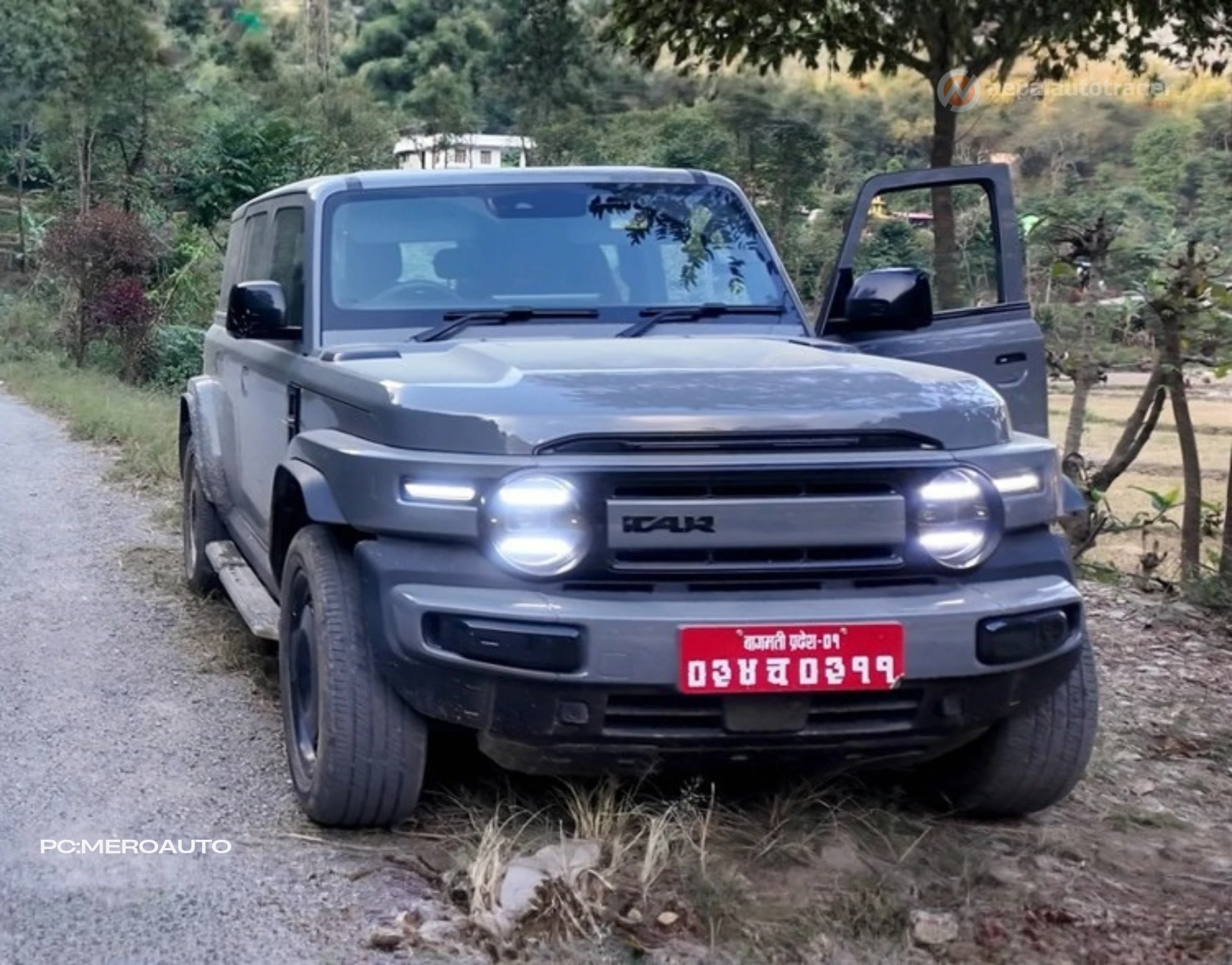
An electric SUV travelling across Nepal is no longer an unusual sight. But taking one through remote mountain roads, washed-out tracks and sections where finding a nearby settlement becomes difficult is another matter entirely.
That was the challenge behind Sagar Gajurel's five-day journey in the iCAUR V23, covering approximately 1,400 kilometres during the Tihar holidays. The trip began in Kathmandu and passed through Pokhara, Burtibang, Pyuthan, Swargadwari, Dang and Bhairahawa before returning to the capital.
Published on November 14, 2026, the account offers something more useful than a conventional showroom assessment. It shows how an electric SUV behaves when Nepal's road conditions become unpredictable, and when the driver cannot rely on a charging station around every corner.
The trip also tested the person behind the wheel. Range anxiety was part of the experience, but so were damaged tyres, limited roadside assistance and the possibility of getting stranded far from help.
That is a much more meaningful test of an electric SUV's touring credentials.
The journey began at 6 am with the V23 showing 87% battery charge. The first destination was Burtibang in Baglung, approximately 396 kilometres from the starting point.
The initial drive along the Prithvi Highway was relatively straightforward. After around five hours, the vehicle reached Pokhara with 41% charge remaining. The team stopped at Elite Motors, the authorized Omoda, Jaecoo and iCAUR dealer in Pokhara, where the battery was charged to 98% while the occupants had lunch.
The road became considerably more challenging after Baglung Bazaar. The stretch towards Galkot Bazaar included unpaved gravel sections, with rainwater having washed away parts of the road. Conditions improved along the Madhya Pahadi Lokmarga, although the final stretch approaching Burtibang remained difficult.
The V23 reached Burtibang at 5:30 pm. The drive from Pokhara to Burtibang consumed 61% of the battery, demonstrating how road conditions and climbing sections can influence energy consumption.
There was another important decision the following morning. Rather than forcing the V23 onto the difficult road towards Dhorpatan, the team used a Mahindra Bolero Camper. It was a sensible choice, particularly given the limitations of charging infrastructure and the uncertainty surrounding the route.
The third day became the defining part of the journey. Travelling from Burtibang towards Swargadwari, Gajurel selected the shorter route through Gulmi, despite local advice to consider another road.
The section between Indrageunda and Chaldikhola was in particularly poor condition. Dense forest, limited traffic and damaged surfaces made even a simple tyre puncture a worrying possibility. There were no nearby workshops or settlements to offer assistance.
After reaching Tamghas, the driver received directions from locals and continued through Arkhale, Jaisithok, Bhanbhane and Sautamare. At Sautamare, he stopped at a temporary police post to check the condition of the road towards Pyuthan.
The advice was mixed, but he eventually chose the Pyuthan route. What followed was approximately 42 kilometres of some of the most difficult driving of the entire trip.
Stones, mud, slush and deep potholes demanded constant attention. The V23's ground clearance became particularly valuable, while its slippery driving mode was used repeatedly to negotiate difficult surfaces. The driver also had to carefully manage the underside of the vehicle when crossing larger obstacles.
Despite the demanding conditions, the SUV completed the stretch without a breakdown. It still had 55% battery charge when it reached the end of the difficult section near Bagdulla.
That result is encouraging, although it should not be treated as a controlled off-road performance test. Speed, terrain, driving inputs and battery conditions all influence the outcome.
After the difficult section, the road improved. However, the journey was far from over. The climb towards Swargadwari involved approximately 15 kilometres of steep uphill driving from Bhingri Bazaar.
The vehicle had around 45% battery remaining at that point and reached Swargadwari at 5 pm. After spending some time there, the team decided to continue towards Dang, with the battery showing 30% charge.
One interesting observation came during the descent. Regenerative braking added approximately 4% battery charge, showing how downhill sections can help recover some energy during mountain journeys.
However, regeneration could not eliminate the need for careful planning. At Banadanda in Pyuthan, the battery had dropped to 23%. The original plan to reach Ghorahi was abandoned, and the team instead headed to Bhaluwang for an overnight stay and charging at Pauwa Hotel.
The experience illustrates an important distinction between advertised driving range and practical touring range. A vehicle might have an impressive official range, but steep climbs, road surfaces, speed and driving conditions can change the equation considerably.
For EV owners planning similar journeys, identifying charging opportunities before departure remains essential.
The V23's performance during the trip makes more sense when considered alongside its technical specifications. The Nepal-market model uses a rear-wheel-drive electric motor and a lithium iron phosphate battery pack.
| Specification | iCAUR V23 |
|---|---|
| Powertrain | Rear-wheel-drive electric motor |
| Motor output | 100 kW |
| Peak torque | 180 Nm |
| Battery capacity | 59.93 kWh LFP |
| Claimed range | 401 km, CLTC |
| Ground clearance | Approximately 205 to 210 mm, depending on specification source |
| Drive configuration | Rear-wheel drive |
Its boxy proportions and high ground clearance are central to its lifestyle SUV character. The vehicle also has dedicated driving modes, including a slippery-road setting that proved useful during the journey.
For additional context, readers can explore our iCAUR V23 Nepal launch and specification report.
The 100 kW motor and rear-wheel-drive layout provide the mechanical foundation, while the battery offers a sizeable energy reserve. Still, a specification sheet cannot tell the entire story. The Pyuthan experience demonstrated that driver judgement and road selection remain just as important as the vehicle's hardware.
After the previous day's demanding drive, the fourth day offered a welcome change. The team travelled through Ghorahi, Tulsipur, Deukhuri and Lamahi before reaching Bhairahawa in the evening.
The roads were smoother, traffic was more manageable and the experience was closer to conventional long-distance highway driving. Tihar celebrations in Bhairahawa added a different atmosphere, with illuminated streets, decorated houses and Deusi-Bhailo performances.
The final day brought another surprise. Traffic was unusually light, allowing the driver to maintain speeds of up to 80 km/h on sections towards Narayangadh and use cruise control.
The vehicle reached Narayangadh in approximately 1 hour and 31 minutes, followed by another 30 minutes to Mugling. The roughly 110 kilometres between Mugling and Kathmandu took two and a half hours.
In total, the Bhairahawa to Kathmandu journey took approximately 4 hours and 30 minutes. It was a much easier conclusion to a trip that had included some genuinely challenging driving.
The experience also provides useful context for buyers considering the V23 against alternatives such as the BYD Atto 2 and Dongfeng Nammi VIGO. These vehicles target different buyer priorities, and the V23's higher-clearance, rugged SUV character gives it a distinct appeal.
Pricing deserves separate attention. A September 24, 2026 report listed the V23 at Rs 5.399 million, with a Dashain promotional price of Rs 5.199 million. Those were dated promotional figures, not a confirmed current offer or a price paid for the test vehicle.
Q: How far did the iCAUR V23 travel during the Nepal road test?
A: The SUV covered approximately 1,400 kilometres over five days. The route included Kathmandu, Pokhara, Burtibang, Pyuthan, Swargadwari, Dang and Bhairahawa.
Q: What is the battery capacity of the iCAUR V23 in Nepal?
A: The Nepal-market V23 is equipped with a 59.93 kWh LFP battery pack. Its claimed CLTC driving range is 401 kilometres, although actual range depends on driving conditions.
Q: What is the motor output of the iCAUR V23?
A: The Nepal-market model uses a 100 kW rear-wheel-drive electric motor producing 180 Nm of peak torque.
Q: What was the most challenging road section during the journey?
A: The approximately 42-kilometre stretch between Sautamare and Bagdulla in Pyuthan was the toughest section. It included stones, mud, slush and badly damaged surfaces.
Q: What is the price of the iCAUR V23 in Nepal?
A: A September 2026 report listed the regular price at Rs 5.399 million and a temporary Dashain offer at Rs 5.199 million. Buyers should confirm the latest price and available offers with SPG Automobiles.
Q: Is the iCAUR V23 suitable for long-distance travel in Nepal?
A: The five-day journey suggests that it can handle demanding long-distance routes when the driver plans charging stops and assesses road conditions carefully. However, remote routes without reliable charging access still require preparation and sound judgement.

Nepal Auto-Trader is one-stop platform for all automotive needs. We provide unbiased and unparalleled news/reviews of all auto-motives being launched in Nepalese Auto-Industry. Find recent updates and price of bikes/cars, compare and review recently launched bikes/cars, buy/sell/trade reconditioned cars/bikes and all government news about changing rules and regulation, road safety by subscribing us.

Subscribe to our Newsletter
© Copyright 2026, Nepal Autotrader


.png)
.png)