

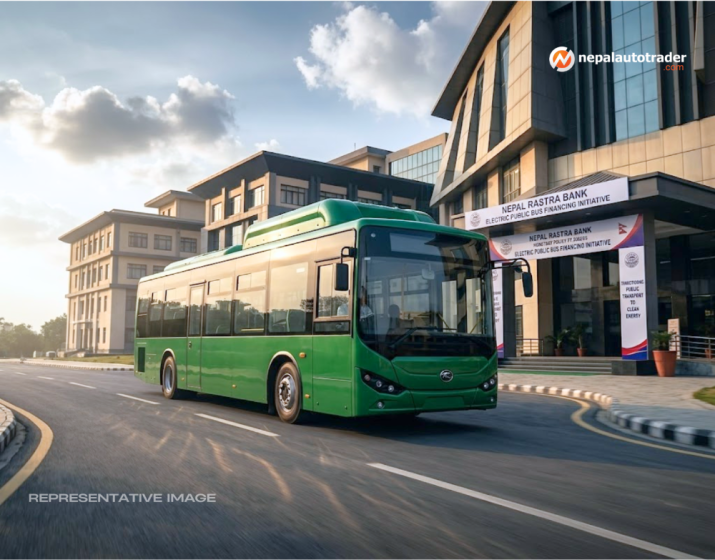
Nepal Rastra Bank has taken another step toward supporting Nepal's electric mobility ambitions, announcing plans to make financing easier for large electric vehicles used in public transportation. The measure forms part of the country's Monetary Policy for the fiscal year 2083/84, unveiled on Tuesday by Governor Dr. Bishwanath Paudel.
While the announcement does not immediately change lending rules, it signals that commercial banks and financial institutions will soon receive updated guidance allowing more favorable financing for eligible public transport EVs. The implications extend far beyond the banking sector. Lower upfront capital requirements could encourage transport operators to replace diesel fleets with electric alternatives more quickly.
The centerpiece of the announcement is a commitment to introduce a special policy framework for the Loan to Value (LTV) ratio applicable to large electric public transport vehicles.
Today, banks can finance up to 60 percent of the purchase price for all categories of vehicles. Buyers are required to contribute the remaining 40 percent as a down payment.
| Policy Area | Current Rule | Future Direction |
|---|---|---|
| Private Vehicles | 60% Loan to Value ratio | No announced change |
| Large Electric Public Vehicles | 60% Loan to Value ratio | Special policy with eased financing, exact ratio yet to be announced |
The monetary policy does not specify the revised percentage. Instead, the central bank says detailed implementation will follow through an official circular. That detail matters because transport operators are waiting to see just how much financing flexibility will actually be provided.
The timing is particularly significant given Nepal's broader transport strategy. The government has already identified large electric buses as a priority for the future of public transportation, aiming to reduce fuel imports, improve urban air quality and encourage cleaner mobility.
The central bank's decision aligns financial policy with that broader objective. Access to affordable credit has remained one of the biggest barriers for operators considering electric fleets, especially because large buses require substantial upfront investment.
For consumers, the change could be substantial. Easier financing for operators may eventually accelerate the introduction of cleaner buses into daily public transport services.
This announcement also revives a debate that has continued for several years.
Previously, electric vehicles benefited from an 80 percent Loan to Value ratio, allowing buyers to finance a much larger share of the purchase price. That provision was later tightened, bringing EV financing in line with other vehicle categories at 60 percent.
| Loan to Value Timeline | LTV Ratio | Status |
|---|---|---|
| Previous EV Financing Policy | 80% | Earlier provision |
| Current Vehicle Financing Rule | 60% | Currently applicable |
| Upcoming Public EV Policy | To be announced | Awaiting NRB circular |
Automobile businesses and EV stakeholders have consistently urged regulators to restore the previous 80 percent financing limit, arguing that high down payment requirements have slowed adoption.
Whether the new framework reaches that level remains unknown. The real challenge isn't cost, it's execution. Everything now depends on the detailed circular that will define the new lending parameters.
The announcement establishes the policy direction but leaves one critical question unanswered, the final Loan to Value ratio for public electric transport vehicles.
Until the implementation circular is released, banks will continue operating under the existing lending framework. Operators planning fleet purchases are therefore likely to wait before making major investment decisions.
While the change may appear incremental, its long-term impact could be considerable. If the revised financing rules significantly reduce upfront costs, Nepal's transition toward electric public transportation could gather pace over the coming years.
Q: Has Nepal Rastra Bank increased the Loan to Value ratio for public electric buses?
A: Not yet. The monetary policy announces that the ratio will be eased through a special policy, but the exact percentage will be confirmed in a future NRB circular.
Q: Does the new policy apply to private electric cars?
A: No. The monetary policy does not announce any changes for private vehicles. They remain under the existing 60 percent Loan to Value rule.
Q: What is the current Loan to Value ratio for vehicle financing?
A: Banks and financial institutions can currently finance up to 60 percent of a vehicle's value, while buyers must arrange the remaining 40 percent as a down payment.
Q: Why is this policy important for Nepal's EV market?
A: Easier financing can lower the initial investment required for transport operators, making it easier to adopt large electric buses and support the government's clean mobility goals.
Q: Was the Loan to Value ratio for EVs higher in the past?
A: Yes. Electric vehicles previously benefited from an 80 percent Loan to Value ratio before the limit was reduced to 60 percent.

Nepal Auto-Trader is one-stop platform for all automotive needs. We provide unbiased and unparalleled news/reviews of all auto-motives being launched in Nepalese Auto-Industry. Find recent updates and price of bikes/cars, compare and review recently launched bikes/cars, buy/sell/trade reconditioned cars/bikes and all government news about changing rules and regulation, road safety by subscribing us.

Subscribe to our Newsletter
© Copyright 2026, Nepal Autotrader


.png)
.png)