

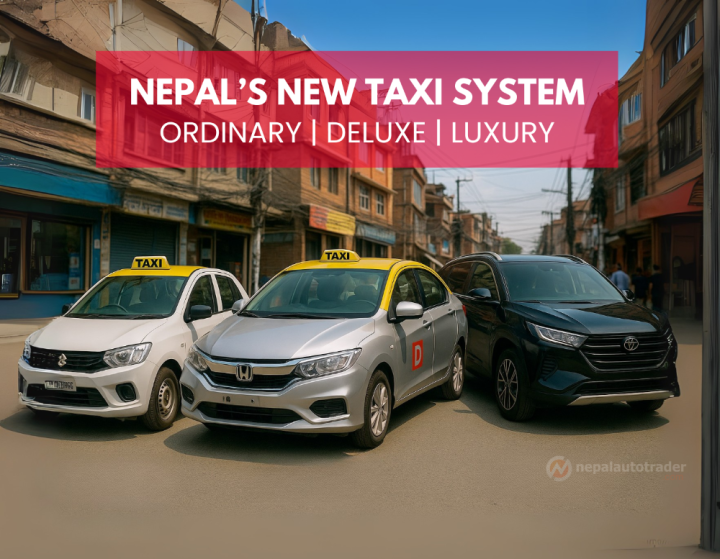
Nepal introduces three-tier taxi system: Ordinary, Deluxe, and Luxury
New National Taxi Standard 2081 replaces outdated 2076 model
Fare structure: Deluxe taxis cost 20% more, Luxury taxis 100% more than Ordinary
Taxis now require distinct classification stickers for public identification
Existing taxis can upgrade category with official approval if safety standards are met
The Government of Nepal has officially implemented the "National Taxi Standards 2081", revolutionizing how taxis operate across the country. With effect from Baisakh 30, this standard eliminates the old 2076 meter-based guideline and introduces a modern, three-tier classification system: Ordinary, Deluxe, and Luxury taxis.
This move by the Ministry of Physical Infrastructure and Transport is designed to enhance passenger experience, safety, and clarity in pricing—laying the groundwork for a more structured and transparent urban transport sector.
The most common category, Ordinary taxis, form the bulk of Nepal’s current taxi fleet.
Fare: Regulated by the government
Eligibility: All taxis registered before the new rule fall under this category by default
Upgradable: Yes, if they meet safety and feature criteria
Geared toward passengers who seek enhanced comfort, these vehicles must meet higher mechanical, safety, and feature benchmarks.
Fare: Up to 20% higher than Ordinary taxis
Requirements:
Improved suspension and seating
Air conditioning and digital fare meter
Enhanced passenger safety features (ABS, airbags)
Nepal’s answer to global executive taxi services, Luxury taxis promise premium quality, superior ride experience, and state-of-the-art safety.
Fare: Up to 100% more than Ordinary taxis
Requirements:
High-end car models with advanced infotainment
Premium interiors, leather seats, climate control
Advanced Driver Assistance Systems (ADAS)
| Taxi Category | Fare Regulation |
|---|---|
| Ordinary (O) | Government-regulated base fare |
| Deluxe (D) | Up to 20% more than Ordinary |
| Luxury (Y) | Up to 100% more than Ordinary |
This classification ensures price transparency and empowers commuters to choose services based on comfort and budget.
Every taxi operating under the new regulation must carry a visibly placed sticker that reflects its class.
Design Specifications:
80mm x 80mm transparent square
Red background with 60mm high English letter:
O for Ordinary
D for Deluxe
Y for Luxury
Sticker Placement:
Front windshield: Top-left corner (driver side)
Rear left glass panel
Rear doors: Both right and left
This makes taxi classification instantly visible to passengers and authorities.
Yes—if your taxi meets the safety and feature requirements, you can apply to the vehicle registration office to change your taxi’s classification.
However, if your vehicle lacks essential safety features, such as airbags or anti-lock braking systems (ABS), your taxi cannot be upgraded to Deluxe or Luxury.
To qualify for Deluxe or Luxury status, a taxi must offer:
Dual airbags
Anti-lock Braking System (ABS)
Digital fare meters
Passenger-side seat belt warning
Child lock and central locking
GPS tracking system (preferred for Luxury)
Effective Date: Baisakh 30, 2081
Replaces: Taxi Meter Standard of 2076
Legal Authority: Ministry of Physical Infrastructure and Transport, Government of Nepal
Execution Partner: Department of Transport Management (DoTM)
For passengers, it means more options, better service, and fare transparency.
For drivers, it opens new revenue streams through Deluxe and Luxury services—if safety upgrades are made.
The rollout of the National Taxi Standard 2081 marks a pivotal moment for Nepal’s transportation ecosystem. With a structured system in place, both commuters and operators stand to benefit. As Nepal moves toward safer, smarter, and more premium public transportation, this classification lays the foundation for a modern, commuter-focused mobility infrastructure.

Nepal Auto-Trader is one-stop platform for all automotive needs. We provide unbiased and unparalleled news/reviews of all auto-motives being launched in Nepalese Auto-Industry. Find recent updates and price of bikes/cars, compare and review recently launched bikes/cars, buy/sell/trade reconditioned cars/bikes and all government news about changing rules and regulation, road safety by subscribing us.

Subscribe to our Newsletter
© Copyright 2026, Nepal Autotrader


.png)
.png)