

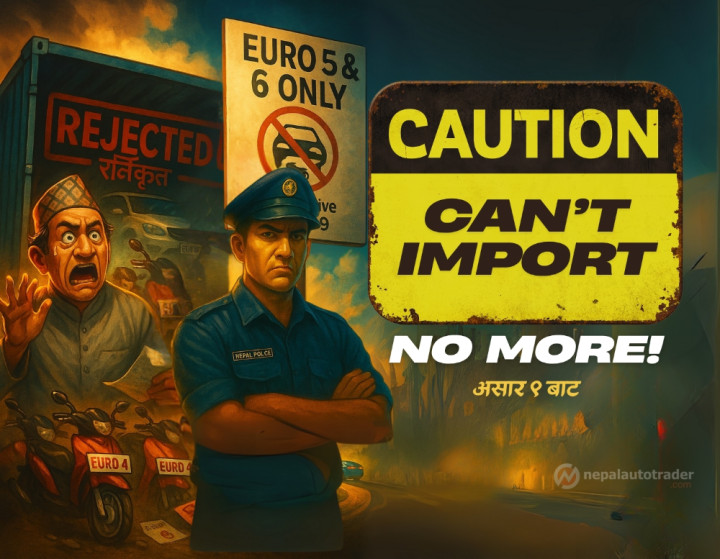
The Government of Nepal enforced a major policy change on Asar 9, 2082 BS (24 June 2025)—prohibiting the import of vehicles that don’t meet Euro 5 or Euro 6 emission standards.
But here’s the catch: no official date announcement, no notice period. Dealers who had already ordered compliant vehicles under earlier rules now face blocked shipments and sunk costs.
This abrupt enforcement, without warning or grace period, has left the auto sector blindsided.
However, vehicles that were ordered (but not paid for in full) are still subject to the new ban.
Dealers typically order vehicles 3 months in advance from India and 6 months from other countries.
Now, they can’t clear or sell vehicles already on the way. That’s billions of rupees lost overnight.
Most scooters and motorbikes brought into Nepal still comply with Euro 4. With Euro 5 suddenly enforced, inventory is now unsellable unless sent back or scrapped.
Trucks, buses, and delivery vans—most of which come under Euro 4 or below—can’t be cleared anymore.
Even orders placed months before Asar 9 are stuck due to unclear government stance on partial payments.
Environmental benefits are real. But without:
NADA (Nepal Automobile Dealers Association) and other groups welcome the cleaner standards but strongly oppose the manner of execution.
They were never consulted. No roadmap was shared. Businesses were not given time to adapt.
Calls for a 6-month grace period are now gaining traction among auto stakeholders.
Yes, Euro 5 and Euro 6 are a step forward—bringing Nepal in line with global standards.
Yes, it’s essential for cutting down urban pollution and protecting public health.
But real change doesn’t come by catching an entire industry off guard.
To move forward:
That’s how we make cleaner air and a healthy economy work together.

Nepal Auto-Trader is one-stop platform for all automotive needs. We provide unbiased and unparalleled news/reviews of all auto-motives being launched in Nepalese Auto-Industry. Find recent updates and price of bikes/cars, compare and review recently launched bikes/cars, buy/sell/trade reconditioned cars/bikes and all government news about changing rules and regulation, road safety by subscribing us.

Subscribe to our Newsletter
© Copyright 2026, Nepal Autotrader


.png)
.png)