

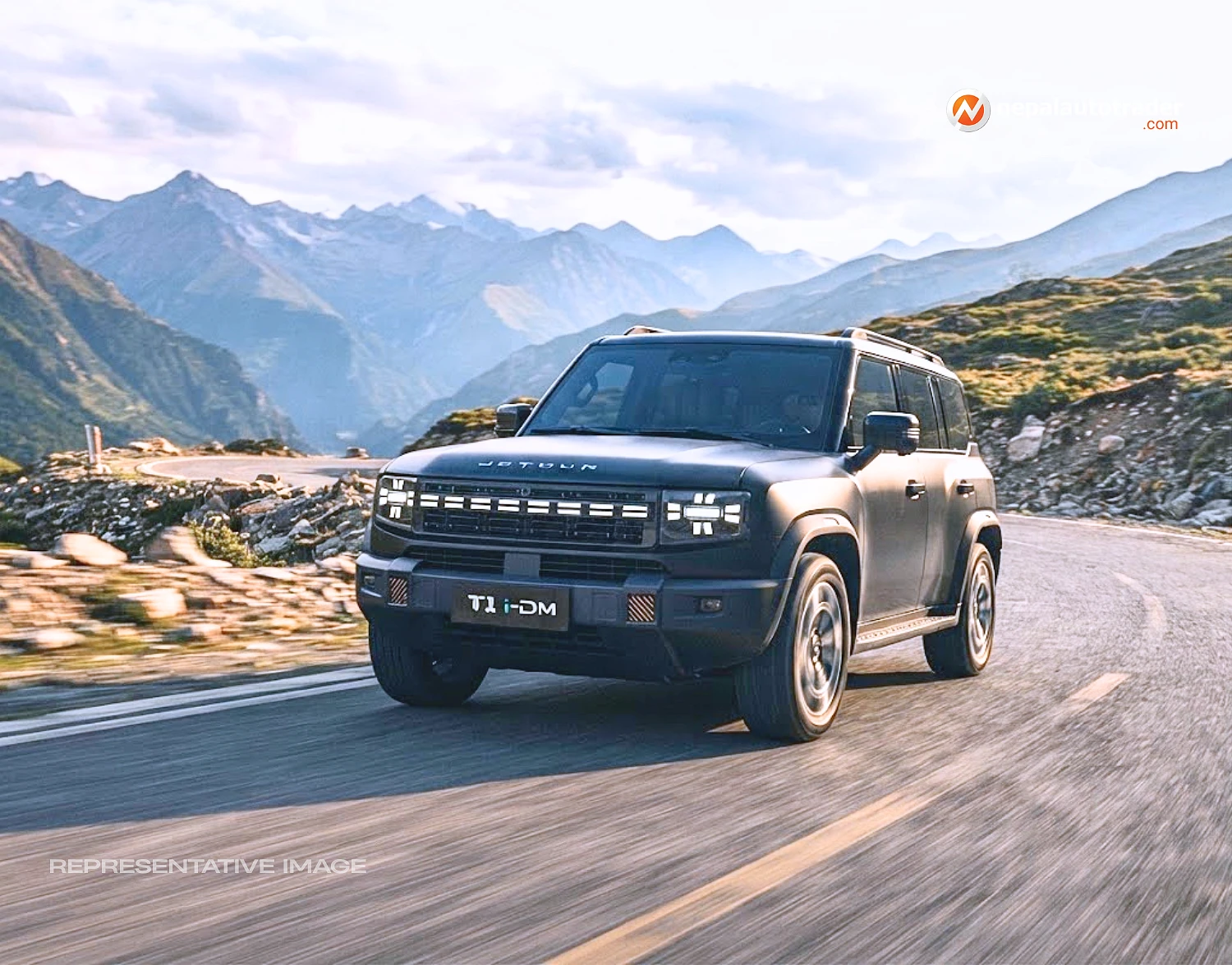
Nepal's SUV market has no shortage of tough-looking electric vehicles and premium crossovers. The Jetour T1 i-DM wants to offer something slightly different, combining a petrol engine with electric driving capability in a boxy SUV body designed for more than city commuting.
Laxmi Motorhub, the official distributor of Jetour in Nepal, has opened bookings for the model. The reported starting price is Rs 1,42,96,000, putting it firmly in premium SUV territory. That is a serious purchase, and buyers will expect more than an adventurous appearance to justify the money.
The T1's appeal rests on its plug-in hybrid powertrain, generous cabin technology and hardware aimed at handling uneven roads. Whether those qualities translate into a convincing ownership proposition will depend on real-world efficiency, charging access and the support available after delivery.
The Jetour T1 i-DM is listed at a starting price of Rs 1,42,96,000 in Nepal. The distributor has opened bookings, allowing interested buyers to inspect the vehicle and discuss the purchase with the company.
| Details | Jetour T1 i-DM |
|---|---|
| Reported price | Rs 1,42,96,000 |
| Vehicle type | Plug-in hybrid SUV |
| Official distributor | Laxmi Motorhub |
| Booking status | Bookings open |
| Showroom location | Thapathali, Kathmandu |
| Transmission | Dedicated hybrid DHT e-CVT |
Buyers should confirm the final transaction price, delivery schedule, warranty terms and availability of the exact specification with the distributor. The published report does not establish a separate trim structure or a confirmed customer delivery date.
For context, the same distributor has also opened bookings for the Jetour T2 in Nepal. Its reported price is Rs 1,55,96,000. The T1 is therefore the lower-priced entry point in the brand's initial local lineup, although the two SUVs differ in their powertrain and intended use.
The most important part of the T1 is under the bonnet. Its 1.5-litre turbocharged petrol engine works with an electric motor through a dedicated hybrid transmission. This plug-in hybrid arrangement allows the vehicle to drive electrically on suitable shorter journeys while retaining a petrol engine for longer trips.
The published Nepal report lists the following powertrain figures.
| Specification | Reported figure |
|---|---|
| Petrol engine | 1.5-litre turbocharged |
| Petrol engine power | 100 kW (136 PS) |
| Petrol engine torque | 220 Nm |
| Electric motor power | 150 kW |
| Electric motor torque | 310 Nm |
| Battery chemistry | LFP |
| Battery capacity | 18.4 kWh |
| Transmission | DHT e-CVT |
These figures describe the engine and electric motor separately. They should not be added together to produce a claimed combined output, since the source does not provide a verified combined power figure for the Nepal specification.
The battery uses lithium iron phosphate chemistry. Plug-in charging gives owners the option of replenishing the battery before driving, potentially reducing petrol use on shorter journeys. On longer trips, the petrol engine provides another source of energy.
That flexibility is appealing in Nepal, where daily commuting and intercity travel can demand very different things from a vehicle. But the practical benefit depends on how often the owner can charge at home or work. The source does not provide a confirmed electric-only range, charging time or official fuel-consumption figure for the Nepal model, so those numbers should be checked before purchase.
The T1 looks deliberately rugged. Its upright proportions, squared-off design and substantial body give it the visual presence buyers often seek in an adventure-oriented SUV. The design has also received a Red Dot Design Award, according to the published report.
Its dimensions provide a useful sense of scale. The wheelbase is relatively long, while the ground clearance and approach and departure angles suggest that the design considers rougher surfaces as well as paved roads.
| Dimension or capability | Specification |
|---|---|
| Length | 4,705 mm |
| Width | 1,967 mm |
| Height | 1,843 mm |
| Wheelbase | 2,800 mm |
| Ground clearance | 190 mm |
| Approach angle | 28 degrees |
| Departure angle | 28 degrees |
| Claimed water-wading depth | 600 mm |
Suspension consists of MacPherson independent suspension at the front and a multi-link independent setup at the rear. Jetour also says more than 85 percent of the body uses high-strength steel. Battery protection includes side guards and an aluminium underbody guard.
There is a sensible distinction here. These figures describe useful design provisions, not proof that the T1 is a dedicated rock-crawling machine. Ground clearance and approach angles can help on broken roads, steep ramps and uneven tracks, but tyres, traction control, weight and driver judgement still matter.
The claimed 600 mm water-wading capability also needs to be treated carefully. It is not an invitation to drive through floodwater. Conditions can change quickly, and water depth alone does not reveal the strength of a current or the state of the road beneath it.
The cabin moves away from the stripped-back feel found in some adventure-themed SUVs. A large central screen, digital instrumentation and connected features give the T1 a more technology-focused character.
Driver assistance and parking technology are also prominent. The reported equipment list includes lane-keeping assistance, lane-following assistance, blind-spot collision avoidance assistance, smart cruise control with stop-and-go functionality, driver attention warnings and automatic high-beam assistance.
Other safety systems include ABS, electronic brakeforce distribution, traction control, hill-start assistance, hill-descent control and electronic stability control. Front and rear parking sensors work alongside a 540-degree panoramic-view camera to help with tight parking manoeuvres.
The camera description is unusual, since conventional surround-view systems are generally marketed using 360-degree terminology. Buyers should ask the showroom to demonstrate the actual camera views and explain what the additional perspective covers.
The T1 enters a competitive part of Nepal's SUV market. Buyers spending this much may compare plug-in hybrids with fully electric SUVs, conventional petrol-powered vehicles and larger off-road-styled models. The right choice depends on how the vehicle will be used, rather than which one has the longest equipment list.
The T1's strongest argument is flexibility. A household with regular access to charging may be able to use electric driving for suitable daily trips, while the petrol engine provides another option for longer journeys. The tall body, independent suspension and driver assistance equipment broaden its appeal beyond a conventional urban crossover.
There are still important questions. The published Nepal report does not specify the electric-only range, combined power output, fuel economy, charging duration or full warranty terms. Those are not minor omissions for a plug-in hybrid costing Rs 1,42,96,000.
Before booking, prospective owners should ask for written confirmation of the following:
Readers considering other new arrivals can also explore the Jetour T2 and its Nepal pricing, or review the earlier report on Jetour's entry into Nepal for background on the brand's local plans.
The Jetour T1 makes a clear pitch: a premium-looking SUV, plug-in hybrid flexibility and a long list of comfort and safety features. Its final verdict will depend less on the rugged styling than on the details buyers cannot judge from a showroom walkaround, particularly efficiency, charging convenience, reliability and long-term support.
Q: What is the price of the Jetour T1 in Nepal?
A: The reported starting price of the Jetour T1 i-DM is Rs 1,42,96,000. Buyers should confirm the final price and any applicable charges with Laxmi Motorhub.
Q: Is the Jetour T1 available for booking in Nepal?
A: Yes, Laxmi Motorhub has opened bookings for the plug-in hybrid SUV. Its showroom is in Thapathali, Kathmandu. A confirmed customer delivery date was not provided in the source report.
Q: What engine does the Jetour T1 use?
A: The Nepal report lists a 1.5-litre turbocharged petrol engine paired with an electric motor and a dedicated DHT e-CVT transmission. The petrol engine produces 100 kW (136 PS) and 220 Nm, while the motor produces 150 kW and 310 Nm.
Q: What is the battery capacity of the Jetour T1?
A: The reported Nepal specification uses an 18.4 kWh LFP battery. The source does not confirm the official electric-only range or charging time, so buyers should request those details from the distributor.
Q: Is the Jetour T1 suitable for rough roads in Nepal?
A: It has 190 mm of ground clearance, 28-degree approach and departure angles, and independent suspension at both ends. These features can help on uneven roads, but they do not replace suitable tyres, careful driving or the capabilities of a dedicated off-road vehicle.
Q: What safety and infotainment features does the Jetour T1 offer?
A: The reported equipment includes ADAS functions, stability control, hill-descent control, parking sensors and a 540-degree panoramic-view camera. The cabin also gets a 15.6-inch touchscreen, a 10.25-inch digital instrument cluster and wireless smartphone connectivity.

Nepal Auto-Trader is one-stop platform for all automotive needs. We provide unbiased and unparalleled news/reviews of all auto-motives being launched in Nepalese Auto-Industry. Find recent updates and price of bikes/cars, compare and review recently launched bikes/cars, buy/sell/trade reconditioned cars/bikes and all government news about changing rules and regulation, road safety by subscribing us.

Subscribe to our Newsletter
© Copyright 2026, Nepal Autotrader


.png)
.png)