

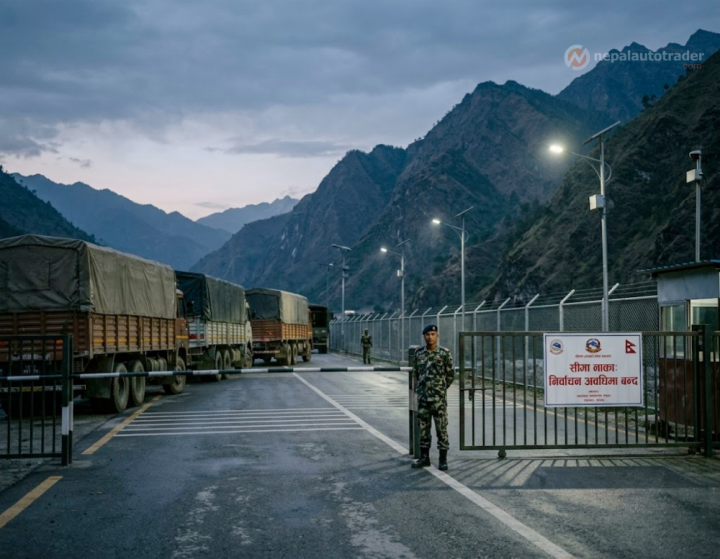
The Election Commission orders the closure of all international border checkpoints 72 hours before the Fagun 21 poll day.
Border gates with India and China will be sealed, halting cross-border road traffic.
Four-day suspension of road imports and exports, plus suspension of flights on election day.
Alcohol sales banned seven days before voting until results are declared.
Security committee cites Security Directive 6-(jha) of the 2082 election management code.
Implications for logistics firms, tourists, and local businesses are immediate.
Government promises coordinated facilitation for essential goods during the shutdown.
The move sets a precedent for future elections in the Himalayan nation.
The Election Commission has invoked Clause 6-(jha) of the 2082 election management directive, requiring that every international border checkpoint linked to India or China be locked down exactly 72 hours before the poll. The decision was communicated through the Ministry of Home Affairs, which issued formal instructions to border-control agencies.
The rationale is straightforward: prevent illegal movement of people or goods that could destabilize the vote. According to the commission’s security brief, past elections saw attempts to smuggle ballot-influencing materials across porous mountain crossings. By sealing the borders early, authorities aim to eliminate such risks.
This is significant because Nepal’s trade corridors with its two major neighbors handle approximately USD 1.5 billion worth of cargo each month. A sudden shutdown could disrupt supply chains, particularly for perishable goods.
All road-based imports and exports will be suspended for four days — the day the closure begins, election day, and the two following days. The restriction does not affect air freight, but flights will be limited to domestic routes on voting day. International flights will operate on a reduced schedule, mainly for essential diplomatic and medical purposes.
The government has promised a fast-track clearance channel for humanitarian supplies, although the definition of “essential” remains unclear. Logistics companies are rerouting shipments, and some have secured additional storage in Kathmandu to avoid bottlenecks.
Why this matters: Small traders who rely on daily cross-border movement could face serious cash flow disruptions. Larger exporters may absorb the impact, but even a few days of halted movement can mean missed contracts and delayed payments.
Kaski (border with China)
Sagarmatha (border with China)
Jumla (border with India)
Dhading (border with India)
Sunsari (border with India)
Bairak (border with India)
Baglung (border with China)
Pyuthan (border with China)
These eight districts account for the majority of Nepal’s overland trade routes and will feel the immediate economic impact.
The High-Level Election Security Committee drafted a multi-layered protocol combining physical barriers and legal restrictions. Key measures include:
Border lockdown: All customs posts closed to public traffic; only security personnel and pre-approved freight allowed.
Alcohol ban: Beginning seven days before voting, sale or distribution of alcohol is prohibited until final results are announced.
Air traffic coordination: Domestic flights continue normally; international carriers receive limited slots on election day.
Rapid response teams: Stationed at each closed border gate to manage emergencies, including medical evacuations and urgent diplomatic shipments.
The plan mirrors similar measures taken during the 2017 parliamentary elections, though this time the restriction window is longer and supported by stronger legal backing. The commission cited previous incidents of unmonitored border activity leading to voter intimidation.
This creates a clear, enforceable timeline for local authorities and signals that any attempt to exploit border access will result in immediate legal action.
After polls close on Fagun 21, border gates will reopen 24 hours later, subject to security clearance. However, the commission has warned that any post-election unrest could lead to a temporary extension of the closure.
In the long term, the 72-hour rule may become standard practice for national elections, influencing how Nepal manages trade, tourism, and cross-border cooperation. Industry groups are already advocating for a compensation mechanism to offset economic losses from future shutdowns.
The coming weeks will test the balance between protecting democratic integrity and maintaining economic stability. If implemented smoothly, Nepal could set a regional benchmark for election-time border management.
| Aspect | Effect | Duration |
|---|---|---|
| Road Trade | Zero movement of commercial trucks | Four days |
| Air Travel | International flights reduced; domestic unchanged | Election day only |
| Alcohol Market | Sales suspended | Seven days before vote until results declared |
| Security Forces | Rapid-response units deployed | Entire election window (approx. 10 days) |
Q: Which border checkpoints will be closed?
All
official road gates connecting Nepal with India and China, particularly
those in Kaski, Sagarmatha, Jumla, Dhading, Sunsari, Bairak, Baglung,
and Pyuthan, will be sealed 72 hours before voting.
Q: When can commercial trucks resume operations?
Road transport will resume 24 hours after the final election results are announced, provided no security extension is imposed.
Q: Can tourists enter Nepal during the shutdown?
International
flights will operate on a limited basis for essential travel. Land
entry will not be possible until borders reopen.
Q: How does the alcohol ban affect restaurants and bars?
All
establishments must stop serving or selling alcohol from seven days
before voting until results are officially declared. Violations may
result in fines or license suspension.
Q: Are emergency medical shipments allowed?
Yes. Pre-approved humanitarian and medical cargo may cross borders under police escort.
Q: Could the closure be extended?
Yes. Authorities may extend the shutdown by 24 hours if credible security threats arise.

Nepal Auto-Trader is one-stop platform for all automotive needs. We provide unbiased and unparalleled news/reviews of all auto-motives being launched in Nepalese Auto-Industry. Find recent updates and price of bikes/cars, compare and review recently launched bikes/cars, buy/sell/trade reconditioned cars/bikes and all government news about changing rules and regulation, road safety by subscribing us.

Subscribe to our Newsletter
© Copyright 2026, Nepal Autotrader


.png)
.png)