

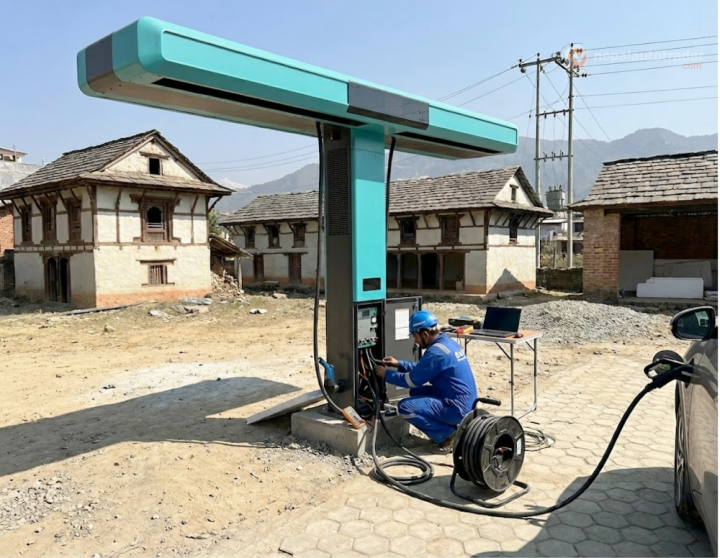
On 2:05 pm, Wednesday, Falgun 13, 2082 (April 26, 2025 Gregorian), BYD disclosed the launch of its MegaWatt Flash Charging Pile plan. The announcement came from the company’s Kathmandu headquarters and was accompanied by a short video showing a prototype unit powering a test EV.
The headline claim is simple: the new charger will outpace the time it takes to fill a petrol tank. In practice, a single second of charging delivers enough energy for 2 km of driving, while a 5‑minute session can replenish 400 km of range – enough for most daily trips.
That matters because Nepal’s current public chargers average 30‑45 minutes for a 80 % top‑up, a barrier that many potential buyers cite when considering an electric vehicle.
These benefits line up with the government’s push for faster EV infrastructure, as outlined in the recent Automobile Policy released by the National Bank.
| Specification | Value | Notes |
|---|---|---|
| Voltage per gun | 1,000 V | High‑voltage DC enables rapid energy transfer |
| Current per gun | 1,000 A | Supports the 1 MW power level |
| Power per gun | 1,000 kW | Equivalent to 1 MW of instantaneous output |
| Maximum system output | 1,360 kW | Achieved when multiple guns operate together |
| Cooling method | Liquid‑cooling | Prevents thermal runaway during high‑current bursts |
| Gun configurations | Single and double gun | Flexibility for different site footprints |
BYD laid out a phased deployment plan that mirrors the country’s major traffic corridors. The timeline is aggressive but realistic, given the company’s partnership with local utilities.
| Phase | Target Areas | Status |
|---|---|---|
| Phase 1 | Central Kathmandu, Tribhuvan International Airport corridor | Installation started, 30 % complete |
| Phase 2 | Pokhara‑Kathmandu highway, Lalitpur inner ring | Site surveys finished, procurement in progress |
| Phase 3 | Eastern Terai (Biratnagar, Dharan), Western hills (Dhangadhi) | Planned for 2026 Q3 |
| Phase 4 | National highway network, rural charging hubs | Conceptual design, funding pending |
The rollout leverages existing electricity distribution assets, minimizing new civil works. Each site will feature a dual‑gun module, allowing two EVs to charge simultaneously at full power.
The speed advantage directly attacks the most common consumer objection: range anxiety. If a driver can top‑up a vehicle in the time it takes to grab a coffee, the psychological barrier drops dramatically.
In short, the MegaWatt Flash Charging Pile could become the backbone of Nepal’s next‑generation mobility ecosystem. The real test will be how quickly the network scales and whether the promised 5‑minute full charge holds up under real‑world traffic.
Q: How long does it really take to add 400 km of range? A: BYD states a 5‑minute full‑charge cycle delivers up to 400 km of usable range, based on a standard 60 kWh battery pack.
Q: Will the chargers work with all EV brands sold in Nepal? A: The system uses a universal DC fast‑charge protocol compatible with most models, including Tesla, Hyundai, Mahindra, and Suzuki.
Q: Where will the first public stations be located? A: Phase 1 sites focus on the Kathmandu city centre and the Tribhuvan Airport access road, with two pilot stations expected to go live by Q4 2025.
Q: What is the cost of using a MegaWatt Flash charger? A: Pricing has not been disclosed yet; BYD indicates rates will be competitive with existing fast‑chargers, with potential subsidies lowering the per‑kWh price.
Q: How does the peak‑saving valley‑filling concept work? A: The charger stores electricity during low‑demand periods (valley) and releases it during peak charging events, reducing strain on the grid and lowering operational costs.
Q: Is the T‑shaped design safe for high‑current operation? A: Yes, the compact chassis houses liquid‑cooled terminals that keep temperatures stable, preventing overheating even at 1,360 kW peak output.

Nepal Auto-Trader is one-stop platform for all automotive needs. We provide unbiased and unparalleled news/reviews of all auto-motives being launched in Nepalese Auto-Industry. Find recent updates and price of bikes/cars, compare and review recently launched bikes/cars, buy/sell/trade reconditioned cars/bikes and all government news about changing rules and regulation, road safety by subscribing us.

Subscribe to our Newsletter
© Copyright 2026, Nepal Autotrader


.png)
.png)