

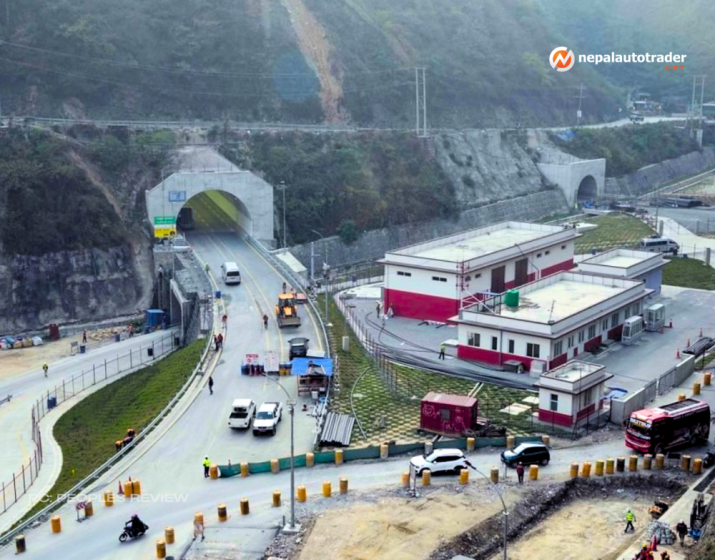
After years of anticipation, Nepal's first road tunnel is finally ready for traffic.
The Nagdhunga-Sisnekhola Tunnel will officially begin operations on Monday, marking one of the country's most significant transport infrastructure milestones. The opening comes 81 months after construction began, considerably longer than the original schedule, yet the project now promises to transform one of Nepal's busiest road corridors.
The inauguration will be jointly conducted by Minister for Infrastructure Development Sunil Lamsal and the President of the Japan International Cooperation Agency (JICA).
What makes this development noteworthy is not its scale alone, but its long-awaited arrival. For thousands of motorists travelling between Kathmandu Valley and the western regions of Nepal, the impact could be immediate.
The tunnel will not immediately open to every vehicle.
According to Project Director Saujanya Nepal, authorities will begin operations by allowing only emergency service vehicles inside the tunnel. Ambulances, fire engines and security agency vehicles will be given priority while operational systems are monitored.
Private and public transport will be introduced gradually in phases.
| Phase | Vehicle Access | Status |
|---|---|---|
| Phase One | Ambulances, fire engines, security vehicles | Operational from opening day |
| Later Phases | Private and public vehicles | Gradual rollout |
The phased approach reflects the importance of ensuring every safety system performs as intended before the tunnel reaches full operating capacity.
Japanese construction company Hazama Ando Corporation started work on Kartik 4, 2076 BS. The original construction schedule targeted completion within 42 months.
Instead, the project required nearly eight years before becoming operational.
The finished tunnel stretches 2,688 metres and represents an investment of approximately Rs 21 billion.
| Project Detail | Information |
|---|---|
| Tunnel Length | 2,688 metres |
| Construction Cost | Around Rs 21 billion |
| Construction Period | 81 months |
| Main Contractor | Hazama Ando Corporation |
Once fully operational, the tunnel is expected to ease congestion on the existing Nagdhunga-Naubise road while reducing fuel consumption and shortening travel times.
Its significance extends beyond convenience. It represents a new chapter for Nepal's highway infrastructure.
The Nagdhunga-Sisnekhola Tunnel Operation Directive 2081 places several restrictions on tunnel traffic.
The following vehicles are not permitted inside the tunnel:
Permitted vehicles include cars, SUVs, jeeps, vans, microbuses, mini trucks, buses and trucks that comply with the size restrictions.
The maximum permitted speed inside the tunnel has been fixed at 60 km/h. Drivers exceeding the limit will face enforcement action.
Unlike conventional toll plazas, the tunnel has been designed around a digital payment ecosystem.
Motorists are expected to use an RFID-based N-Tag, issued as a windshield sticker that communicates automatically with electronic readers.
| Vehicle Category | Entering Kathmandu | Leaving Kathmandu |
|---|---|---|
| Car / Van | Rs 65 | Rs 60 |
| Minibus / Mini Truck | Rs 115 | Rs 80 |
| Bus / Truck | Rs 260 | Rs 200 |
| Heavy Vehicles | Rs 600 | Rs 250 |
N-Tag cards are currently available through Global IME Bank, Kumari Bank, Nabil Bank, Nepal Investment Mega Bank and Sanima Bank. Users can obtain cards with balances of Rs 1,000, Rs 2,000 or Rs 5,000.
Authorities have also confirmed that QR payments and cash collection will remain available during the initial operating period. Tourists arriving from India and China will also be able to pay in cash.
Operation and maintenance responsibilities have been awarded to the Yusin ART Company, a Nepali-Chinese joint venture.
The company secured a five-year operating contract worth Rs 1.10 billion. During that period it will oversee tunnel operations, maintenance, repairs and staffing.
Around 150 employees will be required to keep the tunnel functioning 24 hours a day.
Traffic estimates suggest that more than 8,000 four-wheel and larger vehicles currently pass through the Nagdhunga checkpoint every day, excluding two-wheelers. Officials expect roughly 4,000 to 5,000 vehicles, approximately 50 to 60 percent of that daily volume, to shift to the tunnel.
The timing is particularly significant given the growing traffic pressure on Kathmandu's western gateway. While the opening begins cautiously, the long-term impact could extend well beyond faster journeys. Reduced congestion, lower fuel consumption and improved freight movement could make this one of Nepal's most important transport investments in recent years.
Q: When will the Nagdhunga-Sisnekhola Tunnel open to the public?
A:
Operations begin on Monday, but only emergency service vehicles will
initially be allowed. Access for private and public vehicles will be
introduced gradually.
Q: Which vehicles are prohibited inside the tunnel?
A:
Motorcycles, scooters, three-wheelers, petroleum tankers, vehicles
carrying explosives, most weapon-carrying vehicles, non-motorised
vehicles and oversized vehicles are prohibited.
Q: What is the speed limit inside the tunnel?
A: The maximum permitted speed is 60 km/h. Drivers exceeding this limit will face action under the operating directive.
Q: How much is the toll for cars?
A: Cars and vans pay Rs 65 when entering Kathmandu and Rs 60 when leaving Kathmandu through the tunnel.
Q: How do drivers pay the toll?
A: The primary payment method is the RFID-based N-Tag system. QR payment and cash will also be available during the initial operating period.

Nepal Auto-Trader is one-stop platform for all automotive needs. We provide unbiased and unparalleled news/reviews of all auto-motives being launched in Nepalese Auto-Industry. Find recent updates and price of bikes/cars, compare and review recently launched bikes/cars, buy/sell/trade reconditioned cars/bikes and all government news about changing rules and regulation, road safety by subscribing us.

Subscribe to our Newsletter
© Copyright 2026, Nepal Autotrader


.png)
.png)