

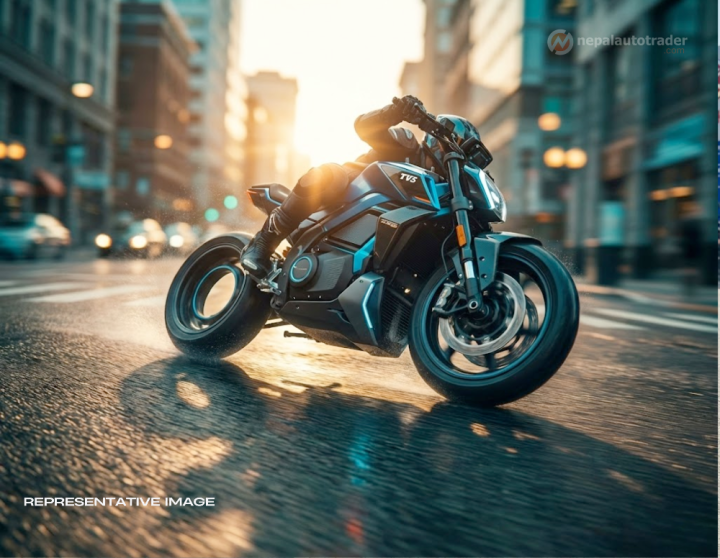
TVS Motors lodged a design patent with the Indian Patent Office that mirrors the concept bike displayed at the 2025 EICMA show in Milan. The filing picture reveals a rectangular front module that replaces the traditional fuel tank with a flat‑pack battery. A sleek metal cover, described as a furring, sits over the pack, likely serving as a thermal shield. That matters because battery temperature management is a key limiter of performance and longevity.
The chassis features a U‑shaped suspension both front and rear, a design cue borrowed from sport‑bike geometry. The suspension appears to be USD (U‑shaped double) type, giving the bike a planted stance while keeping the wheel travel short enough for city riding. The patent also shows a belt‑drive system – a quiet, low‑maintenance alternative to chains that many manufacturers are now exploring.
While the filing does not disclose exact output, the image includes a mid‑mount high‑performance motor. Mid‑mount placement helps centralise mass, improving handling. Coupled with a belt drive, the layout suggests TVS is targeting a balance between spirited urban riding and low‑noise operation. The presence of a dedicated cooling system for the battery – inferred from the vent‑like openings on the cover – indicates the company expects higher discharge rates than typical commuter e‑bikes. This changes things for the Indian market, where most electric scooters rely on passive cooling.
The patent emphasizes tank extensions and edge profiling that run along the bike’s sides. Those elements are not merely aesthetic; they act as air‑flow guides that reduce drag coefficient, a benefit that translates into better range at higher speeds. The aggressive riding posture shown in the sketch – low handlebars, forward‑leaning seat – aligns the FSX Theo with sport‑oriented electric motorcycles rather than the upright scooter class.
TVS is a heavyweight in the Indian two‑wheel market, but its electric portfolio is still nascent. The FSX Theo could be the brand’s answer to the Ather 450X, which offers 6 kW power and a 70 km range, and the Bajaj Chetak, a retro‑styled commuter with modest performance. By filing a design patent now, TVS signals intent to move beyond the low‑speed scooter segment and challenge these incumbents with a sportier offering.
The Indian electric two‑wheel market is projected to cross 10 million units by 2028, according to industry forecasts. A well‑designed, performance‑oriented model could capture a slice of that growth, especially among younger riders seeking excitement without the emissions of a petrol bike. That matters for TVS’s long‑term strategy, as the company aims to electrify a significant portion of its lineup by 2030.
The patent was filed under the name “FSX Theo”, echoing the concept shown at EICMA 2025. No official launch date has been announced, but the filing suggests TVS is protecting its design ahead of a possible 2026‑2027 market entry. Production tooling, supply‑chain arrangements for battery packs, and homologation processes will likely dictate the final timeline.
If TVS follows the typical Indian rollout pattern, the bike could debut in major metros first, with a pricing bracket aimed at the ₹1.5 lakh to ₹2.0 lakh segment – a sweet spot between premium scooters and entry‑level sport bikes. However, without confirmed numbers, this remains speculation.
The patent also hints at a digital instrument cluster, a feature increasingly expected in modern electric motorcycles. Combined with the belt‑drive and cooling system, the FSX Theo could set a new benchmark for performance‑oriented electric two‑wheelers in India.
Stay tuned as TVS rolls out more details. In the meantime, the design patent alone tells us that the company is serious about delivering a sporty, thermally‑managed electric motorcycle that could reshape the Indian market.
Q: When is the TVS FSX Theo expected to launch in India? A: TVS has not announced an official launch date. The design patent suggests a possible market entry in 2026 or 2027, pending final development and regulatory clearance.
Q: Will the FSX Theo have a disclosed price range? A: Pricing details have not been released. Industry analysts speculate it could sit between ₹1.5 lakh and ₹2.0 lakh, but this is not confirmed by TVS.
Q: What type of battery cooling does the FSX Theo use? A: The patent image shows a vented cover over the battery pack, indicating a dedicated cooling system, likely passive airflow aided by the cover’s geometry.
Q: How does the belt‑drive compare to a chain drive? A: Belt drives are quieter, require less maintenance and provide smoother power delivery, though they may have slightly lower torque capacity than high‑strength chains.
Q: Which competitors will the FSX Theo face? A: Primary rivals include the Ather 450X, Bajaj Chetak, and Hero Photon, all of which target the fast‑growing Indian electric two‑wheel segment.
Q: Will the bike feature a digital instrument cluster? A: Yes, the patent shows a clean digital cluster, aligning the FSX Theo with contemporary electric motorcycle ergonomics.

Nepal Auto-Trader is one-stop platform for all automotive needs. We provide unbiased and unparalleled news/reviews of all auto-motives being launched in Nepalese Auto-Industry. Find recent updates and price of bikes/cars, compare and review recently launched bikes/cars, buy/sell/trade reconditioned cars/bikes and all government news about changing rules and regulation, road safety by subscribing us.

Subscribe to our Newsletter
© Copyright 2026, Nepal Autotrader


.png)
.png)