

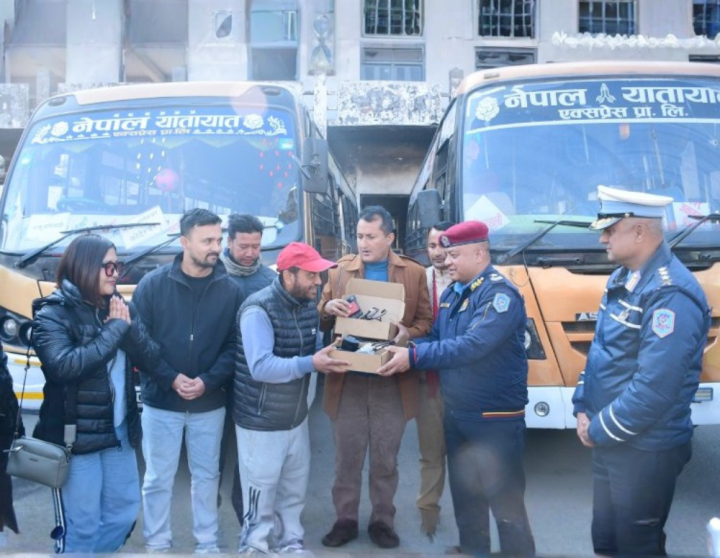
The traffic police office in Kathmandu Valley announced a pilot program on Wednesday that places CCTV units inside every public‑service vehicle that ferries commuters across the valley. The move follows a string of complaints about luggage theft, passenger harassment and ambiguous fault in road collisions. By capturing a clear, time‑stamped view of the interior, authorities hope to deter wrongdoing before it happens. That matters because a single recorded incident can settle a dispute that would otherwise drag on in court.
Each unit consists of a compact dashboard camera mounted near the driver’s line of sight, paired with a rear‑facing CCTV lens that watches the passenger cabin. The system records in full HD, stores footage on a local SSD, and uploads a compressed clip to a cloud server whenever the vehicle connects to Wi‑Fi at a depot. Operators can retrieve video on demand, while police retain read‑only access for investigations. The technology is off‑the‑shelf, proven in fleet management worldwide, but its first‑time use on Nepali public transport is a game‑changer.
According to Nares Raj Subedi, the expense falls squarely on the vehicle owners. The police office will not subsidise hardware or installation, but they have promised a streamlined, free‑of‑charge service centre where owners can drop off their buses for a quick fit‑out. The cost per vehicle is estimated at roughly NPR 12,000 for the camera kit and wiring, a figure that most operators deem affordable given the potential reduction in theft claims and insurance premiums. This cost‑sharing model pushes the market to self‑regulate, a subtle shift that could accelerate safety upgrades across the board.
While city‑bound buses get the visual surveillance first, Subedi revealed that GPS modules will soon be rolled out on long‑distance vehicles that ply routes beyond the valley. Real‑time location data will feed into a central command centre, allowing dispatchers to monitor route adherence and respond swiftly to breakdowns or accidents. The dual‑layer of video and positioning data creates a robust safety net, especially on winding mountain roads where pinpointing fault is notoriously hard. This expansion underscores the police’s long‑term vision: a fully connected transport ecosystem.
For the everyday rider, the presence of a camera is a silent but potent reminder that misconduct will be recorded. Early reports from pilot operators indicate a noticeable dip in petty theft and a calmer cabin atmosphere. When accidents occur, investigators can replay the footage to determine whether the driver, a passenger, or road conditions were at fault, cutting down on blame‑shifting. Over time, the data collected could inform policy changes, such as stricter licensing rules or targeted driver‑training programs. In short, the initiative promises a safer, more accountable ride for anyone hopping on a bus or van in Kathmandu.
Q: Will the camera footage be available to the public?
A: No, footage is stored on a secure server and accessed only by authorized police officers or vehicle owners for dispute resolution.
Q: How much will a vehicle owner pay for the installation?
A: The estimated cost is NPR 12,000 per vehicle, covering the camera kit, wiring and a one‑year cloud‑storage subscription.
Q: When will GPS units be installed on long‑distance coaches?
A: The police plan to begin GPS roll‑out within the next two months, following the completion of the CCTV phase.
Q: Are there penalties for tampering with the cameras?
A: Yes, any deliberate obstruction or removal of the camera system is treated as a traffic violation, punishable by fines and possible license suspension.
Q: How will the system help in accident investigations?
A: Video and GPS data together provide a timestamped record of vehicle speed, position and interior activity, allowing investigators to reconstruct events with greater accuracy.
Q: Will the installation cause any downtime for the vehicles?
A: Installations are designed to be completed within a single service window, typically under two hours, minimizing disruption to regular routes.

Nepal Auto-Trader is one-stop platform for all automotive needs. We provide unbiased and unparalleled news/reviews of all auto-motives being launched in Nepalese Auto-Industry. Find recent updates and price of bikes/cars, compare and review recently launched bikes/cars, buy/sell/trade reconditioned cars/bikes and all government news about changing rules and regulation, road safety by subscribing us.

Subscribe to our Newsletter
© Copyright 2026, Nepal Autotrader


.png)
.png)