

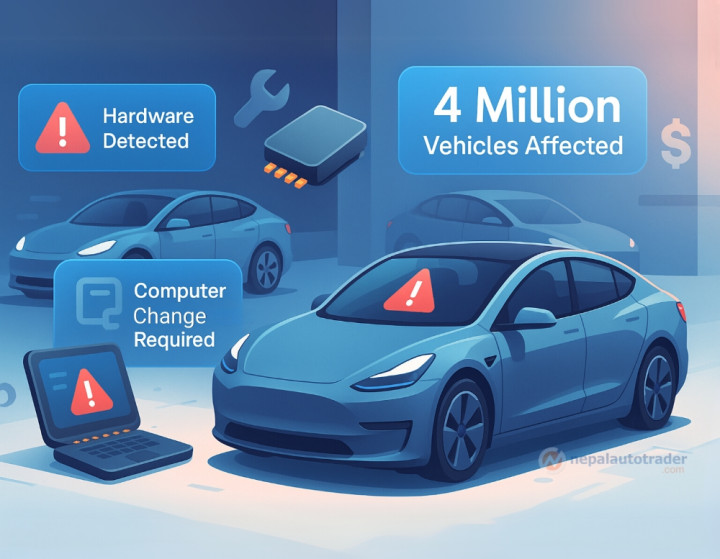
Tesla’s HW3 self-driving computer cannot support unsupervised autonomous driving.
Over 4 million vehicles affected worldwide—most delivered between 2019 and 2023.
Elon Musk confirms retrofitting HW3 cars will be “painful” but “necessary” for FSD buyers.
Tesla faces potential liability exceeding several billion dollars.
Legal precedents already exist forcing Tesla to offer free upgrades.
This could become the most expensive recall-like operation in automotive history.
Tesla's promise was clear: every car made since 2016 came with “full self-driving hardware.” That claim hasn’t aged well. In 2025, Elon Musk admitted that HW3—the computer inside roughly 4 million Teslas—cannot deliver level 4 or 5 autonomy.
HW3, introduced in 2019, was supposed to unlock Tesla’s Full Self-Driving (FSD) vision. It doesn’t. And that has massive consequences—for drivers, for Tesla, and for the future of autonomous vehicles.
Let’s be direct: Tesla sold a future it couldn’t build. Owners were told their cars would eventually become autonomous robotaxis via software updates. Now Musk says otherwise. HW3, it turns out, lacks the power to handle unsupervised driving.
“We're going to have to upgrade people’s Hardware 3 computer… that’s going to be painful and difficult, but we’ll get it done.” — Elon Musk
Here’s a breakdown of the affected hardware rollouts:

| Hardware Version | Years in Production | Estimated Units |
|---|---|---|
| HW3 | Apr 2019 – Late 2023 | ~4 million |
| HW4 | Jan 2023 – Present | ~2.5–3 million |
Tesla advertised every car since 2016 as being “hardware-ready” for full self-driving. That marketing led many to believe that autonomy was only a software update away. It wasn’t. The hardware was never capable of delivering what was promised.
This isn’t just a PR issue. It’s a false advertising problem, with legal consequences already surfacing:
In 2022, a judge ruled Tesla must upgrade a customer's computer for free so they could subscribe to FSD.
Multiple lawsuits are ongoing, and more are expected following Musk’s 2025 admission.
| Claim | Reality |
|---|---|
| “All hardware necessary for full self-driving is already in the car.” | HW3 can’t support full autonomy. |
| “FSD will eventually turn your car into a robotaxi.” | HW3 limits FSD to supervised features only. |
| “Appreciating asset thanks to autonomy.” | Vehicle value impacted negatively by unmet promise. |
Musk’s response? He’s “glad not that many people bought FSD.” That may not sit well with over half a million paying customers.
Unlike a typical recall, this isn’t about safety defects. This is about broken promises baked into Tesla’s core product vision. Retrofitting FSD computers at scale means:
Service centre overload.
Logistics for millions of hardware upgrades.
Disruption to global inventory and staffing.
Costs that could exceed $2–3 billion globally.
And that’s just for the FSD buyers. The remaining 3.5 million HW3 cars? Those owners may also have a case for compensation, based on Tesla’s blanket hardware claims.
HW4 is more powerful and paired with upgraded cameras and vision-only systems. But confidence is low. Tesla’s track record—HW2, HW2.5, HW3—suggests that promises don’t always match performance.
Even if HW4 enables real FSD, many Teslas on the road today will never get there. And owners are just finding that out.
Tesla might attempt limited retrofit programs or offer trade-in bonuses, like it has done in the past. But full-scale computer replacements? Not likely without legal pressure.
Here’s what’s likely:
More class-action lawsuits, especially outside North America.
Courts forcing Tesla to honor its original marketing.
Retroactive compensation schemes for non-FSD buyers.
For Tesla, this isn’t just about upgrading cars—it’s about rebuilding trust.
Tesla has always blurred the line between vision and execution. But the HW3 story breaks that line entirely. Customers bought into a self-driving future. Tesla sold that dream, knowing the hardware couldn't support it.
Now, with 4 million vehicles on the road that will never be truly autonomous, Tesla has a responsibility—either upgrade the hardware or compensate the people who were promised more.
It’s not just about fixing cars. It’s about fixing promises.

Nepal Auto-Trader is one-stop platform for all automotive needs. We provide unbiased and unparalleled news/reviews of all auto-motives being launched in Nepalese Auto-Industry. Find recent updates and price of bikes/cars, compare and review recently launched bikes/cars, buy/sell/trade reconditioned cars/bikes and all government news about changing rules and regulation, road safety by subscribing us.

Subscribe to our Newsletter
© Copyright 2026, Nepal Autotrader


.png)
.png)