

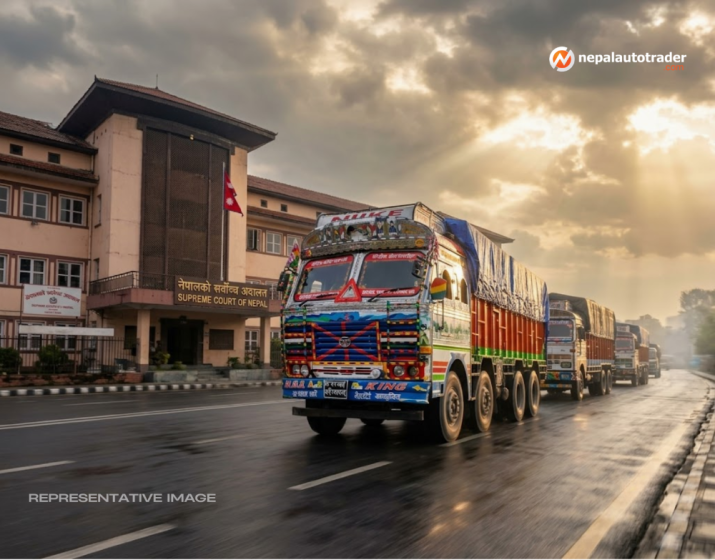
Nepal's Supreme Court has delivered a significant judgment for the country's freight transport sector, ruling against the dual administrative system used to enforce truck route permits.
The joint bench of Justice Sapana Pradhan Malla and Justice Nityananda Pandey issued the order on Monday, Asar 15, granting the writ petition and accepting the claims made by the petitioner.
The ruling follows a lengthy legal battle over whether truck operators holding a valid route permit could legally be subjected to additional inter-provincial permit requirements and enforcement measures.
The implications extend far beyond a single legal dispute. The decision provides long-awaited clarity for freight operators who argued that overlapping government rules created unnecessary legal uncertainty.
The case was filed on Shrawan 31, 2080 by Rajendra Bikram Baniya, President of the Nepal Truck Transport Entrepreneurs Federation. The writ named seven respondents, including the Office of the Prime Minister and Council of Ministers and the Department of Transport Management.
The federation argued that authorities continued penalizing freight vehicles even when operators already possessed a valid route permit.
According to the petition, traffic police were:
The federation maintained these actions lacked legal justification while valid permits remained in force.
| Case Timeline | Development | Status |
|---|---|---|
| Shrawan 31, 2080 | Writ petition filed | Case registered |
| Bhadra 7, 2080 | Interim order issued | Implementation of departmental directive suspended |
| Asar 15 | Final Supreme Court verdict | Writ granted |
The final verdict did not come without warning. During the initial hearing, a single bench led by Justice Prakash Kumar Dhungana issued an interim order on Bhadra 7, 2080.
The court instructed authorities not to implement the Department of Transport Management's directive issued on Jestha 7, 2080.
The bench observed that taking enforcement action against freight vehicles while their legally issued route permits remained valid did not appear justified at first glance. Based on the principles of balance and convenience, implementation of the directive was temporarily halted until the final hearing.
That interim order ultimately became an important indicator of how the court viewed the legal question.
The decision is expected to remove a major administrative burden for Nepal's commercial freight industry.
For operators, the change could be substantial.
According to the federation, the judgment establishes a legal basis to prevent duplicate administrative action against freight vehicles operating under valid route permits.
| Issue | Before Verdict | After Verdict |
|---|---|---|
| Valid route permit | Additional enforcement possible | Court ruled in favor of permit holders |
| Traffic penalties | Fines and vehicle control reported | Legal basis challenged successfully |
| Administrative system | Dual enforcement approach | Court rejected the disputed practice |
The significance emerges when viewed in a broader context. Nepal's freight sector depends on uninterrupted inter-provincial movement, and uncertainty surrounding permit enforcement can directly affect logistics efficiency, operating costs and supply chains.
Following the judgment, Rajendra Bikram Baniya welcomed the decision, describing it as a victory for the rule of law and for transport entrepreneurs.
He said the federation had not sought special treatment, but only the protection of rights already guaranteed under existing law.
Baniya also stated that the ruling sends a clear message to government authorities that route permit regulations must be implemented fairly and consistently.
The federation now expects the relevant government agencies to revise enforcement practices in line with the Supreme Court's order.
While the immediate legal dispute has been settled, implementation will determine the long-term impact. Government agencies are now expected to align route permit administration with the court's ruling, bringing greater consistency to Nepal's freight transport framework.
Q: What did the Supreme Court decide?
A: The Supreme Court ruled in favor of truck operators, accepting the writ petition and rejecting the disputed dual route permit enforcement system.
Q: Who filed the case?
A: The writ petition was filed by Rajendra Bikram Baniya, President of the Nepal Truck Transport Entrepreneurs Federation, on Shrawan 31, 2080.
Q: Why was the route permit system challenged?
A: The federation argued that freight vehicles with valid route permits were still being fined, detained and subjected to additional administrative requirements, which it claimed violated existing law.
Q: What happens after the verdict?
A: The federation expects relevant government agencies to implement route permit rules in accordance with the Supreme Court's decision and discontinue duplicate administrative enforcement.

Nepal Auto-Trader is one-stop platform for all automotive needs. We provide unbiased and unparalleled news/reviews of all auto-motives being launched in Nepalese Auto-Industry. Find recent updates and price of bikes/cars, compare and review recently launched bikes/cars, buy/sell/trade reconditioned cars/bikes and all government news about changing rules and regulation, road safety by subscribing us.

Subscribe to our Newsletter
© Copyright 2026, Nepal Autotrader


.png)
.png)