

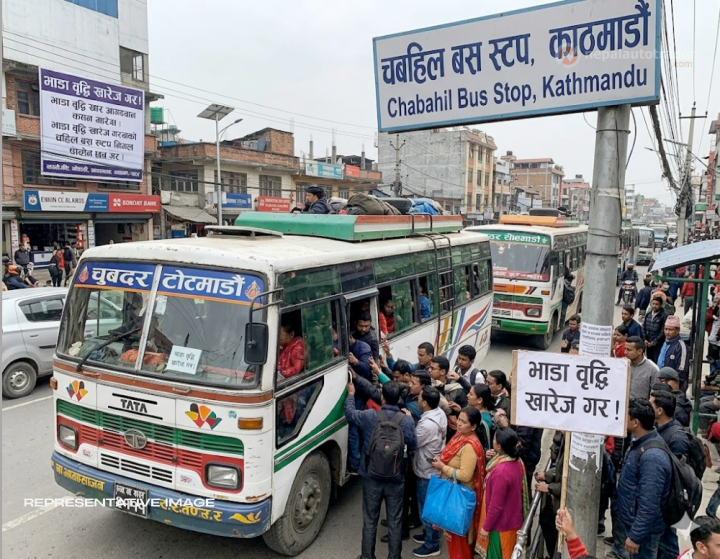
Nepal’s public transport users are once again facing higher travel costs. The Department of Transport Management has officially increased public transport fares, following a fresh adjustment in petroleum prices. This is not a discretionary move. It is part of a structured mechanism that links fuel prices directly to transport tariffs.
The system is designed to respond automatically. When fuel prices move, fares follow. No delays. No prolonged negotiations. That matters.
This latest revision comes after a change in the price of petroleum products, triggering the predefined formula used by authorities. The result, immediate fare adjustments across multiple categories of transport services.
The fare structure in Nepal is governed by a scientific mechanism that considers multiple variables. Fuel cost is the most critical factor, but not the only one.
This model aims to maintain balance. Transport operators get relief when fuel prices rise. Passengers, however, absorb the immediate impact. This changes things.
The recent revision affects multiple transport segments. While exact percentage changes vary by category, the scope is broad.
| Category | Impact | Coverage |
|---|---|---|
| Passenger Vehicles | Fare increased | Nationwide routes |
| Freight Transport | Tariff adjusted | Goods movement sectors |
| Public Buses and Microbuses | Revised fares | Urban and intercity services |
The adjustment is not isolated to a single region or service type. It is systemic. Every commuter feels it, whether traveling short distances within cities or longer intercity routes.
At the core of this recurring cycle is Nepal’s dependence on imported petroleum. Any fluctuation in global oil prices, or domestic adjustments by the Nepal Oil Corporation, quickly cascades into transport economics.
Operators argue that fare adjustments are essential to sustain operations. Rising fuel costs squeeze margins. Without revisions, services become unsustainable.
Commuters see it differently. For them, each revision chips away at daily affordability. Especially for those relying on public transport for work, education, and essential travel. That tension is constant.
The impact is most visible in urban corridors. Cities like Kathmandu experience immediate ripple effects as fare adjustments translate into higher daily commuting costs.
Even marginal increases matter when applied daily. Over weeks and months, the cumulative effect becomes significant. That matters.
The revision does not stop at passenger fares. Freight transport tariffs have also been adjusted, which carries broader implications.
Higher freight costs often translate into increased prices for goods. Supply chains absorb the change first, then pass it along to consumers.
| Sector | Effect of Fare Hike | Outcome |
|---|---|---|
| Logistics | Higher transport cost | Increased delivery expenses |
| Retail | Cost pass-through | Price adjustments |
| Consumers | Indirect burden | Higher cost of living |
This is where transport policy intersects with inflation. A fare revision may seem localized, but its reach is wide. Quietly wide.
This is not the first adjustment. It will not be the last. As long as fuel prices remain volatile, fare revisions will continue under the current system.
The bigger question is structural. Can Nepal reduce dependence on fuel-driven transport economics? Electric mobility offers one path. Policy reforms offer another.
Until then, commuters remain tied to a system where every fuel price change echoes through daily life. Quickly. Predictably. Relentlessly.
Q: Why have public transport fares increased in Nepal?
A: Fares have increased due to a rise in petroleum prices. Nepal uses an automatic adjustment system that links fuel costs directly to transport tariffs.
Q: Who decides the transport fare adjustments?
A: The Department of Transport Management implements fare revisions based on a predefined pricing formula tied to fuel price changes.
Q: Does the fare hike affect all types of transport?
A: Yes, the adjustment applies to passenger vehicles and freight transport across the country.
Q: Are fare increases temporary or permanent?
A: Fare changes depend on fuel prices. If fuel costs decrease, fares may be revised downward under the same mechanism.
Q: How does this impact daily commuters?
A: Commuters face higher travel expenses, especially those relying on public transport daily, increasing overall cost of living.

Nepal Auto-Trader is one-stop platform for all automotive needs. We provide unbiased and unparalleled news/reviews of all auto-motives being launched in Nepalese Auto-Industry. Find recent updates and price of bikes/cars, compare and review recently launched bikes/cars, buy/sell/trade reconditioned cars/bikes and all government news about changing rules and regulation, road safety by subscribing us.

Subscribe to our Newsletter
© Copyright 2026, Nepal Autotrader


.png)
.png)