

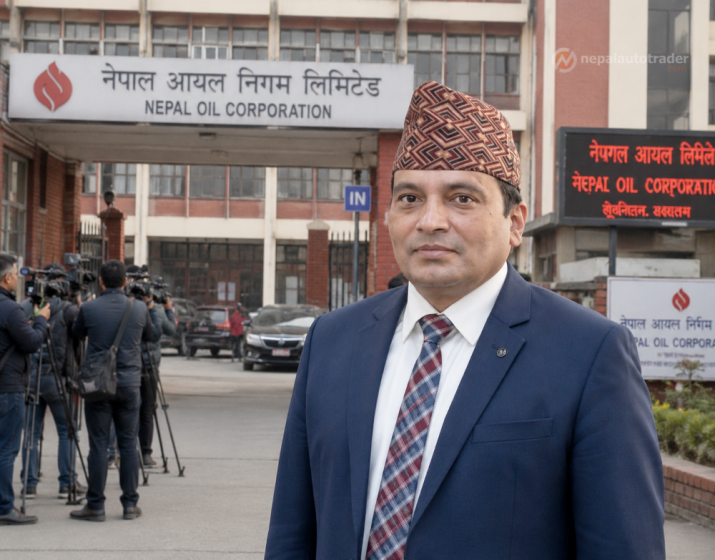
Dr. Chandika Prasad Bhatta has resigned from the post of Executive Director of Nepal Oil Corporation, adding another major development to the government’s ongoing move to clear politically appointed officials from key public institutions.
The resignation was submitted on Wednesday to the Ministry of Industry, Commerce and Supplies. Ministry spokesperson Netra Prasad Subedi confirmed that the resignation letter had been received.
The move comes as the government pushes ahead with an ordinance aimed at removing political appointments made under previous administrations. That matters. Nepal Oil Corporation had initially not been included among institutions directly affected by the decision, yet Bhatta’s exit effectively opened the door for leadership restructuring inside the state-owned fuel monopoly.
The resignation is closely tied to the government’s broader administrative reshuffle. Reports indicate that the administration led by Balendra Shah introduced an ordinance designed to remove political appointees installed under previous governments.
According to multiple reports, officials appointed during the tenure of former Prime Minister Pushpa Kamal Dahal have come under pressure as the new administration reviews appointments across public corporations and agencies.
Bhatta had been appointed Executive Director of Nepal Oil Corporation for a three-year term on Falgun 6, 2080 BS, following a Cabinet decision. His appointment was seen as a significant return to the corporation, especially considering his earlier leadership role over a decade ago.
| Position Detail | Information |
|---|---|
| Organization | Nepal Oil Corporation |
| Outgoing Executive Director | Dr. Chandika Prasad Bhatta |
| Resignation Submitted | Wednesday |
| Ministry | Ministry of Industry, Commerce and Supplies |
| Appointed By | Council of Ministers |
| Appointment Date | February 18, 2024 |
| Tenure Length | 3 years |
This changes things for Nepal’s fuel sector administration. Nepal Oil Corporation sits at the center of the country’s petroleum supply chain, and leadership instability there rarely stays confined to Singha Durbar.
This was not Bhatta’s first stint at Nepal Oil Corporation. He had earlier served as Executive Director in 2070 BS. That period remains notable because the corporation introduced an automatic petroleum pricing mechanism during his leadership.
The pricing system, launched on October 1, 2014, became one of the most discussed reforms in Nepal’s petroleum sector at the time. It linked domestic fuel price adjustments more closely with international oil market fluctuations.
Industry observers had viewed his return in 2024 as an attempt to bring back a familiar administrator with prior institutional experience.
Over the years, Nepal Oil Corporation has faced recurring pressure tied to fuel pricing, LPG distribution, infrastructure expansion and supply management. Leadership at the corporation has often carried political weight beyond the energy sector itself.
That institutional backdrop makes every executive-level change highly consequential. Especially now.
Reports published by several Nepali media outlets suggest that pressure had increased on Bhatta in recent days. Some reports claimed that Industry Minister Gauri Kumari Yadav had asked him to resign and cooperate with the government’s restructuring efforts.
Sources also indicated that the government had already decided to revoke previous political appointments across different state bodies. Bhatta’s resignation appears to have come within that broader administrative transition.
| Timeline | Development |
|---|---|
| 2070 BS | Bhatta first served at Nepal Oil Corporation |
| October 1, 2014 | Automatic fuel pricing system launched |
| February 18, 2024 | Cabinet appoints Bhatta again |
| May 2026 | Government moves to revoke political appointments |
| Wednesday, May 13, 2026 | Bhatta submits resignation |
The timing is significant. Nepal’s public corporations are entering another phase of political transition, and Nepal Oil Corporation is now directly inside that cycle.
Nepal Oil Corporation has historically experienced frequent leadership turnover, often linked to shifting political alliances and changes in government.
Previous executives have also exited amid controversy, administrative restructuring and policy disagreements. That pattern has repeatedly affected long-term planning inside the corporation.
The latest resignation now raises fresh questions around continuity in key operational areas, including:
The corporation remains one of Nepal’s most strategically important public enterprises. Every leadership shift is watched closely by transport operators, fuel dealers and consumers alike.
For the government, this resignation also sends a broader political signal. The campaign to revisit earlier appointments is no longer symbolic. It is now visibly reshaping leadership across state-owned institutions.
The government has not yet announced who will replace Bhatta at Nepal Oil Corporation. No interim appointment had been officially confirmed at the time of publication.
Still, the resignation immediately creates a vacancy at the top of Nepal’s state-owned petroleum supplier during a period of administrative realignment.
The development arrives as Nepal continues balancing fuel supply stability, infrastructure expansion and energy transition discussions. The corporation remains central to all three.
Recent conversations around electric mobility and alternative energy have also intensified in Nepal. Articles discussing projects such as the Nepal EV market growth, the Tata Punch EV launch in Nepal, and the BYD Atto 3 Cosmos Black Edition highlight how the country’s wider transport landscape is evolving alongside traditional fuel infrastructure.
But petroleum still powers the overwhelming majority of Nepal’s transport and logistics network. That reality keeps Nepal Oil Corporation at the center of the country’s economic machinery.
And now, once again, its leadership is changing.
Q: Who resigned from Nepal Oil Corporation?
A: Dr. Chandika Prasad Bhatta resigned from the post of Executive Director of Nepal Oil Corporation. The resignation was submitted on Wednesday to the Ministry of Industry, Commerce and Supplies.
Q: Why did Chandika Bhatta resign?
A: The resignation comes amid the government’s broader move to revoke political appointments made under previous administrations through a new ordinance and restructuring process.
Q: When was Chandika Bhatta appointed Executive Director?
A: Bhatta was appointed Executive Director of Nepal Oil Corporation by the Council of Ministers on February 18, 2024 for a three-year term.
Q: What major reform is associated with Bhatta’s earlier tenure?
A: During his earlier leadership at Nepal Oil Corporation, the corporation introduced an automatic fuel pricing system on October 1, 2014.
Q: Has the government announced Bhatta’s replacement?
A: No official replacement or interim executive had been publicly announced at the time this article was prepared.
Q: Why does leadership change at Nepal Oil Corporation matter?
A: Nepal Oil Corporation manages fuel imports, LPG supply and petroleum pricing across Nepal. Leadership transitions there can directly affect fuel policy, infrastructure projects and supply management.

Nepal Auto-Trader is one-stop platform for all automotive needs. We provide unbiased and unparalleled news/reviews of all auto-motives being launched in Nepalese Auto-Industry. Find recent updates and price of bikes/cars, compare and review recently launched bikes/cars, buy/sell/trade reconditioned cars/bikes and all government news about changing rules and regulation, road safety by subscribing us.

Subscribe to our Newsletter
© Copyright 2026, Nepal Autotrader


.png)
.png)