

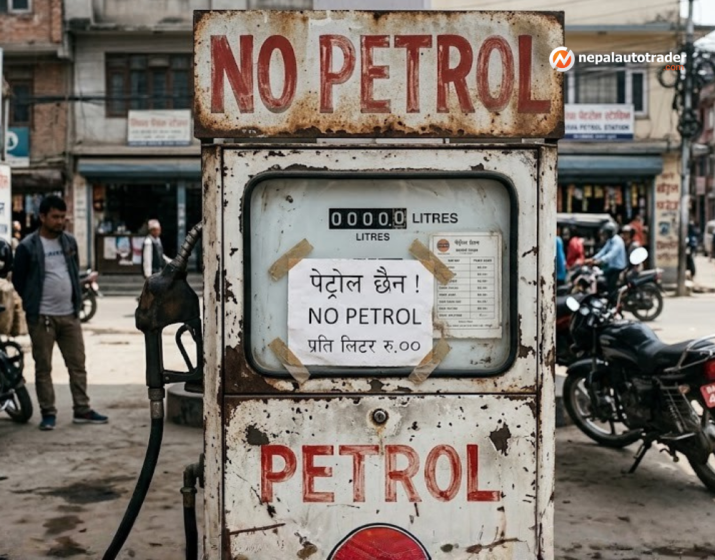
Nepal Oil Corporation introduced a significant reduction in petroleum prices effective today, but instead of bringing immediate relief to motorists, the decision has resulted in widespread disruption across Kathmandu.
Most privately operated petrol pumps suspended operations shortly after the revised prices came into effect. Pump operators argued that the corporation reduced fuel prices too sharply in a single adjustment and closed their stations as a form of protest.
For motorists, the effect was immediate. Drivers searching for fuel found locked forecourts across much of the capital.
| Fuel | Price Reduction |
|---|---|
| Petrol | Rs 20 per litre |
| Diesel/Kerosene | Rs 30 per litre |
| Domestic Aviation Fuel | Rs 40 per litre |
| LPG | Rs 100 per cylinder |
With most private outlets closed, motorists shifted to government-operated filling stations. Long queues quickly developed at fuel stations operated by the Nepal Army, Nepal Police, Armed Police Force and Sajha.
The sudden surge in demand created congestion as drivers waited for extended periods to refuel. While government stations continued operating, they faced significantly higher customer volumes than usual.
The situation illustrates how quickly supply bottlenecks can emerge when a large section of the retail fuel network suspends operations.
Pump operators say the sharp reduction in prices has affected their business interests and chose to halt fuel sales in protest.
The shutdown has also drawn criticism because fuel distribution is regarded as an essential public service. Consumers who expected lower fuel costs instead faced limited availability and longer waiting times.
The significance emerges when viewed in a broader context. Fuel price revisions are intended to benefit consumers, yet the latest adjustment has temporarily reduced access to those lower-priced supplies.
| Situation | Current Status |
|---|---|
| Fuel Price Revision | Implemented immediately |
| Private Petrol Pumps | Mostly closed in Kathmandu |
| Government Stations | Operating with heavy queues |
| Monitoring | Inspection teams deployed |
Nepal Oil Corporation has deployed monitoring teams to observe the situation following the shutdowns. However, no official information has been released indicating that any petrol pump has faced disciplinary action.
The absence of immediate enforcement has become another talking point as consumers continue dealing with fuel shortages at private stations despite the nationwide price reduction.
The real challenge is not the price cut itself, it is ensuring uninterrupted fuel distribution after major pricing decisions.
Attention now turns to how quickly private fuel retailers resume normal operations and whether discussions between the authorities and pump operators lead to a resolution.
The timing is particularly significant because sudden disruptions in fuel availability can affect daily commuting, commercial transport and broader economic activity. While the lower prices offer financial relief on paper, consumers will benefit fully only when normal retail operations return.
Q: Why are many private petrol pumps closed?
A: Pump operators closed their stations in protest after Nepal Oil Corporation introduced a sharp reduction in fuel prices effective immediately.
Q: How much has petrol become cheaper?
A: Petrol prices have been reduced by Rs 20 per litre.
Q: Which fuel products received price cuts?
A: Petrol, diesel, kerosene, domestic aviation fuel and LPG all received price reductions under the latest revision.
Q: Where can motorists still buy fuel?
A: Government-operated filling stations, including those run by the Nepal Army, Nepal Police, Armed Police Force and Sajha, have continued operating, although long queues have been reported.
Q: Has any petrol pump been penalised?
A: According to the available information, Nepal Oil Corporation has deployed monitoring teams, but no action against any petrol pump has been officially announced.

Nepal Auto-Trader is one-stop platform for all automotive needs. We provide unbiased and unparalleled news/reviews of all auto-motives being launched in Nepalese Auto-Industry. Find recent updates and price of bikes/cars, compare and review recently launched bikes/cars, buy/sell/trade reconditioned cars/bikes and all government news about changing rules and regulation, road safety by subscribing us.

Subscribe to our Newsletter
© Copyright 2026, Nepal Autotrader


.png)
.png)