

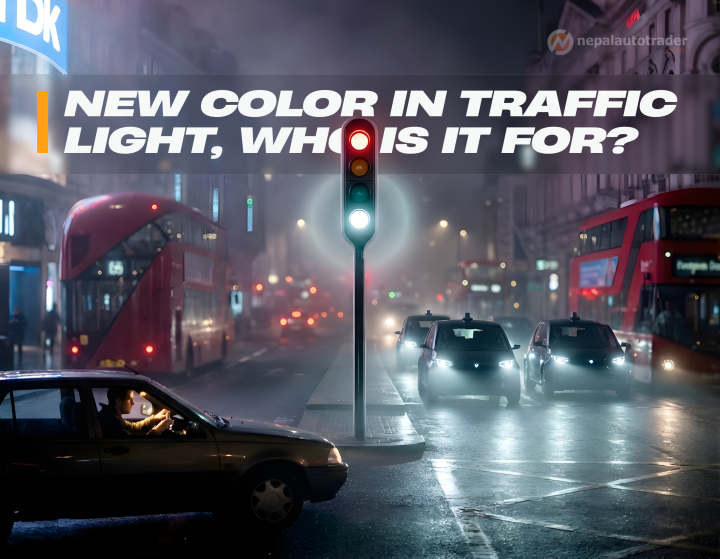
A proposed fourth traffic light color white aims to make intersections smarter and safer as autonomous cars increase.
Early studies already show reduced congestion even with a small percentage of autonomous vehicles.
Human drivers follow the flow of autonomous cars when the white signal appears.
Real-world testing will begin in controlled zones such as ports and logistics hubs.
A major shift in how cities manage traffic could be closer than expected.
We all grew up with the same traffic light trio red, yellow and green. Now researchers at North Carolina State University want to add a fourth signal to the mix. The newcomer is white. It is not decorative. It signals that autonomous vehicles have taken temporary control of the intersection.
The idea is simple. When enough autonomous cars gather at a crossing, they coordinate with each other and the traffic light. The white light appears to tell human drivers to relax and follow the vehicle in front. The autonomous cars handle the timing. The familiar three colors remain active at all times. The white light appears only when the intersection can manage itself more efficiently.
Autonomous vehicles share data at lightning speed. They exchange braking decisions, acceleration patterns, directions and intentions. Humans cannot match this level of precision. The white light exists to tap into that ability.
When the white light is active, the intersection becomes a temporary smart zone. The autonomous vehicles form a coordinated unit. They set the pace. Human drivers simply trail behind. This aligns traffic flow in a way that removes hesitation and reduces chaos at busy crossings.
Picture a cluster of autonomous vehicles approaching an intersection. They begin communicating with each other and with the traffic signal. The system checks whether there are enough autonomous vehicles to take over coordination.
If yes, the white light turns on. Human drivers follow the lead vehicle. Traffic passes through with minimal stopping and starting. When the autonomous group moves on, the white light switches off. The standard traffic signals take over again. It is surprisingly intuitive once you see it in motion.
Even with only ten percent of cars being autonomous, researchers have measured a three percent reduction in delays during simulations. Three percent might look small, but in traffic systems every fraction is valuable. Multiply it by millions of vehicles and years of driving and the impact becomes enormous.
Smoother flow means less fuel burned, lower emissions and fewer stressful moments for drivers. As the number of autonomous cars grows, these improvements scale. The long term possibility is simple. Fewer traffic jams. Possibly none.
Rollouts will start in controlled environments where autonomous vehicles already operate comfortably. Ports are strong candidates because they have predictable movement patterns and few pedestrians. Industrial complexes and automation friendly campuses may follow.
These locations help engineers refine timing, communication reliability and safety. Once the system proves itself, cities can evaluate broader adoption.
The white signal does not eliminate traditional driving rules. It serves as a brief invitation to sync with autonomous vehicles. Human drivers still obey red, yellow and green. When white appears, they simply follow the car ahead rather than making independent choices.
This coordination is key to reducing sudden stops, unpredictable lane behavior and inefficient acceleration.
White lights support smarter road ecosystems by enabling vehicle to infrastructure communication. They help prevent misunderstandings between human and automated traffic. They prepare cities for broader autonomous adoption while improving efficiency today.
The idea may look unusual now, but so did the first traffic light in 1868. As autonomous vehicles grow, the white light could become the symbol of a calmer, cleaner and more coordinated road system.

Nepal Auto-Trader is one-stop platform for all automotive needs. We provide unbiased and unparalleled news/reviews of all auto-motives being launched in Nepalese Auto-Industry. Find recent updates and price of bikes/cars, compare and review recently launched bikes/cars, buy/sell/trade reconditioned cars/bikes and all government news about changing rules and regulation, road safety by subscribing us.

Subscribe to our Newsletter
© Copyright 2026, Nepal Autotrader


.png)
.png)