

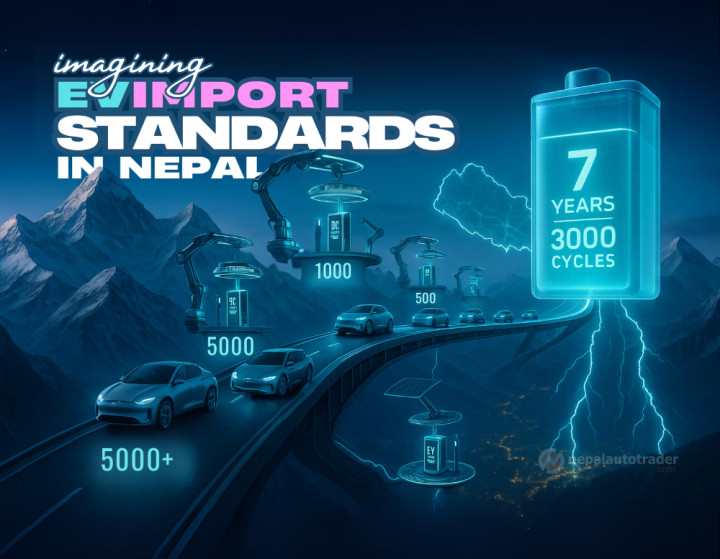
EV importers in Nepal will now face strict regulatory obligations.
Minimum battery life: 7 years or 3,000 charge cycles.
Charging stations must be installed based on import volume.
Minimum range: 300km for cars, 100km for two- and three-wheelers.
More EVs imported = More fast chargers + more service centres required.
Service centre staffing and international battery safety standards are mandatory.
| Units Imported | DC Fast Chargers | Service Centres |
|---|---|---|
| Up to 500 | 5 | 3 |
| Up to 1,000 | 10 | 5 |
| Up to 5,000 | 20 | 10 |
| Over 5,000 | 50 | 15 |
Nepal’s EV Directive: Not a Suggestion, A Mandate
The Department of Transport Management (DoTM) isn’t playing around. Their new draft directive lays out what’s essentially a compliance manual for anyone bringing EVs into the country. It’s got teeth — miss a requirement and your import pipeline could be shut down.
There’s no half-measure here. Want to sell EVs in Nepal? Build the ecosystem too. Period.
Lifespan: Minimum of 7 years or 3,000 full charge cycles
Safety: Must meet international protection and thermal stability standards
Compatibility: Must sync flawlessly with Nepal’s power grid + charging stations
Subpar batteries won’t just be frowned upon—they’ll be outright banned.
In a country where terrain varies wildly, a decent driving range isn’t optional. The DoTM now wants:
| Vehicle Type | Minimum Claimed Range |
|---|---|
| 4-Wheelers (Cars) | 300 km |
| 2/3-Wheelers | 100 km |
This move alone will weed out budget imports that barely make it across town.
If you’re importing EVs, you’re now also in the infrastructure business. This directive demands importers build and operate:
Brand-authorised service centres
Workshops staffed with EV-certified technicians
Spare parts hubs with diagnostic and emergency repair capabilities
Think you're done after selling the car? Think again.
Nepal isn’t just demanding infrastructure—it wants quality personnel on the ground.
Expect this:
Qualified EV mechanics
Technicians trained in high-voltage safety
Diagnostic expertise to handle modern EV platforms
This is about building a real ecosystem, not just sales figures.
This is the first time Nepal is telling EV importers: grow up, gear up, or get out.
No more importing flimsy scooters and calling it electrification.
No more showroom-only operations without service networks.
No more low-range, high-markup business models.
Nepal’s EV import rulebook is aggressive, strategic, and long overdue. It puts pressure where it’s needed — on the importers to build infrastructure, not just offload cars.
This is a system-level approach to electrification, and if followed through, it will set Nepal ahead of many countries still stuck handing out EV subsidies without building the backbone.
For the big players? Opportunity.
For the short-termers? Exit door’s that way.

Nepal Auto-Trader is one-stop platform for all automotive needs. We provide unbiased and unparalleled news/reviews of all auto-motives being launched in Nepalese Auto-Industry. Find recent updates and price of bikes/cars, compare and review recently launched bikes/cars, buy/sell/trade reconditioned cars/bikes and all government news about changing rules and regulation, road safety by subscribing us.

Subscribe to our Newsletter
© Copyright 2026, Nepal Autotrader


.png)
.png)