

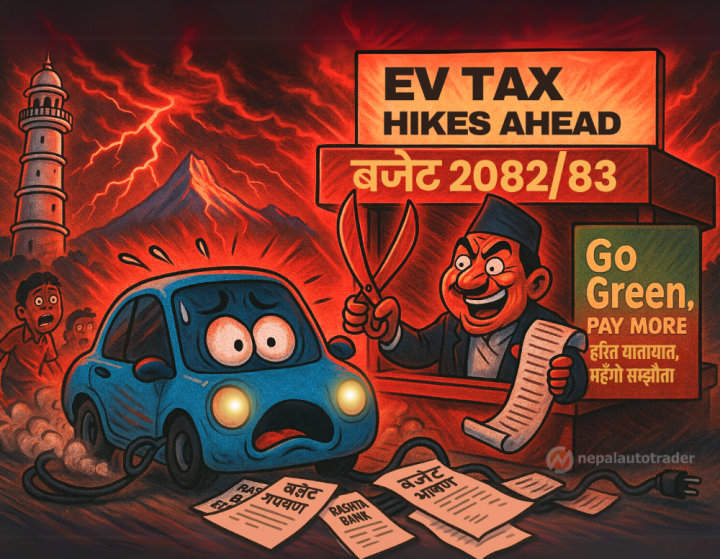
The Government of Nepal has pondered on raising customs and excise duties on electric vehicles (EVs) in the fiscal budget for 2082/83. The changes will apply across almost all EV categories:
| EV Segment (Power) | Old Customs | New Customs | Old Excise | New Excise |
|---|---|---|---|---|
| Up to 50 kW | 10% | 15% | 0% | 5% |
| 51–100 kW | 15% | 20% | 10% | 15% |
| 101–200 kW | 20% | 30% | 20% | 20% |
| 201–300 kW | 40% | 60% | 45% | 35% |
| Above 300 kW | 60% | 80% | 60% | 50% |
| Passenger EVs (≤10 seats) | 10% | 15% | 0% | 5% |
For smaller EVs—those under 100kW capacity—this adds up to a 12%–15% jump in the final price. On top of that, EV loans now require 40% down payment, up from the previous 20%.
Buyers in the 50–100 kW range, which includes popular budget and mid-range electric cars in Nepal, will see price tags increase by Rs. 3–5 lakhs or more depending on the model.
With financing also tightened, consumers now face:
The Nepal Rastra Bank’s revised lending policy now demands 40% down payment for EVs, limiting access to easy vehicle loans. Previously, buyers paid only 20% upfront, making EVs more accessible.
The price of a 16-seater electric microvan, previously around NPR 60 lakhs, is now projected to cross NPR 65 lakhs. This directly affects:
The ripple effect? Higher fares, lower margins, and potential slowdown in e-mobility adoption in Nepal’s cities.
Nepal had set ambitious EV targets:
The new tax structure contradicts these goals, especially when charging infrastructure is still underdeveloped, and local EV manufacturing is nonexistent.
With lower revenues from petroleum-based vehicle taxes, the government appears to be treating EVs as the next big taxable item. It’s a short-term fix that could have long-term policy costs:
Dealerships report that the tax increase adds significant friction in the buying process. Some are already seeing pre-orders stall.
“This hurts the momentum we had built over the past two years,” says one major Kathmandu-based EV dealer.
Activists and NGOs argue this contradicts Nepal’s climate commitments, and shifts the burden onto low-emission technology users—ironically those driving positive change.

Nepal Auto-Trader is one-stop platform for all automotive needs. We provide unbiased and unparalleled news/reviews of all auto-motives being launched in Nepalese Auto-Industry. Find recent updates and price of bikes/cars, compare and review recently launched bikes/cars, buy/sell/trade reconditioned cars/bikes and all government news about changing rules and regulation, road safety by subscribing us.

Subscribe to our Newsletter
© Copyright 2026, Nepal Autotrader


.png)
.png)