

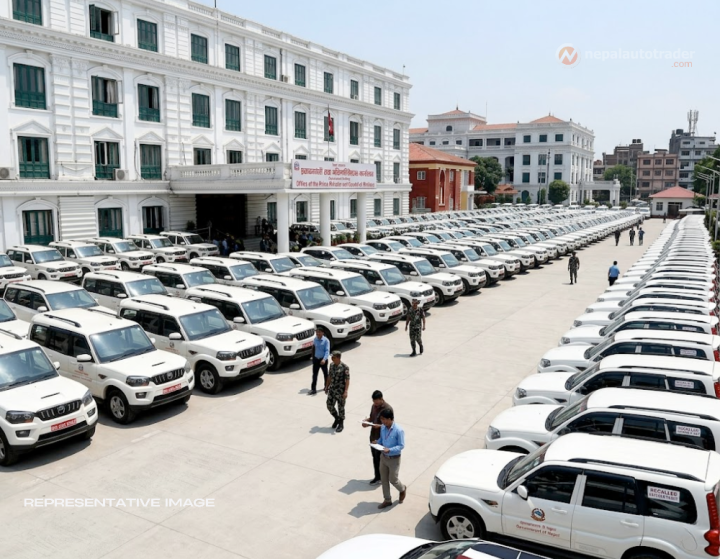
A hard reset. That is what this looks like.
The Office of the Prime Minister and Council of Ministers has pulled back 622 government vehicles from officials and employees who were using them without legal entitlement. The action follows a directive aimed squarely at years of unchecked access, a system where influence often trumped policy.
This is not a minor administrative tweak. It is a visible correction of how state resources are distributed, and misused.
According to a preliminary investigation by the Prime Minister’s Secretariat, only gazetted first-class officials or above are entitled to government vehicles. Yet, vehicles were widely being used by lower-ranking personnel, across ministries, subordinate bodies, and constitutional commissions.
The result, a bloated fleet under informal control. Now, that pipeline is being shut down.
The turning point came on April 20. A circular was issued to all ministries, agencies, and constitutional bodies with a clear instruction, return vehicles being used outside legal provisions.
The response was immediate, and measurable.
| Action | Date | Outcome |
|---|---|---|
| Circular Issued | April 20 | Directive to return unauthorized vehicles |
| Compliance Phase | Following days | Data collected from all agencies |
| Vehicles Returned | By April 28 | 622 vehicles reclaimed |
This was not voluntary reform. It was enforced accountability. Agencies were required to submit detailed records of vehicle usage, exposing how widespread the deviation had become.
The speed of recovery tells its own story. This was systemic.
The new rule is blunt, and deliberately so.
Individual use of government vehicles is now restricted strictly to those defined by law. Everyone else, regardless of position or influence, is cut off from exclusive access.
Here is how the revised framework stands:
Shared mobility inside government. That is the pivot.
| Category | Previous Practice | New Rule |
|---|---|---|
| Senior Officials | Individual use | Continues as per law |
| Mid and Lower Officials | Widespread individual use | Restricted, shared use only |
| Emergency Use | Flexible | Allowed under defined conditions |
It is a structural shift, not just a policy update. Government mobility is moving from entitlement to allocation.
This is not just about governance optics. It is about money.
The government has explicitly linked the move to rising international petroleum prices and the country’s broader economic situation. Operating hundreds of vehicles outside legal necessity carries real costs, fuel, maintenance, servicing, all quietly compounding.
The financial bleed is now under scrutiny.
A detailed study is currently underway to quantify the exact burden caused by unauthorized usage. Expect numbers. And when those numbers arrive, they will likely reshape how fleet budgets are structured.
This is where policy meets pressure.
This campaign is being framed as more than cost control. It is about discipline.
The government has positioned the recall as a step toward good governance, targeting what it calls the “extreme exploitation” of limited state resources. Strong words, but backed by visible action.
It also signals a shift in administrative culture. Access to state assets is being redefined, from privilege to compliance.
And this comes at a time when public scrutiny over government spending is rising.
There is also a signaling effect. When vehicles are pulled back, visibly, in large numbers, it reinforces that rules are no longer optional.
The immediate action is done. The next phase is more complex.
With 622 vehicles back under central control, the government now faces operational questions, allocation efficiency, tracking, and long-term policy enforcement.
Key next steps likely include:
This could also open the door for modernization, shared mobility models, digital tracking, even eventual electrification strategies in line with Nepal’s growing EV momentum.
For perspective on how fleet strategies are evolving globally, read our deep dive on EV infrastructure expansion in Nepal.
The recall of 622 vehicles is not the end of the story. It is the start of a new operating discipline.
This changes things.
Q: Why did the government recall 622 vehicles?
A: The vehicles were being used by officials and employees who were not legally entitled to them. The move aims to stop misuse of state resources and enforce existing laws.
Q: Who is allowed to use government vehicles now?
A: Only gazetted first-class officials or above can use government vehicles individually. Others can only access vehicles on a shared basis under specific conditions.
Q: When did the recall process begin?
A: The process was triggered by a circular issued on April 20, directing all government bodies to return unauthorized vehicles immediately.
Q: Will employees still have access to vehicles for work?
A: Yes, but only through shared use arrangements, especially in special or operationally necessary situations.
Q: What financial impact is expected from this move?
A: The government expects to reduce costs related to fuel, maintenance, and servicing. A detailed study is underway to quantify the total financial burden.
Q: What happens to the reclaimed vehicles now?
A: The vehicles are now under government control and are expected to be reassigned or managed based on legal provisions and operational needs.
PREVIOUS NEWS

Nepal Auto-Trader is one-stop platform for all automotive needs. We provide unbiased and unparalleled news/reviews of all auto-motives being launched in Nepalese Auto-Industry. Find recent updates and price of bikes/cars, compare and review recently launched bikes/cars, buy/sell/trade reconditioned cars/bikes and all government news about changing rules and regulation, road safety by subscribing us.

Subscribe to our Newsletter
© Copyright 2026, Nepal Autotrader


.png)
.png)