

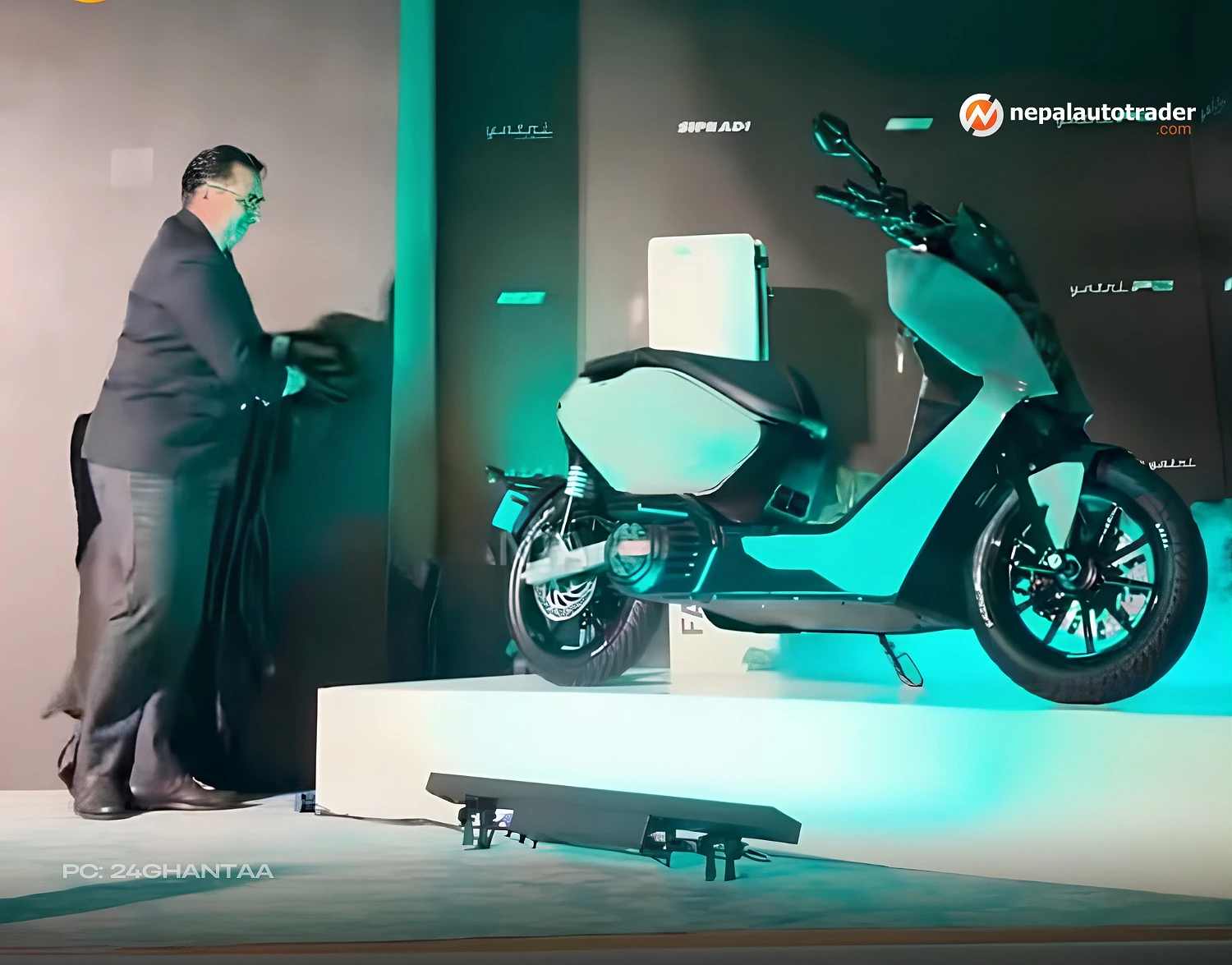
There is something unusually significant about the Yatri P2. This is not simply another electric scooter entering Nepal's increasingly crowded EV market. It is being presented as a product designed, developed and manufactured in Nepal, a distinction that gives the launch a much bigger meaning than another set of specifications on a showroom sheet.
The P2 was unveiled in Kathmandu alongside strong comments about Nepal's ability to design and manufacture its own automotive products. Finance Minister Dr. Swarnim Wagle described the scooter as a world class product and argued that locally developed design could compete with foreign brands rather than simply copy them.
That ambition is reflected in the engineering. The numbers are serious for a scooter, and the charging system could be just as important as the headline power figure.
At the heart of the P2 is a 10 kW electric motor. The company has paired it with three battery choices, giving buyers different range and battery-capacity options rather than forcing every customer into one configuration.
| Specification | Yatri P2 |
|---|---|
| Motor | 10 kW |
| Battery options | 5.2 kWh, 3.7 kWh and 3 kWh |
| Claimed range | 157 km, 112 km and 90 km respectively |
| Wheelbase | 1,390 mm |
| Wheel size | 14 inch alloy |
| Ground clearance | 175 mm |
| Seat height | 795 mm |
| Footboard height | 300 mm |
The claimed range figures are 157 km with the 5.2 kWh battery, 112 km with the 3.7 kWh battery and 90 km with the 3 kWh battery. Those options give the P2 a useful spread, particularly for riders who may value lower battery capacity over maximum range.
There is another interesting detail here. The P2 uses a 1,390 mm wheelbase, which Yatri says contributes to stability at higher speeds and over uneven roads while also creating more legroom. In Nepal, where road quality can change dramatically within a short ride, that is not a specification that exists merely for a brochure.
Electric scooter buyers often focus on range. Daily users eventually discover that charging time can matter just as much.
Yatri has equipped the P2 with a 3.3 kW DC fast charger, which the company says can take the battery to 80 percent in 41 minutes. A home charger can achieve 80 percent in 2 hours and 50 minutes, according to the launch information.
The infrastructure plan matters. A fast charging system is useful only when riders can actually find compatible chargers. By planning a network across 35 locations, Sipradi Yatri is attempting to make the charging hardware part of the product proposition rather than leaving customers to solve that problem themselves.
The P2 also takes a different physical approach from many conventional scooters. It rides on 14 inch alloy wheels and has 175 mm of ground clearance. The seat height is 795 mm, while the footboard height is 300 mm.
That combination gives the P2 a more substantial stance. The longer wheelbase, larger wheels and relatively generous ground clearance are especially relevant in Nepal, where urban streets can quickly give way to rough surfaces and uneven roads.
The design reinforces that impression. Earlier testing and teaser images showed a scooter with a motorcycle influenced appearance, muscular front and rear sections, sharp edges and an LED headlamp. Yatri also uses an aluminium swingarm and double sided spring suspension.
| Chassis and equipment | Yatri P2 |
|---|---|
| Wheels | 14 inch alloy |
| Ground clearance | 175 mm |
| Seat height | 795 mm |
| Footboard height | 300 mm |
| Wheelbase | 1,390 mm |
| Swingarm | Aluminium |
| Suspension | Double sided spring suspension |
The result is a scooter designed around stability and road presence rather than simply compact city mobility. That distinction could become important as Nepal's electric two wheeler market matures.
Yatri has not treated the P2 as a basic electric commuter. The scooter supports Apple CarPlay and Android Auto, while its cockpit includes a smart display and real time energy meter. Its battery management system has also been certified by India's Automotive Research Association of India, according to the launch report.
That technology focus fits the wider philosophy behind the project. Sipradi Trading CEO Rajanbabu Shrestha described the P2 as evidence that Nepal can design, engineer and manufacture products rather than simply assemble imported products. The partnership between Sipradi and Yatri is also being positioned as the beginning of further products.
The significance emerges when viewed in a broader context. Nepal's electric vehicle market has already become comfortable with imported technology. A locally developed product has a different burden. It has to prove not only that it can compete on price and range, but that local engineering can stand on its own.
The available launch information confirms the three battery configurations and their respective range figures, but it does not disclose an exact purchase price. That makes a direct value comparison impossible at this stage.
It also means the P2 cannot yet be judged purely on specifications. A 10 kW motor, 157 km claimed range and DC fast charging create an impressive technical proposition, but customers ultimately compare those features against the amount they must pay.
The competitive context is therefore still developing. The source material does not identify specific rival models or provide exact rival prices, so a precise model by model comparison would go beyond the available facts. What can be said is that Yatri is deliberately positioning the P2 against established electric scooter products in Nepal by emphasizing its own design, longer wheelbase, larger wheels, fast charging and locally developed engineering.
The P2 arrives after Yatri says it has tested thousands of kilometres and worked through weaknesses identified during development. The earlier development story involved multiple prototypes and testing stages, while the final product is now being presented as the company's first production electric scooter.
That makes the launch a test of something larger than consumer demand. It is a test of whether a Nepal developed automotive product can earn the same kind of trust normally attached to international brands.
The early signs are promising on paper. There is meaningful motor output, three battery choices, a claimed range of up to 157 km, 41 minute DC charging to 80 percent, substantial ground clearance and a planned charging network.
But the real verdict will come from riders. They will decide whether the P2's design feels as convincing on Nepal's roads as it does in a specification sheet. And that is where this story gets interesting.
If Yatri can turn the P2 into a dependable product and follow it with more locally engineered vehicles, the consequences could extend well beyond one scooter. Sipradi has already described the P2 as the beginning of its partnership with Yatri, with ambitions to introduce future products and take Nepal developed technology beyond the domestic market.
The P2, then, is not just another electric scooter launch. It is a statement about what Nepal believes it can build next.
Q: What is the claimed range of the Yatri P2?
A: The 5.2 kWh battery has a claimed range of 157 km, while the 3.7 kWh and 3 kWh batteries are claimed to deliver 112 km and 90 km respectively.
Q: How powerful is the Yatri P2 motor?
A: The Yatri P2 uses a 10 kW electric motor. The launch source does not provide a torque figure, so no torque number is included here.
Q: How quickly can the Yatri P2 charge?
A: Yatri says its 3.3 kW DC fast charger can charge the scooter to 80 percent in 41 minutes. A home charger takes 2 hours and 50 minutes to reach 80 percent, according to the company.
Q: What wheels and ground clearance does the Yatri P2 have?
A: The P2 uses 14 inch alloy wheels and has 175 mm of ground clearance. Its wheelbase measures 1,390 mm, with a 795 mm seat height.
Q: How much does the Yatri P2 cost?
A: The supplied launch sources do not state an exact purchase price. For that reason, a price figure or value comparison has not been added.
Q: Where will Yatri P2 DC chargers be available?
A: Sipradi Yatri says it plans to install DC chargers at 35 locations across Nepal. The supplied source does not provide the individual locations.

Nepal Auto-Trader is one-stop platform for all automotive needs. We provide unbiased and unparalleled news/reviews of all auto-motives being launched in Nepalese Auto-Industry. Find recent updates and price of bikes/cars, compare and review recently launched bikes/cars, buy/sell/trade reconditioned cars/bikes and all government news about changing rules and regulation, road safety by subscribing us.

Subscribe to our Newsletter
© Copyright 2026, Nepal Autotrader


.png)
.png)