

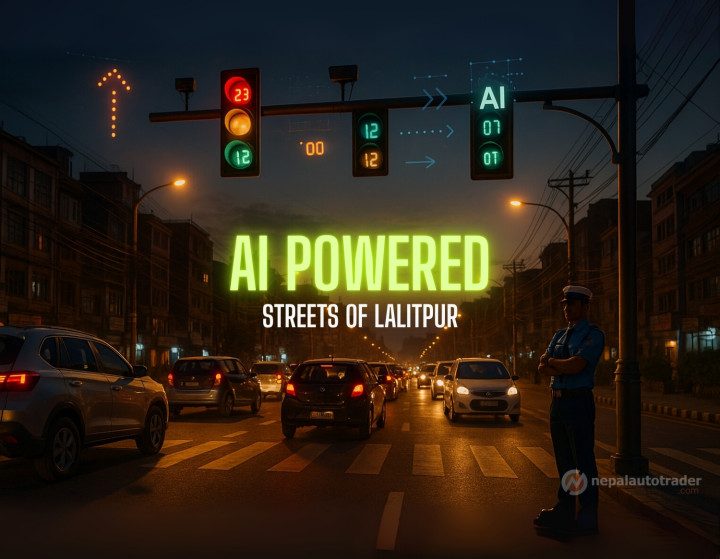
AI-powered traffic lights now run 24/7 at 8 major intersections
Traffic police are no longer waving hands or blowing whistles
VIP vehicles must wait like everyone else—no exceptions
Real-time sensors adjust red and green lights based on traffic volume
Smart signals cut congestion, reduce wait times, and collect live data
Expansion plans already in motion for more intersections
Lalitpur is now home to Nepal’s first AI-powered smart traffic light system. These lights don’t just blink on a timer—they think. Using sensors and vehicle detectors, they respond to traffic in real time. That means no more unnecessary waiting at empty intersections or gridlock at peak hours.
Each smart light is equipped with a vehicle detection system that tracks how many vehicles are waiting, how fast they’re moving, and in which direction. Based on this data, the lights adjust automatically—green or red—every 30 to 40 seconds.
It’s all automated. No human needed.
Here’s where the system is already active:
Jawalakhel – 3 spots
Pulchowk – 2 spots
Harihar Bhawan – 1 spot
Pulchowk Petrol Pump – 1 spot
Kupandol – 1 spot
That’s 8 locations in total—and counting.
Before this system, traffic cops often cleared intersections for ministers and VIPs, even during red lights. Not anymore.
“Now, even ministers stop at red lights. The system doesn’t care who’s in the car,” says Sitaram Hachhethu, head of Lalitpur’s traffic police.
Fair play, every time.
The AI adjusts the timing on the fly. In most cases, lights change every 30 to 40 seconds. During office rush, traffic heading toward Kathmandu gets priority, but no one waits more than a minute.
This means:
Less honking
Less fuel waste
Shorter commutes
Safer crossings for pedestrians
Each smart pole also includes a vehicle counter. It doesn’t just detect movement—it gathers and sends data straight to the central server:
How many vehicles passed
Which direction they went
Average speed
Level of congestion
This info isn’t just for the lights. It helps city planners make better calls on future road designs and traffic rules.
The system’s already working at 8 spots, but Lalitpur’s not stopping there. New installations are in the works for:
Gwarko
Balkhu
Satdobato
More areas will follow as the city scales this up—and other cities are watching closely.
Nepal has never used a system like this before. It’s automated, fair, and fast. And for once, the traffic light is actually doing what it’s supposed to—making roads safer and smoother.
| Benefit | Impact |
|---|---|
| AI-controlled lights | Less human error, better consistency |
| Equal treatment for all | No manual overrides, VIPs treated the same |
| 30-40 second light changes | Shorter waits, quicker commutes |
| Real-time data collection | Smarter urban planning |
| 24/7 operation | Safer roads, even at night |
This isn't just a traffic upgrade, it's a shift toward smarter, fairer cities in Nepal. As Lalitpur leads, others will follow. If this works here, it can work anywhere.

Nepal Auto-Trader is one-stop platform for all automotive needs. We provide unbiased and unparalleled news/reviews of all auto-motives being launched in Nepalese Auto-Industry. Find recent updates and price of bikes/cars, compare and review recently launched bikes/cars, buy/sell/trade reconditioned cars/bikes and all government news about changing rules and regulation, road safety by subscribing us.

Subscribe to our Newsletter
© Copyright 2026, Nepal Autotrader


.png)
.png)