

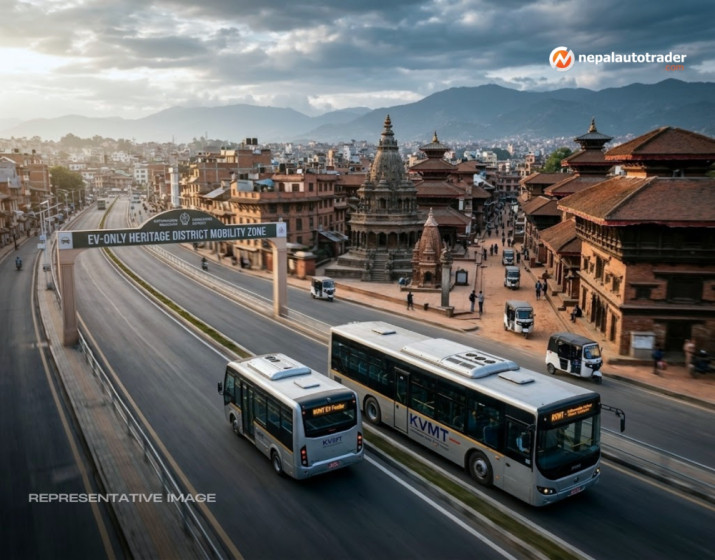
Anyone who travels across Kathmandu Valley knows the problem. Too many overlapping routes. Too many small vehicles. Inconsistent service quality. Congested corridors where buses, microbuses and tempos compete for the same passengers.
Now, a long-discussed solution is back on the table.
A report prepared under the Kathmandu Sustainable Urban Transport Project (KSUTP) has proposed dividing the valley's public transport network into three operational layers. The study, originally prepared in 2014 and recently made public again by the Ministry of Physical Infrastructure Development, forms part of a broader effort to modernize urban mobility across the capital region.
The objective is straightforward. Create a cleaner, more organized and more passenger-friendly system while reducing duplication and improving service quality.
That matters.
The proposal arrives at a time when Nepal's transport sector is increasingly embracing electrification and larger-capacity public transit solutions. Readers following developments in Blue Bus expansion plans and the growth of electric public transport initiatives will recognize many of the same themes.
According to the report, the current network of roughly 200 routes would be restructured into three categories:
| Route Category | Purpose | Vehicle Type |
|---|---|---|
| Primary Routes | Main high-demand urban corridors | 12 to 18-meter large buses |
| Secondary Routes | Connect suburban areas to major hubs | 9 to 10-meter medium buses |
| Tertiary Routes | Feeder services in dense neighborhoods | Small EVs and electric tempos |
The logic is simple. Large buses should move the largest number of passengers along the busiest corridors. Smaller vehicles should handle local distribution and neighborhood access.
Not everyone will notice it immediately. But separating these functions could dramatically reduce route duplication that currently clogs many major roads.
The proposed primary network focuses on roads that already carry the highest passenger volumes.
Among the corridors identified are:
These routes would be served by large buses measuring between 12 and 18 meters. Dedicated bus lanes are also proposed to improve travel times and service reliability. According to the report, the primary network would require 467 buses, each capable of carrying around 80 passengers.
Here's the thing. Dedicated bus infrastructure is often what separates a functioning transit system from one trapped in the same congestion as private vehicles.
While primary corridors handle the heavy lifting, secondary routes are designed to bring passengers into the system.
Areas such as Budhanilkantha, Kirtipur, Gokarna, Nagarkot, Sanga, Sisneri, Godawari and Chapagaun would be connected to major urban centers and interchange points.
| Key Metric | Secondary Route Plan |
|---|---|
| Vehicle Length | 9 to 10 meters |
| Fleet Requirement | 437 buses |
| Role | Suburban connectivity and passenger transfer |
This middle layer could become one of the most important pieces of the network. Efficient feeder-to-trunk integration is what allows high-capacity corridors to operate effectively.
Without it, even the best bus rapid transit style corridor struggles.
The most striking part of the proposal concerns the valley's inner neighborhoods and heritage zones.
More than 40 local roads have been identified as tertiary routes where smaller vehicles would provide feeder services. Many of these areas feature narrower streets and lower passenger volumes.
Routes highlighted in the report include:
These corridors would prioritize small electric vehicles, particularly electric tempos.
And the proposal goes a step further.
Historic areas including the New Road, Durbar Square and Lagan zones would permit only electric vehicles, with pedestrian convenience forming a key part of the strategy.
That aligns closely with global urban mobility trends where heritage districts increasingly favor low-emission transport and pedestrian-first design.
Road expansion often dominates transport discussions. Yet the report identifies a different problem.
The valley's public transport system suffers from fragmented operations, weak regulation, overlapping routes, poor service quality and insufficient terminal infrastructure. Simply adding more road capacity does not automatically solve those issues.
A structured route hierarchy could.
If implemented properly, the proposal would create a clearer operating framework for operators, improve fleet allocation and accelerate electrification where it makes the most sense.
The challenge, of course, lies in execution.
The report itself dates back to 2014, and the ministry has indicated that the recommendations will need updating before implementation. Even so, the underlying concept remains relevant. Perhaps even more relevant today than when it was first drafted.
For a valley searching for cleaner air, more reliable mobility and less chaotic public transport, dividing the network into three layers may prove to be one of the most practical ideas currently on the table.
Q: What is the proposed three-level route system for Kathmandu Valley?
A: The proposal divides public transport into primary, secondary and tertiary routes. Each category would use different vehicle sizes and serve different transport functions across the valley.
Q: How many existing routes could be affected?
A: The report recommends revising, merging or replacing approximately 200 existing public transport routes currently operating in Kathmandu Valley.
Q: What vehicles will operate on primary routes?
A: Large buses between 12 and 18 meters long are proposed for high-demand corridors. Dedicated bus lanes are also recommended.
Q: Will electric vehicles play a major role?
A: Yes. The tertiary feeder network prioritizes electric vehicles, particularly electric tempos, and several historic city zones are proposed as EV-only areas.
Q: How many buses are required under the plan?
A: The report estimates 467 buses for primary routes and 437 buses for secondary routes.
Q: Has the proposal been implemented?
A: No. The report has been made public by the ministry, which has indicated that the recommendations would require updates and revisions before implementation.

Nepal Auto-Trader is one-stop platform for all automotive needs. We provide unbiased and unparalleled news/reviews of all auto-motives being launched in Nepalese Auto-Industry. Find recent updates and price of bikes/cars, compare and review recently launched bikes/cars, buy/sell/trade reconditioned cars/bikes and all government news about changing rules and regulation, road safety by subscribing us.

Subscribe to our Newsletter
© Copyright 2026, Nepal Autotrader


.png)
.png)