

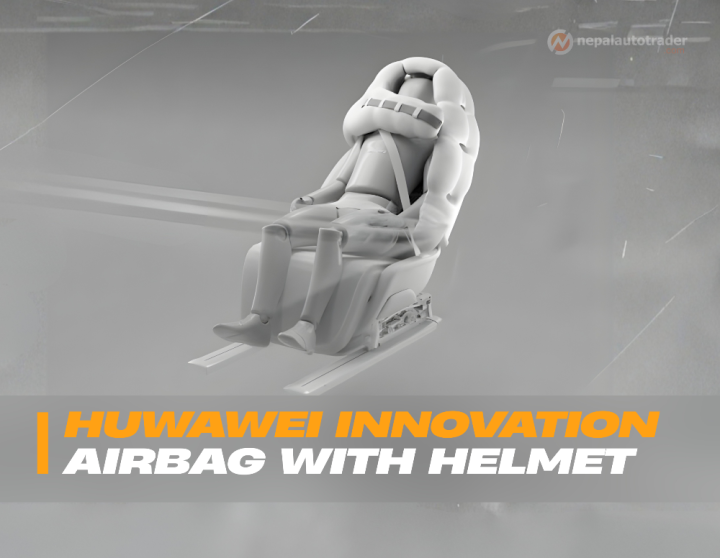
First production ready car to feature a helmet airbag system
Designed to protect the head and neck during side and complex crashes
Uses intelligent sensors for ultra fast deployment
Signals a major shift in next generation automotive safety
We are seeing a meaningful rethink of how cars protect people. Huawei’s helmet airbag is not about adding more cushions inside the cabin. It is about protecting the most critical and fragile area the head.
As vehicles become stronger and faster, the way injuries occur has changed. Side impacts and rotational forces now play a bigger role. This technology responds directly to that reality.
A helmet airbag works differently from traditional airbags. Instead of pushing forward from the steering wheel or door, it forms a protective enclosure around the head at the moment of impact.
It stabilizes the head, limits sudden movement, and reduces strain on the neck.
| Aspect | Helmet Airbag | Conventional Airbag |
|---|---|---|
| Coverage area | Head and partial neck | Chest and face |
| Impact focus | Side and angled crashes | Mostly frontal |
| Injury reduction | Rotational and neck injuries | Direct impact injuries |
| Deployment logic | Sensor driven precision | Impact triggered inflation |
Huawei relies on a dense network of sensors that monitor vehicle speed, direction, and collision forces in real time. When a critical threshold is crossed, the helmet airbag deploys in milliseconds.
There is no delay and no unnecessary activation. The system reacts only when protection is genuinely needed.
Modern car structures absorb crash energy well, but that energy still moves occupants inside the cabin. The head often experiences violent rotation even when seatbelts and airbags do their job.
This is where the helmet airbag stands out. It addresses a gap that existing safety systems were never designed to solve.
Rising incidence of side impact collisions
Increased vehicle speeds in urban traffic
Better body protection revealing new injury patterns
Growing focus on brain and neck safety
Huawei’s helmet airbag is designed to work alongside seatbelts, side airbags, and intelligent driver assistance systems. It does not operate in isolation.
This coordinated approach allows safety systems to act as a unified response rather than separate components.
From the inside, nothing changes. There are no visible additions and no compromise on comfort. The system stays dormant until a serious collision occurs.
That balance between invisibility and effectiveness is what makes this technology practical for everyday cars.
The world’s first car with a helmet airbag raises the bar for everyone else. Head centric protection is no longer theoretical. It is now part of a production vehicle.
Automakers will have to rethink how they approach occupant safety in future models.
New benchmarks for head injury prevention
Increased focus on side and rotational impacts
Pressure to adopt intelligent restraint systems
Evolving safety expectations from buyers
Huawei’s helmet airbag signals a future where safety is smarter, more targeted, and more human focused. It is not about adding layers. It is about adding intelligence.
This launch marks the moment when head protection moved to the center of automotive safety design.

Nepal Auto-Trader is one-stop platform for all automotive needs. We provide unbiased and unparalleled news/reviews of all auto-motives being launched in Nepalese Auto-Industry. Find recent updates and price of bikes/cars, compare and review recently launched bikes/cars, buy/sell/trade reconditioned cars/bikes and all government news about changing rules and regulation, road safety by subscribing us.

Subscribe to our Newsletter
© Copyright 2026, Nepal Autotrader


.png)
.png)