

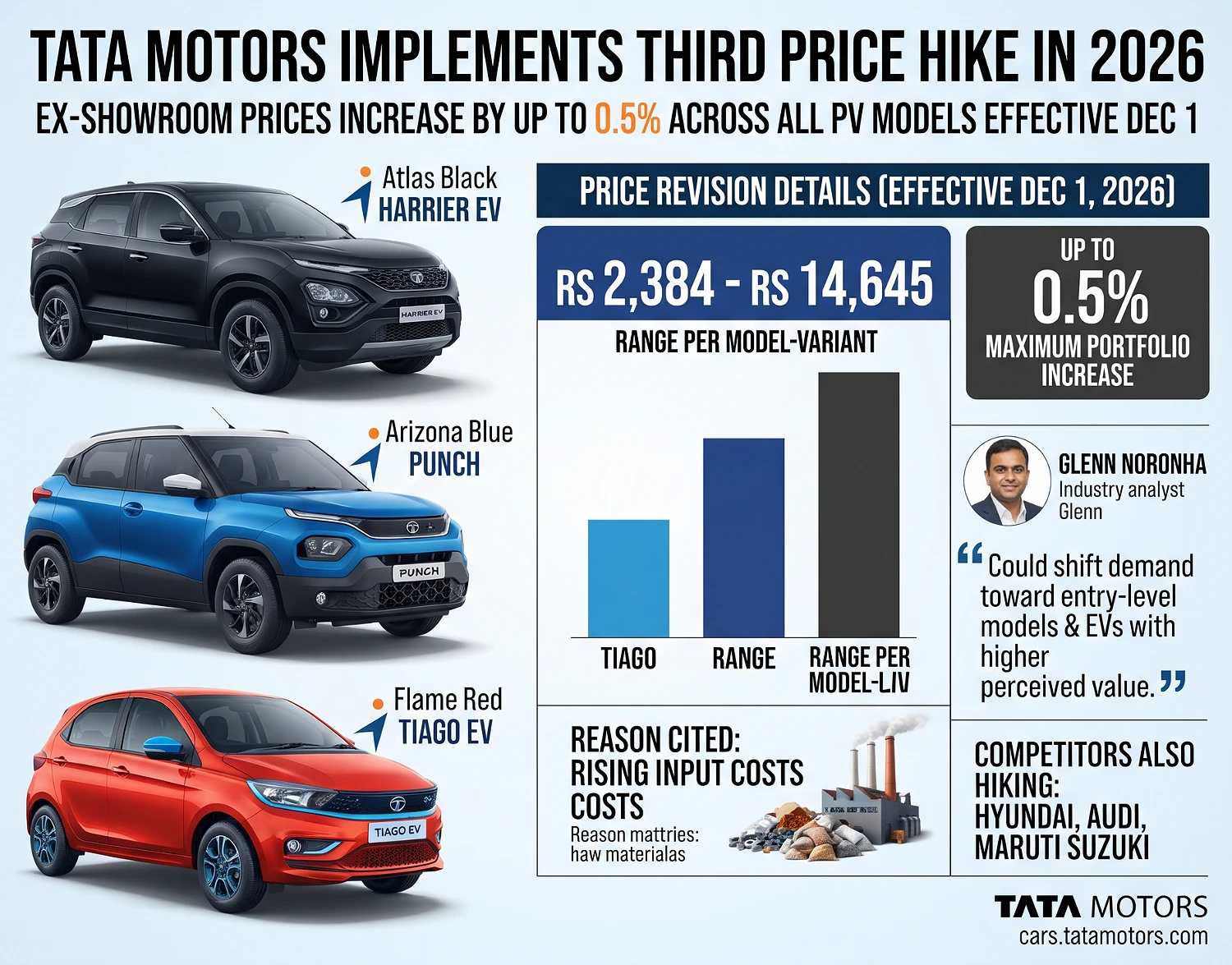
The portfolio‑wide revision announced on 24 November 2026 is the third adjustment Tata Motors has made in twelve months. Earlier in the year, price tweaks arrived in July and September, each responding to fluctuations in raw‑material and logistics expenses. This latest step pushes the ex‑showroom price of every model higher, a signal that the cost‑inflation cycle is not yet over.
Tata Motors stresses that it has been shouldering a “significant portion” of the cost rise to keep the impact on customers manageable. Nonetheless, the price hike is unavoidable because the margin squeeze threatens the profitability of both ICE and EV segments. By applying a uniform ceiling of 0.5 percent, the automaker aims to preserve price‑point integrity while still covering the higher outlay on components, batteries, and steel.
Below is the complete list of ex‑showroom price ranges that will be in effect from 1 December 2026. All figures are expressed in Indian rupees (lakh).
| Model | New Price Range (Rs lakh INR) |
|---|---|
| Tiago | 4.76 ‑ 8.62 |
| Tiago EV | 6.99 ‑ 10.09 |
| Aeris | 5.30 ‑ 9.75 |
| Tigor EV | 12.49 ‑ 13.75 |
| Altroz | 6.00 ‑ 10.90 |
| Punch | 5.75 ‑ 10.77 |
| Punch EV | 9.79 ‑ 12.99 |
| Nexon | 7.40 ‑ 14.22 |
| Nexon EV | 12.49 ‑ 17.69 |
| Curvv | 10.00 ‑ 18.75 |
| Curvv EV | 17.19 ‑ 19.39 |
| Sierra | 11.49 ‑ 21.29 |
| Sierra EV | 18.79 ‑ 25.99 |
| Harrier | 13.00 ‑ 25.50 |
| Harrier EV | 21.79 ‑ 29.29 |
| Safari | 13.40 ‑ 26.27 |
The ICE models have always been cheaper than their electric cousins, but the new bands show the gap widening in several segments. For instance, the Harrier now tops out at Rs 25.50 lakh, while the Harrier EV starts at Rs 21.79 lakh and can climb to Rs 29.29 lakh. The premium attached to battery packs, cooling systems, and fast‑charging hardware is reflected in the higher ceiling.
On the compact end, the Tiago still offers the most affordable entry point at Rs 4.76 lakh, yet the Tiago EV begins at Rs 6.99 lakh. Buyers who prioritize low upfront cost will likely gravitate toward the gasoline‑powered version, unless government incentives offset the EV premium.
Tata Motors is not acting in isolation. Hyundai, Audi, and Maruti Suzuki have all announced price adjustments for their 2026 lineups, citing similar pressures from raw‑material inflation and logistics bottlenecks. The collective upward movement compresses the overall market, forcing consumers to re‑evaluate budget allocations.
For example, Maruti’s popular Baleno and Hyundai’s i20 are slated for modest hikes of around 0.3 percent, slightly lower than Tata’s 0.5 percent ceiling. Audi’s premium models, however, are seeing a steeper rise, echoing Tata’s strategy of passing on a larger share of cost increases for higher‑end vehicles.
Since the article went live, the piece has garnered 2.1 K views, indicating strong interest. Social media chatter shows a mix of acceptance and frustration. Some owners applaud Tata for being transparent and for continuing to absorb part of the cost surge. Others worry about the cumulative effect of three hikes in a single year, especially first‑time buyers and fleet operators.
Dealerships report that negotiations are becoming tighter. Buyers are demanding more accessories, longer service packages, or even a switch to a different brand to avoid the higher outlay. Yet, the EV segment still enjoys a perception of future‑proofing, and many customers are willing to pay the premium for lower running costs and environmental benefits.
Analysts, including Glenn Noronha, suggest that the price trajectory may level off if input costs stabilize. However, the global supply chain remains vulnerable to geopolitical tensions, commodity price swings, and currency fluctuations. Should any of these factors worsen, Tata Motors could be forced into a fourth hike before the calendar flips to 2027.
In the meantime, the automaker is likely to double‑down on cost‑efficiency measures: localising more components, negotiating better terms with battery suppliers, and expanding its EV manufacturing capacity. A stronger focus on value‑added services, such as free home‑charging installation or extended warranties, could also soften the blow for price‑sensitive buyers.
Q1: When will the new prices take effect? A: All listed ex‑showroom price ranges become active on 1 December 2026.
Q2: Does the hike apply to both gasoline and electric models? A: Yes. The price hike is portfolio‑wide, covering every ICE and EV vehicle in the Tata Motors Passenger Vehicles lineup.
Q3: How much can I expect to pay extra for a specific model? A: The increase per variant varies between Rs 2,384 and Rs 14,645, which is roughly 0.2 percent to 0.5 percent of the previous price.
Q4: Are there any models that escaped the increase? A: No. Every model, from the entry‑level Tiago to the flagship Harrier EV, has been adjusted.
Q5: Will Tata Motors offer any compensation or discounts to offset the rise? A: The company has not announced any universal discount scheme, but dealers may provide promotional accessories or financing offers on a case‑by‑case basis.
Q6: How does this compare with price changes from other manufacturers? A: While Hyundai, Audi, and Maruti Suzuki are also raising prices, Tata’s 0.5 percent ceiling is among the higher ends of the industry adjustments.
PREVIOUS NEWS

Nepal Auto-Trader is one-stop platform for all automotive needs. We provide unbiased and unparalleled news/reviews of all auto-motives being launched in Nepalese Auto-Industry. Find recent updates and price of bikes/cars, compare and review recently launched bikes/cars, buy/sell/trade reconditioned cars/bikes and all government news about changing rules and regulation, road safety by subscribing us.

Subscribe to our Newsletter
© Copyright 2026, Nepal Autotrader


.png)
.png)