

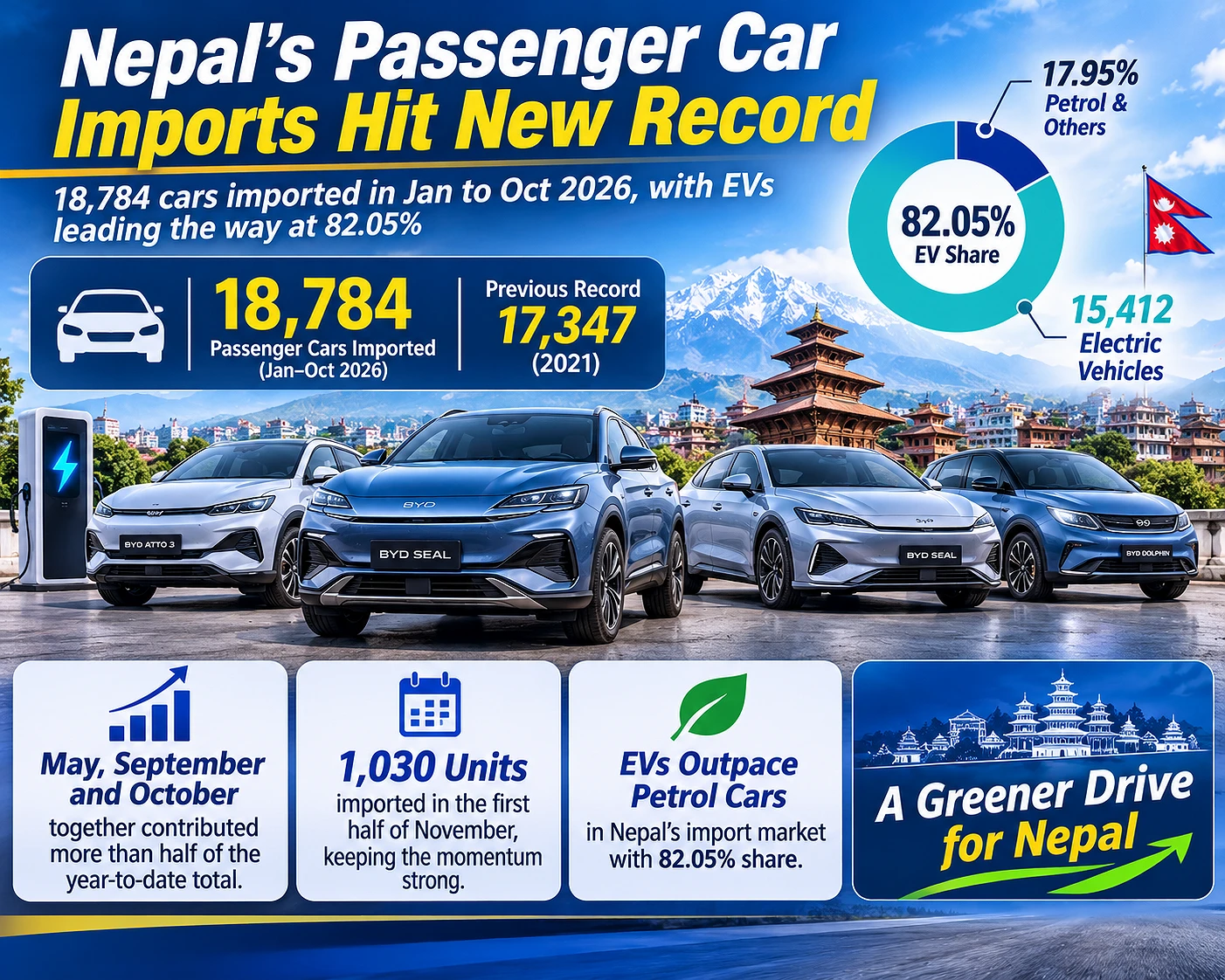
The 2026 calendar year has turned into a milestone for Nepal’s automotive sector. From January through the first half of November, 18,784 passenger cars rolled across the border, a figure that shatters the 2021 high of 17,347 units. The surge is not random; it mirrors a clear consumer preference for cleaner technology. While the total number of cars imported grew, the composition changed dramatically. Electric vehicles now dominate the market, comprising 82.05% of all arrivals. In contrast, petrol‑powered cars slipped to a modest 17.95%, a stark reversal from previous years when internal‑combustion models were the norm.
The data tells a simple story: Nepali buyers are embracing EVs at an unprecedented rate. With 15,412 electric units imported, the market share has leapt well beyond the half‑way mark. This shift is reflected in the monthly breakdown, where the largest spikes align with the release of new EV models and promotional financing schemes. The modest 3,372 petrol‑powered cars imported during the same period highlight how quickly traditional demand is fading. Industry analysts in Kathmandu point to lower operating costs, expanding charging infrastructure, and government incentives as key drivers behind the EV surge.
Below is a month‑by‑month view of the import flow. The numbers illustrate how the market built momentum, peaked in the autumn months, and kept climbing into November.
| Month | Units Imported |
|---|---|
| January | 937 |
| February | 771 |
| March | 1,129 |
| April | 1,102 |
| May | 2,977 |
| June | 623 |
| July | 785 |
| August | 1,154 |
| September | 3,389 |
| October | 4,887 |
| First half of November | 1,030 |
The three‑month window from August to October alone contributed roughly 10,500 units, a clear indication that demand spikes when new model launches coincide with seasonal buying cycles. May also stands out as a mid‑year high point, driven largely by a wave of affordable compact EVs entering the market.
When the 2021 record of 17,347 units was set, the market was still heavily weighted toward petrol‑powered cars. Fast forward to 2026, and the total has risen by 1,437 units while the fuel mix has flipped. The EV share jumped from a single‑digit percentage in earlier years to over 80% today. This transformation underscores how policy, consumer awareness, and global supply chains have converged to reshape Nepal’s automotive landscape.
The dominance of electric vehicles carries several consequences:
Overall, the market is moving toward a greener, more technology‑focused future. The rapid adoption rate suggests that Nepal could become a regional showcase for EV integration in a developing‑economy context.
If the current trajectory holds, 2027 may see passenger car imports climb past 20,000 units, with EVs pushing the market share closer to 90%. Anticipated policy measures, such as reduced import duties on electric models and subsidies for domestic charging infrastructure, could amplify this trend. Manufacturers are already hinting at localized assembly plants, a step that would lower costs and further stimulate consumer uptake.
Stakeholders should watch three key indicators: the pace of charging network expansion, the evolution of government incentives, and the entry of new EV models tailored to Nepal’s mountainous terrain. Together, these factors will determine whether the 2026 boom translates into sustained growth.
Q1: How many passenger cars were imported into Nepal in the first 10.5 months of 2026? A: A total of 18,784 units were imported, breaking the previous record set in 2021.
Q2: What proportion of those imports were electric vehicles? A: 15,412 units, or 82.05%, were electric, making EVs the clear majority.
Q3: How did petrol‑powered car imports compare? A: Only 3,372 units, representing 17.95% of the total, were petrol‑powered.
Q4: Which months saw the highest import volumes? A: September and October topped the chart, with 3,389 and 4,887 units respectively, while May also contributed a strong 2,977 units.
Q5: What does the record import level mean for Nepal’s automotive future? A: It signals a decisive shift toward electric mobility, prompting changes in dealership services, financing, and infrastructure development that will shape the market for years to come.

Nepal Auto-Trader is one-stop platform for all automotive needs. We provide unbiased and unparalleled news/reviews of all auto-motives being launched in Nepalese Auto-Industry. Find recent updates and price of bikes/cars, compare and review recently launched bikes/cars, buy/sell/trade reconditioned cars/bikes and all government news about changing rules and regulation, road safety by subscribing us.

Subscribe to our Newsletter
© Copyright 2026, Nepal Autotrader


.png)
.png)