

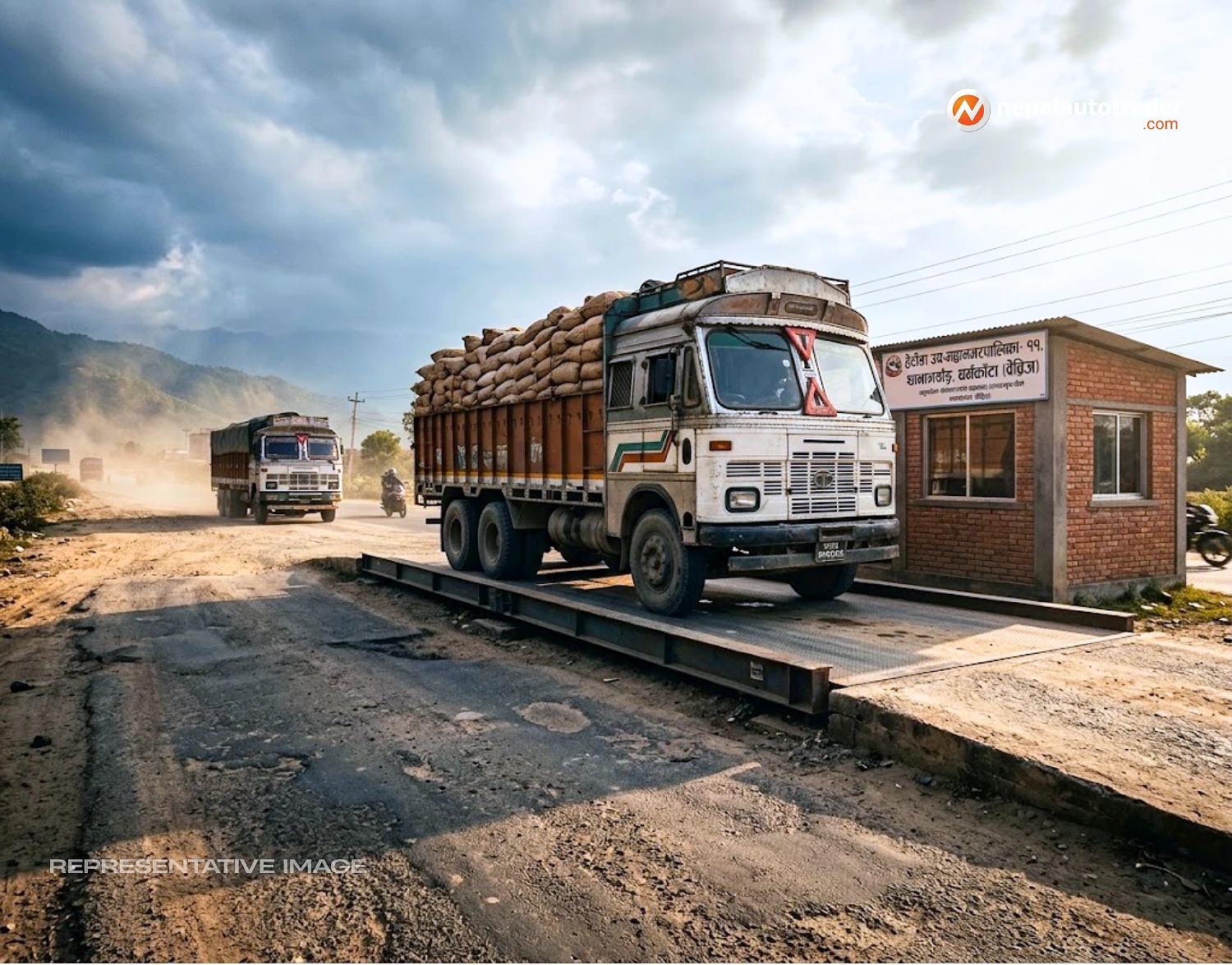
A familiar piece of road infrastructure is back in service, and the timing matters. A weighbridge for cargo vehicles has been brought back into operation at Thānābharyāng in Hetauda Sub-Metropolitan City 11, after the facility had remained closed since 2077.
Narayan Transport Entrepreneurs Association started operating the weighbridge with the agreement of the District Administration Office, Makwanpur. The facility was formally inaugurated on Monday by association chairman Saroj Khanal and Nepal Truck Transport Entrepreneurs Federation general secretary Badriprasad Chaulagain, among others.
The operation follows the government's 2074 rules for weighbridges. That gives the move a regulatory footing, rather than making it simply an industry-led traffic measure.
And there is a clear reason for doing it now.
The Tribhuvan Highway has become an alternative route because the Prithvi Highway is closed following floods and landslides. That has changed the risk profile of the road.
Heavy cargo vehicles already place substantial loads on road infrastructure. When a major highway is disrupted and freight is diverted to another corridor, the consequences of excess loading become more serious. The concern here is not only vehicle control. It is the condition of the route itself.
Narayan Transport Entrepreneurs Association says the weighbridge will help protect the Tribhuvan Highway and support its long-term stability while the road is serving as a lifeline during the disaster period.
That broader context is what makes this development more significant than the reopening of an old weighing station. A road carrying emergency-era traffic has little room for avoidable structural stress.
For wider context, Meroauto's infrastructure coverage tracks the broader pressure on Nepal's road network.
The most important change for freight operators is simple: vehicles exceeding the prescribed load will not be allowed to operate along the Tribhuvan Highway.
For 10-wheel and 12-wheel vehicles, the maximum permitted load on this road is 15 tonnes. Six-wheel and four-wheel vehicles must carry goods only within the capacity stated in their registration book.
| Vehicle type | Permitted load |
|---|---|
| 12-wheel | Maximum 15 tonnes |
| 10-wheel | Maximum 15 tonnes |
| 6-wheel | Registration-book capacity |
| 4-wheel | Registration-book capacity |
The distinction matters. The rule does not establish one universal number for every cargo vehicle. It applies a fixed 15-tonne ceiling to 10-wheel and 12-wheel vehicles on this road, while four-wheel and six-wheel vehicles remain tied to their documented capacity.
That creates a route-specific control point at a time when freight movement is already being reshaped by road closures. Recent disruption across major highways has made alternative corridors increasingly important to the national transport network.
A weighbridge does something that visual inspection cannot. It measures the vehicle's actual weight.
According to the association's chairman, the facility will help identify vehicles carrying more cargo than their permitted capacity and support action against overloading. That makes the weighbridge a practical enforcement tool, not just a piece of roadside equipment.
For freight operators, the immediate implications are operational:
There is also a wider road-safety angle, although the source specifically frames the measure around controlling overload and protecting the highway. The immediate objective is clear, reduce the additional burden placed on a route that is carrying diverted traffic during a period of disruption.
The development also fits into Meroauto's broader traffic coverage, where changing road conditions and enforcement measures are increasingly shaping how vehicles move through Nepal.
The weighbridge is now operational, but its effectiveness will depend on consistent use. The stated purpose is to prevent overloaded vehicles from operating on the Tribhuvan Highway, and the real test will be whether the weighing process translates into sustained compliance.
The timing is particularly important because the route is carrying traffic that would normally use the Prithvi Highway. Until normal highway connectivity is restored, the pressure on alternative roads can remain elevated. Recent reporting has documented the wider disruption caused by flooding and landslides across major road corridors. Flood-damaged highway coverage provides additional context.
There is no separate vehicle launch, pricing programme or competitive market to assess here. This is infrastructure and enforcement, with the road itself effectively becoming the asset that needs protection.
For commercial operators, the message is uncomplicated. Check the permitted capacity before loading, and expect the actual vehicle weight to matter.
For everyone else using the route, the benefit is less visible but potentially more important: keeping a critical highway serviceable when the wider network is already under strain.
The weighbridge cannot fix a damaged national road network. It can, however, prevent one avoidable problem from making a difficult situation worse.
Q: Where is the new weighbridge located?
A: It is operating at Thānābharyāng in Hetauda Sub-Metropolitan City 11, Makwanpur.
Q: Why was the weighbridge reopened?
A: It was reopened to control overloaded cargo vehicles on the Tribhuvan Highway, which is currently being used as an alternative route because the Prithvi Highway is closed after floods and landslides.
Q: What is the maximum load for 10-wheel and 12-wheel vehicles?
A: The source states that 10-wheel and 12-wheel vehicles using the Tribhuvan Highway may carry a maximum of 15 tonnes.
Q: What about four-wheel and six-wheel cargo vehicles?
A: They must carry goods only up to the capacity specified in their registration book.
Q: When was the weighbridge previously closed?
A: The facility at Thānābharyāng had been closed since 2077 before returning to operation.

Nepal Auto-Trader is one-stop platform for all automotive needs. We provide unbiased and unparalleled news/reviews of all auto-motives being launched in Nepalese Auto-Industry. Find recent updates and price of bikes/cars, compare and review recently launched bikes/cars, buy/sell/trade reconditioned cars/bikes and all government news about changing rules and regulation, road safety by subscribing us.

Subscribe to our Newsletter
© Copyright 2026, Nepal Autotrader


.png)
.png)