

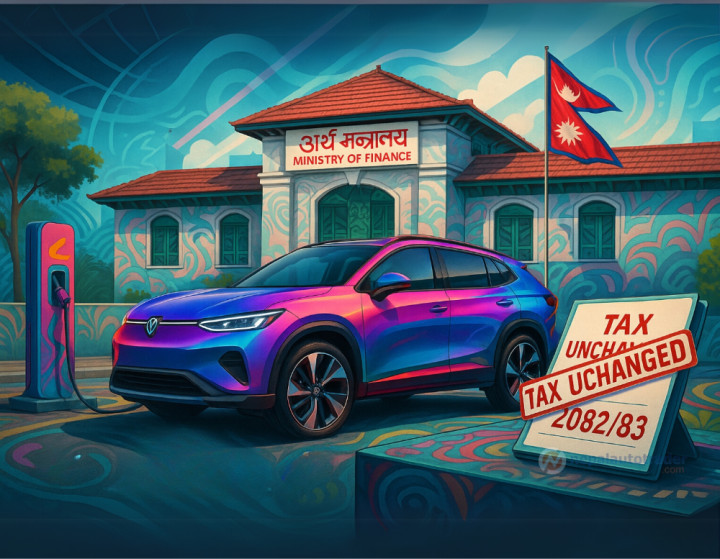
No Increase in EV Taxes: Contrary to earlier proposals, the government has decided to keep the existing customs and excise duties on electric vehicles (EVs) unchanged in the fiscal year 2082/83 budget.
Support for Sustainable Transportation: This decision aligns with Nepal's commitment to promoting clean energy and reducing carbon emissions.
Positive Impact on EV Market: Maintaining the current tax structure is expected to encourage the adoption of EVs and support the growth of the electric mobility sector in Nepal.
Earlier reports had indicated that the government was considering increasing customs and excise duties on EVs across various power categories. For instance, the customs duty for EVs up to 50 kW was expected to rise from 10% to 15%, with an additional 5% excise duty being introduced. Similarly, EVs in the 51–100 kW range were projected to face a 5% increase in both customs and excise duties, raising the total tax burden significantly .
These proposed changes had led to apprehensions among EV importers and consumers, fearing that the increased costs would hinder the adoption of electric mobility in Nepal.
Contrary to earlier expectations, the government has decided to retain the existing tax rates for EVs in the new fiscal budget. The current tax structure is as follows:
| Power Capacity (kW) | Customs Duty | Excise Duty |
|---|---|---|
| Up to 50 kW | 10% | 0% |
| 51–100 kW | 15% | 10% |
| 101–200 kW | 20% | 20% |
| 201–300 kW | 40% | 45% |
| Above 300 kW | 60–80% | 60% |
By maintaining these rates, the government aims to encourage the continued growth of the EV market, making electric vehicles more accessible to the general public and supporting the country's environmental objectives.
The decision to keep EV taxes unchanged has several positive implications:
Market Stability: Importers and dealers can plan their inventories and pricing strategies without the uncertainty of sudden tax hikes.
Consumer Confidence: Potential EV buyers are more likely to proceed with their purchases, knowing that the cost of ownership remains stable.
Environmental Benefits: Continued promotion of EVs aligns with Nepal's goals to reduce carbon emissions and combat air pollution.
This policy decision underscores the government's dedication to fostering a sustainable transportation ecosystem. By avoiding increased financial burdens on EV stakeholders, Nepal positions itself as a forward-thinking nation prioritizing environmental health and energy independence.
The government's approach also reflects an understanding of the broader economic and social benefits of electric mobility, including reduced reliance on imported fossil fuels and the promotion of green jobs within the EV sector.
Nepal's choice to maintain existing EV tax rates in the fiscal year 2082/83 budget is a strategic move that supports the nation's environmental objectives and promotes the adoption of clean transportation. This decision provides stability for the automotive industry and reinforces consumer confidence in transitioning to electric vehicles. As Nepal continues on its path toward sustainable development, such policies play a crucial role in shaping a greener and more resilient future.

Nepal Auto-Trader is one-stop platform for all automotive needs. We provide unbiased and unparalleled news/reviews of all auto-motives being launched in Nepalese Auto-Industry. Find recent updates and price of bikes/cars, compare and review recently launched bikes/cars, buy/sell/trade reconditioned cars/bikes and all government news about changing rules and regulation, road safety by subscribing us.

Subscribe to our Newsletter
© Copyright 2026, Nepal Autotrader


.png)
.png)