

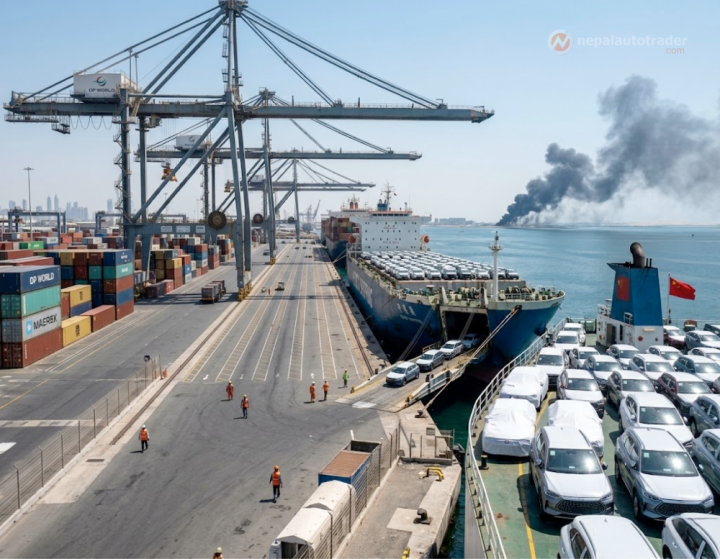
The war between Iran and Israel has intensified beyond the battlefield. Attacks on the strategic Jebel Ali container terminal in Dubai forced the port to close temporarily on March 1. That port was the gateway for most Chinese cars destined for the Middle East, West Africa and North Africa. With the hub offline, the entire transshipment flow stalled.
Chinese automakers have long relied on Dubai’s efficient customs regime, deep‑sea links, and proximity to Gulf markets. The sudden loss of that corridor means trucks sit idle, containers pile up, and dealers wait for inventory that simply cannot arrive.
That matters because the region accounts for a sizable slice of China’s overseas automotive ambition. When a single node goes dark, the whole network feels the tremor.
First, the UAE is now China’s third‑largest automotive export destination. According to the China Passenger Car Association, 567,000 units flowed into the Emirates last year – a 70 percent surge over 2022. Those numbers are not just statistics; they translate into revenue, jobs, and brand exposure for manufacturers ranging from Geely to Dongfeng.
Second, the European Union still dwarfs the Gulf in sheer volume. In 2025 the EU imported more than 1.3 million Chinese cars, cementing its role as the continent’s third biggest regional market for Beijing’s manufacturers. The association warned that the Dubai blockage is already spilling over into European logistics, as shippers scramble for alternative routes.
Finally, the ripple effect reaches West Africa and North Africa, where many dealers depend on Dubai‑based consolidation hubs. Without a reliable gateway, lead‑times could double, and price tags may climb as freight costs rise.
| Metric | 2023 | 2022 |
|---|---|---|
| Chinese cars to UAE | 567,000 units | 332,000 units |
| Growth YoY | 70 percent | - |
| Chinese cars to EU (2025) | 1,300,000+ units | — |
For a deeper look at how Chinese EVs are positioning themselves in Nepal, see the recent coverage of the [Geely EX5 Max Pro](https://nepalauto.com/geely-ex5-max-pro-excellent-bonanja) launch.
| Phase | Date | Status / Details |
|---|---|---|
| Port closure | 1 Mar 2024 | Jebel Ali attacked, operations halted |
| Partial reopening | Mid‑April 2024 (expected) | Limited berths resume, security checks tightened |
| Reroute implementation | Q3 2024 | Chinese firms test rail‑to‑Mediterranean corridors |
| Long‑term strategy | 2025 onward | Invest in **Turkey‑Egypt** hub, diversify logistics |
The short‑term pain is evident, but the crisis may accelerate a strategic shift. Companies that can secure alternative pathways will preserve market share and avoid the cost inflation that rivals in India or South‑East Asia are already feeling.
For readers interested in the broader electric‑vehicle surge, the upcoming [480 km electric scooter](https://nepalauto.com/longest-range-480-km-range-electric-scooter-coming-soon) launch offers a glimpse of how Asian manufacturers are hedging against supply‑chain volatility.
Q: Which Chinese brands rely most on the Dubai hub? A: Major exporters such as Geely, Dongfeng, Great Wall and Changan ship the bulk of their Gulf volume through Jebel Ali.
Q: When is the port expected to operate at full capacity again? A: Industry sources project a full return by late 2024, assuming regional security stabilises.
Q: How will the disruption affect vehicle pricing in the Middle East? A: Dealers are likely to raise retail prices by 3‑5 percent to cover higher freight and storage costs.
Q: Are there alternative routes that can match Dubai’s efficiency? A: Overland rail via Turkey and sea lanes through the Suez Canal are being trialled, but they lack the speed and cost‑effectiveness of the Gulf hub.
Q: Will European exports be impacted as well? A: Indirectly, yes. Freight firms are reallocating container space, which can increase rates for shipments bound for the EU.
Q: What should consumers in Nepal expect from Chinese imports? A: Expect slightly longer lead‑times and modest price adjustments, but the core model lineup should remain unchanged.

Nepal Auto-Trader is one-stop platform for all automotive needs. We provide unbiased and unparalleled news/reviews of all auto-motives being launched in Nepalese Auto-Industry. Find recent updates and price of bikes/cars, compare and review recently launched bikes/cars, buy/sell/trade reconditioned cars/bikes and all government news about changing rules and regulation, road safety by subscribing us.

Subscribe to our Newsletter
© Copyright 2026, Nepal Autotrader


.png)
.png)