

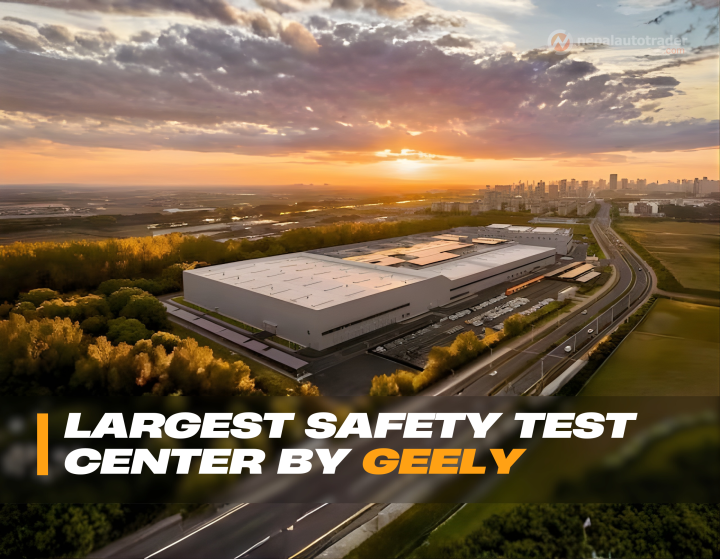
Modern vehicles are expected to protect occupants, pedestrians, and cyclists while also preventing crashes altogether. The Geely Safety Centre exists to handle that responsibility at scale. It goes beyond regulatory testing and focuses on real world accident scenarios that drivers actually face.
This approach turns safety from a compliance task into a core design advantage.
Scale matters when safety is tested daily. The Geely Safety Centre houses multiple crash labs that operate in parallel. Each lab is fitted with high speed cameras, precision sensors, and data acquisition systems capable of capturing thousands of data points in milliseconds.
Key testing areas include
Every test feeds into a unified data platform for rapid design refinement.
The centre recreates real world collisions rather than ideal laboratory conditions. Instrumented crash dummies measure forces across the head, chest, pelvis, and legs, allowing engineers to understand how injuries occur and how to reduce them.
Pedestrian safety receives equal attention, with extensive testing of bumpers, bonnets, and windscreen zones to reduce injury severity in urban traffic.
Safety today starts before impact. The Geely Safety Centre validates advanced driver assistance systems under controlled but complex scenarios.
Testing includes
By simulating unpredictable environments, the centre helps vehicles react faster and more consistently when risk appears.
Every crash produces insight. The Geely Safety Centre combines physical testing with digital simulations to predict structural weaknesses and improve designs early.
Engineers use this data to
This data led process shortens development cycles while improving safety outcomes.
Vehicles tested at the Geely Safety Centre are designed for international markets from day one. Testing protocols align with global NCAP standards, making it easier for vehicles to perform strongly in overseas safety assessments.
This global alignment ensures consistent safety quality regardless of market.
As electric vehicles become mainstream, battery safety becomes critical. The centre tests battery protection during crashes, high voltage isolation, and thermal stability under extreme stress.
These tests are essential for protecting occupants and emergency responders in EV incidents.
Vehicles sold in Nepal increasingly come from global platforms. Safety engineering carried out at facilities like the Geely Safety Centre directly benefits local buyers, even when local regulations are still evolving.
Stronger structures, smarter driver assistance, and proven crash protection reach Nepali roads long before they become mandatory.
The Geely Safety Centre is not a showroom feature. It is a quiet force behind safer vehicles across multiple brands and markets. By focusing on real accidents, intelligent systems, and global standards, it helps ensure that safety improvements are not just promised but delivered.

Nepal Auto-Trader is one-stop platform for all automotive needs. We provide unbiased and unparalleled news/reviews of all auto-motives being launched in Nepalese Auto-Industry. Find recent updates and price of bikes/cars, compare and review recently launched bikes/cars, buy/sell/trade reconditioned cars/bikes and all government news about changing rules and regulation, road safety by subscribing us.

Subscribe to our Newsletter
© Copyright 2026, Nepal Autotrader


.png)
.png)