

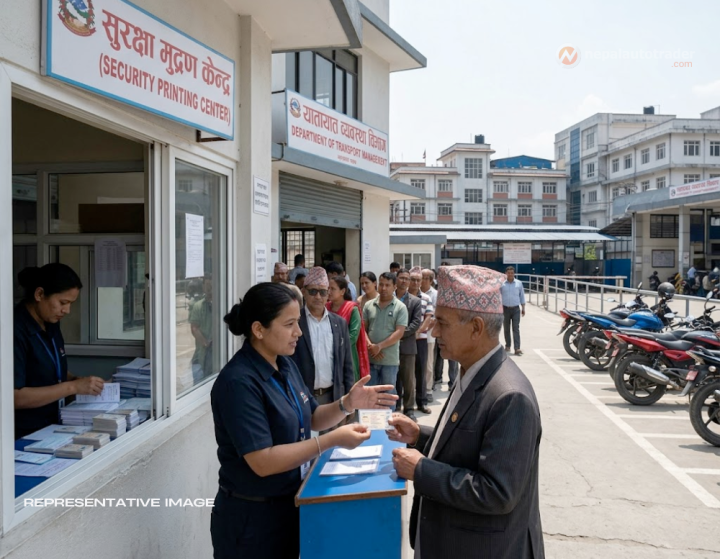
The story of Nepal’s driving license system has been defined by one thing, delay. Not minor inconvenience, not administrative lag, but a structural bottleneck that has left millions waiting. That matters.
At the center of this crisis is the Department of Transport Management, struggling to reconcile demand with capacity. Applicants who passed trials years ago still rely on paper slips. Physical smart cards, the actual proof of mobility, have remained out of reach.
Estimates show that around 3 million licenses are pending for printing and distribution. This backlog includes new applicants and renewals accumulated over multiple years. The scale is not small. It is systemic.
The shift to smart licenses in 2021 was meant to modernize the system. Instead, it exposed infrastructure gaps, budget constraints, and operational inefficiencies. This changes things.
To address the crisis, the government moved production to the Security Printing Center. An agreement with the transport department triggered the first major step, large-scale printing.
The initial target is clear, print 1.2 million licenses within six months. The remaining 1.8 million licenses are planned, but only if additional funding is secured.
| Phase | Volume | Status |
|---|---|---|
| Phase 1 | 1.2 million licenses | Printing underway |
| Phase 2 | 1.8 million licenses | Pending budget approval |
| Total Backlog | 3 million licenses | In process |
The cost structure is also defined. Each license carries a printing cost of Rs 195.17 excluding tax. Completing the remaining backlog will require significant financial allocation from the ministry.
Printing, however, is only half the equation. Distribution remains the real friction point. Cards move from the printing center to the department, then to provincial transport offices, and finally to applicants. Every layer adds time. Every delay compounds frustration.
While mass printing ramps up, the department has maintained a stopgap solution. Emergency licenses are being issued daily. But the numbers tell the real story.
This approach keeps the system alive, but it does not solve the backlog. At current rates, clearing millions would take years. The gap between demand and supply remains wide. That matters.
The demand itself is relentless. Thousands of new applicants enter the system daily, adding pressure to an already strained pipeline.
Even as printing accelerates, one key question remains unresolved, who gets their license first?
The department is currently evaluating two distribution models:
No final decision has been made. That uncertainty matters more than it seems. It directly affects fairness, efficiency, and public trust.
For applicants waiting years, the difference between these models is not theoretical. It determines whether they receive their license now or continue waiting indefinitely.
The broader issue is not just printing capacity. It is infrastructure.
Nepal’s license system operates across 42 transport offices, each handling applications, renewals, and distribution. Coordination between federal and provincial levels adds complexity. Delays in one segment ripple across the entire network.
Recent disruptions, including system outages and damage to infrastructure, have worsened the situation. Digital systems like the Electronic Driving License platform have faced interruptions, slowing down processing and verification.
There is, however, a shift underway. Initiatives like QR-coded licenses and integrated digital systems aim to improve security and efficiency.
The system is evolving. Slowly, but visibly.
The government’s current push signals urgency. Printing has started. Distribution is being restructured. Budget requests are in motion.
But the timeline remains tight. Clearing a backlog of millions while handling ongoing demand is not a short-term fix.
For context, similar structural bottlenecks have been seen in other administrative reforms, including Nepal’s EV adoption challenges and vehicle registration delays. The pattern is familiar. Execution is the real test.
The next phase will define whether this is a temporary acceleration or a lasting transformation.
Because for millions of applicants, this is not about policy. It is about mobility, legality, and everyday life.
And right now, the system is still catching up.
Q: How many driving licenses are currently pending in Nepal?
A: Around 3 million licenses are pending for printing and distribution, including both new applications and renewals accumulated over several years.
Q: How many licenses will be printed in the first phase?
A: The first phase targets 1.2 million licenses to be printed within six months under the agreement with the Security Printing Center.
Q: What is the cost of printing each license?
A: Each license costs Rs 195.17 to print, excluding tax, according to the agreement.
Q: How are licenses currently being distributed?
A: Emergency licenses are being issued at a rate of about 500 per day, while large-scale distribution will be handled through provincial transport offices.
Q: Who will receive licenses first once distribution begins?
A: The government has not finalized the priority system yet, but it is considering distribution by application order or by provinces with the highest backlog.
Q: When will all pending licenses be cleared?
A: The timeline depends on budget approval for the remaining 1.8 million licenses. Without additional funding, full clearance within the current fiscal year remains uncertain.

Nepal Auto-Trader is one-stop platform for all automotive needs. We provide unbiased and unparalleled news/reviews of all auto-motives being launched in Nepalese Auto-Industry. Find recent updates and price of bikes/cars, compare and review recently launched bikes/cars, buy/sell/trade reconditioned cars/bikes and all government news about changing rules and regulation, road safety by subscribing us.

Subscribe to our Newsletter
© Copyright 2026, Nepal Autotrader


.png)
.png)