

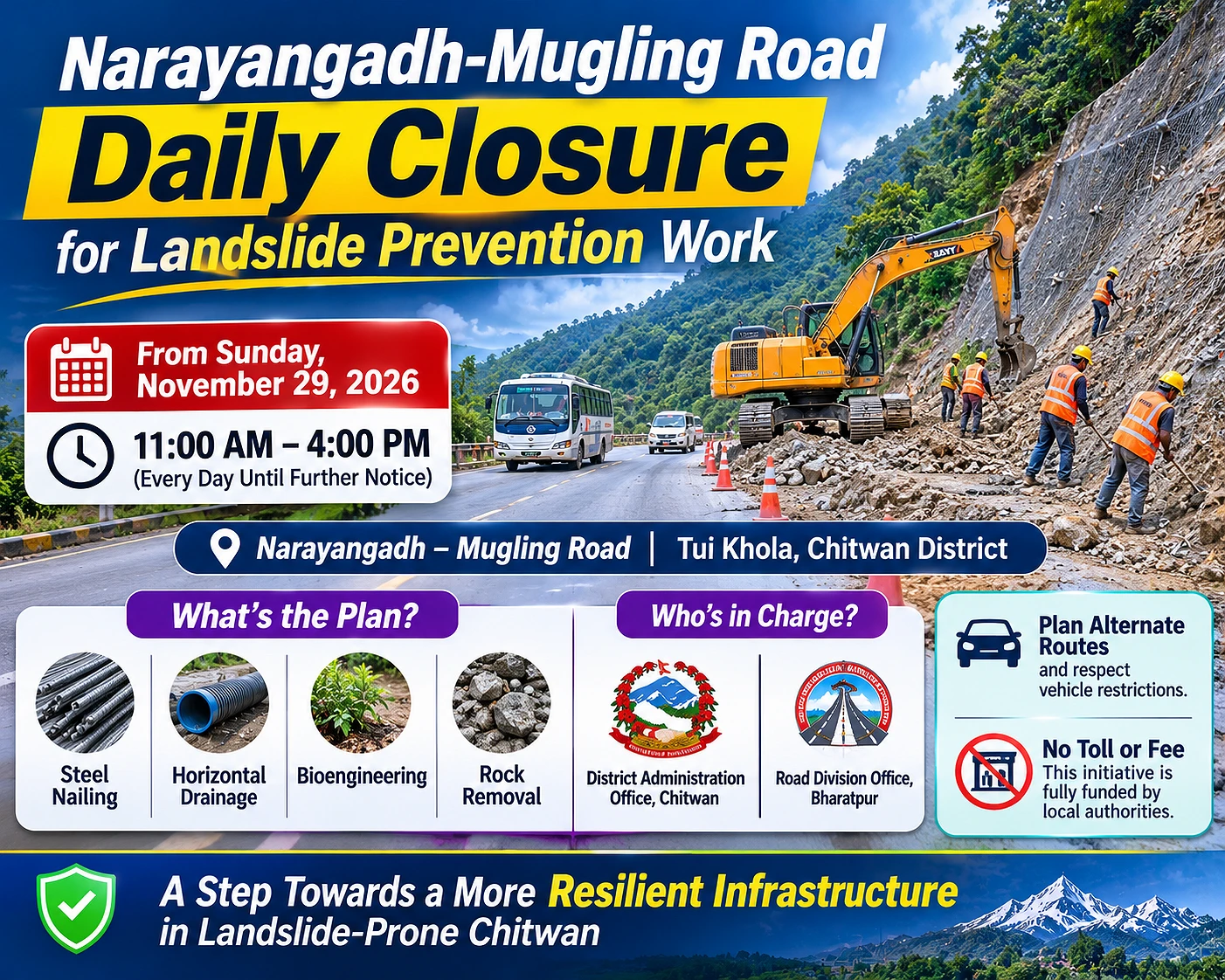
The Narayangadh-Mugling road is a lifeline for residents, traders, and tourists traveling through the Tui Khola area of Chitwan District. Over the past decade, repeated slope failures have disrupted traffic and threatened nearby villages. Recent geological surveys identified a stretch of the road that is especially vulnerable to heavy rains and seismic activity. To prevent a catastrophic landslide, the local government has launched a targeted stabilization program. The timing aligns with the onset of the monsoon season, when the risk of slope movement spikes. By acting now, officials hope to avoid costly emergency repairs and protect lives.
The project will run daily, closing the road to all vehicles for a five‑hour window between 11:00 AM and 4:00 PM. This schedule allows crews to work safely while minimizing disruption during peak traffic periods. The closure starts on November 29, 2026 and will continue until the stabilization measures are deemed complete. No alternative tolls or fees will be imposed; the effort is fully financed by the District Administration Office, Chitwan and the Road Division Office, Bharatpur. The work area stretches roughly 2 km along the riverbank, covering the most unstable sections identified in recent assessments.
| Technique | Purpose |
|---|---|
| **Steel nailing** (driving steel rods into the slope) | Anchors the soil mass, reducing the likelihood of detachment. |
| **Horizontal drainage** systems | Channels water away from the slope, preventing saturation that can trigger slides. |
| **Bioengineering** measures | Uses vegetation and natural materials to reinforce soil structure. |
| **Rock removal** (clearing large boulders from the slope) | Eliminates potential impactors that could destabilize the hillside. |
Each technique addresses a specific failure mode. Steel nailing creates a mechanical bond within the earth, acting like a net that holds loose material in place. Horizontal drainage reduces pore‑water pressure, a key trigger for landslides during intense rainfall. Bioengineering adds a living component; deep‑rooted grasses and shrubs bind the soil while absorbing excess moisture. Finally, rock removal clears the path of heavy stones that could roll downhill if the slope gives way. Together, these interventions form a layered defense system designed to endure years of weathering.
For daily commuters, the vehicle restrictions mean re‑routing around the closed segment. The most common detour follows the older Mugling‑Bharatpur highway, adding roughly 15 km and 30 minutes to a typical round‑trip. Public transport operators have already announced adjusted timetables, and several private bus companies are offering shuttle services between Narayangadh and Mugling during the closure hours. Local businesses near the road are advised to post clear signage and consider temporary delivery windows outside the five‑hour window. While the inconvenience is tangible, officials stress that the short‑term disruption prevents a far larger disruption should a landslide occur.
The joint effort between the District Administration Office, Chitwan and the Road Division Office, Bharatpur reflects a growing trend of inter‑agency collaboration on infrastructure safety. Weekly coordination meetings track progress, allocate resources, and address community feedback. Engineers from the Road Division oversee the technical execution, while administrators from the District Office manage permits, community outreach, and emergency response plans. A dedicated hotline has been set up for residents to report any concerns or observations related to the works. This shared responsibility model helps ensure that both engineering standards and local needs are met.
The schedule is provisional; adverse weather could extend the closure period. Authorities will issue public notices well in advance of any changes. Once the stabilization measures are verified, the road will reopen for unrestricted traffic, offering a safer travel corridor for years to come.
Q1: Why is the road closed for exactly five hours each day? A: The five‑hour window balances safety for the work crew with the need to keep the road usable during peak traffic times. Closing from 11:00 AM to 4:00 PM avoids the early‑morning rush and late‑evening commuter flow.
Q2: Will there be any tolls or fees for the detour routes? A: No. The closure is a public safety measure funded entirely by local authorities. Drivers can use alternate roads without additional charges.
**Q3: How will the *steel nailing* be performed without damaging the existing pavement?** A: Technicians drill into the slope at a safe distance from the road surface, then drive hardened steel rods into pre‑drilled holes. The process is confined to the hillside, leaving the pavement intact.
Q4: What should residents do if they notice fresh cracks or movement on the slope? A: Contact the dedicated hotline (provided by the District Administration Office, Chitwan) immediately. Prompt reporting helps engineers address emerging issues before they become hazards.
Q5: When can we expect the road to reopen fully? A: The target is April 2027, pending successful completion of all technical measures and a final safety audit.
Q6: Are there any plans for future maintenance after the project ends? A: Yes. The agencies have outlined a routine inspection schedule, including periodic drainage cleaning and vegetation monitoring, to preserve the infrastructure resilience achieved by the current works.

Nepal Auto-Trader is one-stop platform for all automotive needs. We provide unbiased and unparalleled news/reviews of all auto-motives being launched in Nepalese Auto-Industry. Find recent updates and price of bikes/cars, compare and review recently launched bikes/cars, buy/sell/trade reconditioned cars/bikes and all government news about changing rules and regulation, road safety by subscribing us.

Subscribe to our Newsletter
© Copyright 2026, Nepal Autotrader


.png)
.png)