

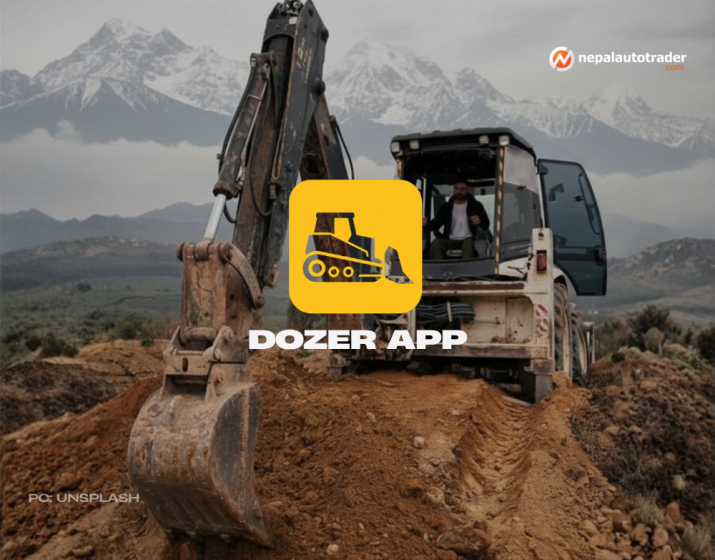
Every monsoon tells the same story across Nepal. Roads disappear under landslides. Rural connections are cut. Construction equipment suddenly becomes one of the most valuable assets on the ground.
That is the backdrop against which Dozer App has entered the conversation.
The newly introduced platform is designed to help connect users with heavy equipment services when weather-related disruptions create urgent operational needs. In a country where monsoon rains routinely affect transportation networks, faster access to machinery can make a meaningful difference.
And that's important.
Technology has already transformed ride-sharing, deliveries and vehicle service support. The emergence of a platform focused on heavy equipment suggests the digital economy is beginning to address a different set of mobility challenges.
Monsoon conditions in Nepal are not merely inconvenient. They can quickly become infrastructure emergencies.
Landslides, flooded roads and debris accumulation often require immediate intervention from excavators, dozers and other heavy machinery. Access to those resources has traditionally depended on local contacts, manual coordination and availability on the ground.
The challenge is straightforward. Finding the right equipment at the right time is often difficult.
| Monsoon Challenge | Typical Requirement | Potential Digital Benefit |
|---|---|---|
| Landslide debris | Heavy equipment support | Faster operator discovery |
| Blocked roads | Rapid clearing operations | Improved response coordination |
| Remote-area disruptions | Equipment availability tracking | Better visibility of resources |
| Emergency access | Operator communication | Digital connectivity |
Not everyone will notice it immediately. But digital access to construction machinery can be just as important as digital access to transportation services when roads are under pressure.
The launch also highlights how Nepal’s automotive and mobility ecosystem continues to evolve beyond conventional vehicle ownership.
In recent years, the market has seen growth in ride-hailing platforms, vehicle service applications and roadside assistance solutions. The arrival of a heavy-equipment focused platform expands that trend.
Here's the thing. Monsoon preparedness is increasingly becoming a technology issue as much as an infrastructure issue.
When equipment owners, operators and users can interact through a centralized platform, information moves faster. During emergencies, speed matters.
While the focus remains on improving access and coordination, the broader concept revolves around simplifying the process of locating and deploying machinery when needed.
That may sound simple. In practice, however, reducing the time spent searching for available equipment can have real-world consequences for communities dealing with blocked roads or localized emergencies.
The value proposition is less about technology itself and more about removing friction from an already difficult process.
There is a broader lesson here.
Nepal’s monsoon challenges are unlikely to disappear. Weather events continue to test transportation networks and local infrastructure every year. As a result, digital tools that improve preparedness, communication and response capability are becoming increasingly relevant.
| Area | Traditional Approach | Digital Approach |
|---|---|---|
| Equipment Search | Personal contacts | Platform-based discovery |
| Coordination | Phone-based communication | Centralized digital interaction |
| Availability | Manual verification | Potential real-time visibility |
| Response | Fragmented process | Streamlined workflow |
That matters.
The automotive sector often focuses on vehicles, launches and sales figures. Yet infrastructure support systems can be just as significant, especially in a country where geography frequently shapes mobility outcomes.
The success of Dozer App will ultimately depend on adoption, operator participation and real-world performance during periods of peak demand.
If the platform can reliably connect users with available machinery when roads are blocked or emergency intervention is required, it could become a useful addition to Nepal’s growing digital mobility landscape.
The timing certainly makes sense. As monsoon pressures return each year, demand for faster coordination and practical problem-solving tools is unlikely to shrink.
Sometimes innovation is not about building something entirely new. Sometimes it is about helping people find the resources that already exist, exactly when they need them.
Q: What is the Dozer App?
A: Dozer App is a digital platform designed to help connect users with heavy equipment services, particularly during situations where machinery may be required for road clearance or related work.
Q: Is the app focused on monsoon-related challenges?
A: Yes. The platform has been highlighted in the context of Nepal’s monsoon season, when landslides, flooding and road disruptions frequently create demand for heavy equipment.
Q: Has pricing information been announced?
A: No specific pricing details were available in the source material.
Q: Who can benefit from the platform?
A: Potential users include individuals, contractors, local stakeholders and organizations that require access to heavy equipment services.
Q: Does the app replace emergency response agencies?
A: No. The platform is intended to improve coordination and access to machinery, not replace official emergency response systems.
Q: Why is this significant for Nepal?
A: Nepal experiences recurring monsoon-related infrastructure challenges, making faster equipment coordination a potentially valuable tool for improving response efficiency.

Nepal Auto-Trader is one-stop platform for all automotive needs. We provide unbiased and unparalleled news/reviews of all auto-motives being launched in Nepalese Auto-Industry. Find recent updates and price of bikes/cars, compare and review recently launched bikes/cars, buy/sell/trade reconditioned cars/bikes and all government news about changing rules and regulation, road safety by subscribing us.

Subscribe to our Newsletter
© Copyright 2026, Nepal Autotrader


.png)
.png)