

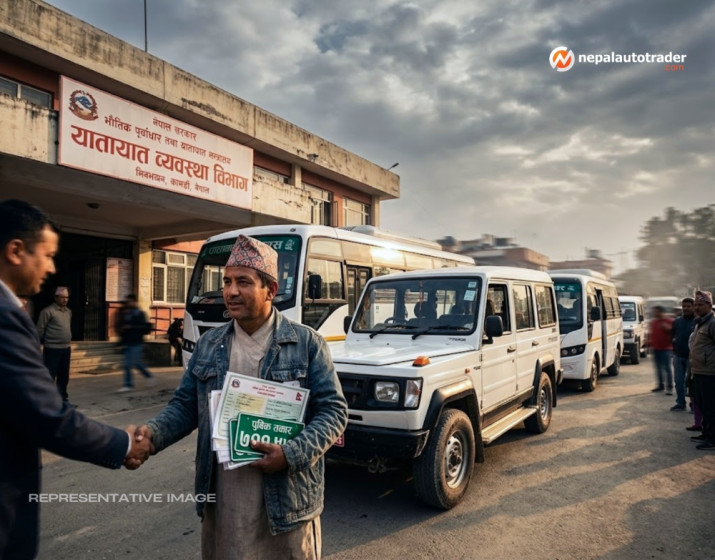
Few policy decisions have rattled Nepal’s transport sector this year quite like the sudden move by the Department of Transport Management to halt new registrations of public vehicles.
The directive, issued in May, instructed provincial transport ministries and local authorities across the country to stop registering new public transport vehicles until further notice. The restriction covered everything from conventional buses and microbuses to electric public transport vehicles.
For operators, financiers and vehicle distributors, the announcement landed without much warning.
The public transport sector had already been dealing with rising operating costs, shifting demand patterns and increasing pressure to modernize fleets. A sudden registration freeze effectively put many investment decisions on hold.
According to DoTM, the move was necessary because public transportation lacked scientific management, resulting in worsening traffic congestion, growing air pollution and mounting pressure on road infrastructure. Authorities also pointed to increasing fuel costs as part of the challenge facing the sector.
The government's reasoning centered on transport system management rather than vehicle technology.
Importantly, the restriction did not only target diesel or petrol-powered vehicles. It also applied to public EVs, a detail that quickly drew criticism from several industry observers and transport entrepreneurs.
| Issue Cited by DoTM | Reason for Concern | Policy Response |
|---|---|---|
| Traffic Congestion | Increasing vehicle density on roads | Registration freeze |
| Air Pollution | Environmental pressure | Temporary suspension |
| Transport Management | Lack of scientific planning | Framework review |
| Fuel Costs | Operational difficulties | Sector restructuring effort |
The department relied on provisions within the Vehicle and Transport Management Act, 1993, which allow authorities to suspend vehicle registrations when environmental concerns, traffic pressure or public interest considerations justify intervention.
On paper, the legal basis existed.
In practice, the reaction was far more complicated.
Not every province accepted the federal directive without question.
Just weeks after the nationwide suspension, Bagmati Province resumed public vehicle registrations, effectively breaking ranks with the federal government.
The provincial government argued that transport entrepreneurs were facing mounting financial pressure. Loan repayments, bank interest and employee expenses continued even while registrations remained frozen.
Here's the thing.
Transport registration is one of the areas where Nepal's federal structure creates overlapping responsibilities. Provincial governments have authority over registration and taxation matters, making federal intervention a politically sensitive issue.
The Bagmati decision exposed that tension in full view.
| Timeline | Development | Status |
|---|---|---|
| May 2026 | DoTM orders nationwide registration halt | Implemented |
| May 2026 | All provinces receive directive | Completed |
| June 2026 | Bagmati resumes registrations | Active |
| Ongoing | New transport framework under discussion | Pending |
The development has become one of the clearest examples of the growing federal versus provincial debate within Nepal's transport sector.
One aspect of the policy attracted particularly strong scrutiny.
The inclusion of electric buses and other public EVs surprised many observers because the official justification referenced fuel prices and pollution concerns.
Critics questioned why cleaner public transport options were grouped with conventional vehicles if environmental improvement was one of the policy objectives.
Not everyone will notice it immediately.
But this detail matters for Nepal's broader electrification ambitions.
The country has spent years encouraging EV adoption through tax policies, infrastructure investments and public awareness campaigns. A registration freeze that also affects electric public transport creates uncertainty for fleet operators considering new investments.
Government officials insist the freeze was never intended as a permanent measure.
Instead, authorities say the objective is to create a more organized and scientifically managed transport system before reopening registrations fully.
Recent government data shows the scale of the challenge. More than 281,921 vehicles were registered during the first eight months of the fiscal year through mid-March, while Nepal's total registered vehicle fleet reached approximately 6.25 million vehicles.
Those numbers help explain why policymakers are increasingly concerned about road capacity and traffic management.
And that's important.
The registration debate is no longer just about paperwork. It has become a test case for how Nepal intends to manage transport growth in the years ahead.
Transport operators, vehicle distributors and provincial governments are now waiting for clarity.
Officials have indicated that work is underway on a revised management framework that could reshape how public transport registrations are handled going forward. However, no final nationwide structure has yet been announced.
Until that framework emerges, uncertainty remains.
For operators planning fleet expansion, especially in the electric mobility space, policy consistency may prove just as important as vehicle technology itself.
The registration freeze began as an administrative directive. It has since evolved into a much larger conversation about governance, infrastructure and the future direction of Nepal's transport network.
Q: Why did DoTM stop public vehicle registrations?
A: The department said rising congestion, air pollution, road pressure and weaknesses in public transport management made a temporary suspension necessary. The move was implemented under provisions of the Vehicle and Transport Management Act.
Q: Did the suspension include electric public vehicles?
A: Yes. The directive applied to both conventional and electric public transport vehicles, which became one of the most debated aspects of the decision.
Q: Which province resumed registrations first?
A: Bagmati Province resumed public vehicle registrations after deciding not to continue waiting for a new federal framework.
Q: Is the registration freeze permanent?
A: No. Authorities have described the suspension as temporary while a new management framework for public transport is being prepared.
Q: What legal provision allowed the suspension?
A: DoTM cited provisions in the Vehicle and Transport Management Act, 1993, which permit vehicle registration suspensions when public interest, environmental or traffic concerns require intervention.

Nepal Auto-Trader is one-stop platform for all automotive needs. We provide unbiased and unparalleled news/reviews of all auto-motives being launched in Nepalese Auto-Industry. Find recent updates and price of bikes/cars, compare and review recently launched bikes/cars, buy/sell/trade reconditioned cars/bikes and all government news about changing rules and regulation, road safety by subscribing us.

Subscribe to our Newsletter
© Copyright 2026, Nepal Autotrader


.png)
.png)