

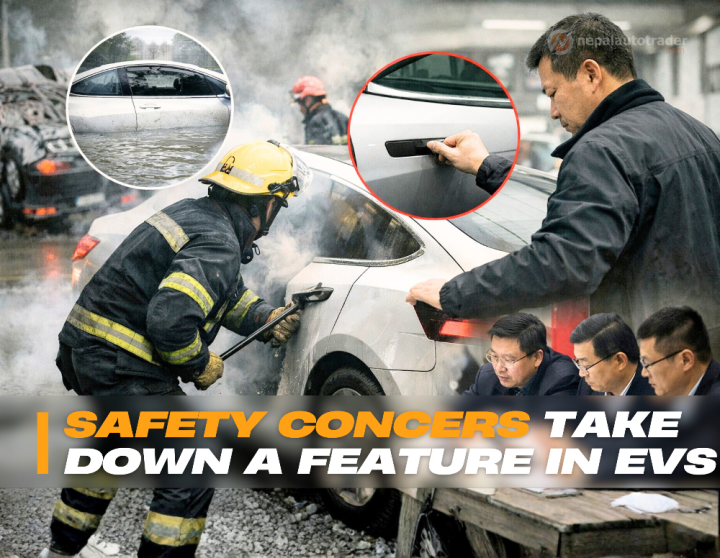
China will ban electric flush door handles on new vehicles starting 2026
Regulators cite safety failures during crashes, fires, floods, and power loss
Most affected vehicles are electric cars from Tesla, BYD, Xiaomi, NIO, and XPeng
Emergency responders report delayed rescue times due to non-functioning handles
Automakers must return to mechanical or manual override door designs
The rule could influence global EV design, including vehicles sold in Nepal
The move reflects a wider shift toward practical EV safety over styling
China’s automotive regulators want one thing from new cars.
They want doors that open when people need to get out.
Electric flush door handles rely on power, sensors, and motors. When those systems fail, doors stay shut. Investigators found this happening after crashes, during fires, and in floods. That risk pushed regulators to act.
You see this design mostly on electric vehicles. It looks clean and modern. But it breaks down in real emergencies.
China’s Ministry of Industry and Information Technology confirmed that new vehicle safety standards for 2025 will not allow fully electric door handles without a mechanical backup.
EV fires where doors would not unlock
Flooded vehicles with disabled electronics
Cold weather failures in northern China
Rescue teams forced to break windows instead of opening doors
This is not a theory. These failures happened on public roads.
If you drive or follow electric cars, you already know the names.
These brands use electric flush door handles across many models:
Tesla
BYD
Xiaomi Auto
NIO
XPeng
Zeekr
Most of these companies sell best-selling EVs in China. They now need to redesign door systems fast.
Automotive safety researcher Li Ming from China Automotive Technology Center says,
“Design should never slow down escape. Mechanical access must always exist.”
Electric flush handles depend on one thing. Power.
When a crash cuts the battery, the system shuts down. When water enters the door module, sensors stop working. When fire damages wiring, the handle does nothing.
Battery disconnect after impact
Water ingress during floods
Heat damage from fires
Frozen actuators in winter
Mechanical handles avoid all of this. You pull. The door opens.
That difference matters when seconds decide survival.
You will still see smooth body panels and aerodynamic shapes. What you will not see is a door that depends only on electronics.
Automakers now have three clear options:
Traditional mechanical handles
Flush handles with a manual pull cable
Hybrid designs with visible emergency releases
Expect option two to dominate.
In 2024, over 68 percent of global EV recalls involved electronic component failures according to China’s State Administration for Market Regulation. Safety rules are tightening because EV sales keep rising.
Nepal imports most electric vehicles from China. That means you will feel this change.
Future EVs arriving in Nepal will likely:
Use simpler door handle designs
Reduce electronic complexity
Improve reliability in monsoon conditions
That is good news if you drive in heavy rain or uneven terrain.
You may lose a flashy design detail. You gain safety.
Nepal-based EV infrastructure consultant Suresh Shrestha explains,
“Practical design matters more than style in our road and weather conditions.”
| Feature | Electric Flush Handles | Mechanical Handles |
|---|---|---|
| Emergency reliability | Low | High |
| Works without power | No | Yes |
| Flood resistance | Weak | Strong |
| Repair cost | High | Low |
| Regulatory approval | Declining | Approved |
China’s ban sends a clear message.
EV design must work when things go wrong. Not just when everything looks perfect.
Flush door handles once signaled progress. Now they signal risk. As electric vehicles mature, you will see fewer gimmicks and more solid engineering.
That is how the EV market grows up.
They fail during crashes, fires, floods, and power loss, making escape harder.
The updated vehicle safety rules apply to new approvals starting in 2025.
Only fully electric systems without mechanical backup are affected.
Yes. Both brands must redesign door systems for the Chinese market.
Yes. Most China-made EVs exported to Nepal will follow the new rules.
Yes. They work without electricity and open immediately in emergencies.

Nepal Auto-Trader is one-stop platform for all automotive needs. We provide unbiased and unparalleled news/reviews of all auto-motives being launched in Nepalese Auto-Industry. Find recent updates and price of bikes/cars, compare and review recently launched bikes/cars, buy/sell/trade reconditioned cars/bikes and all government news about changing rules and regulation, road safety by subscribing us.

Subscribe to our Newsletter
© Copyright 2026, Nepal Autotrader


.png)
.png)