

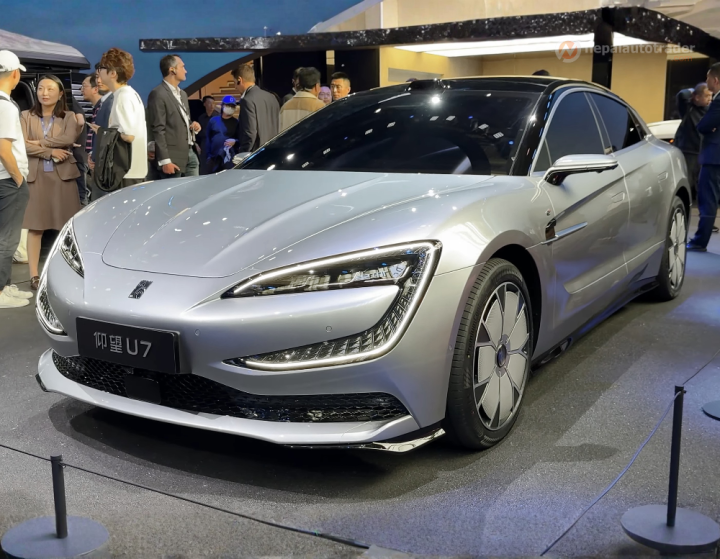
The Yangwang U7 arrives under BYD’s premium Yangwang sub‑brand, a name that already carries weight in China’s high‑end EV arena. The model is positioned as a full‑size, all‑electric SUV that blends raw performance with a theatrical visual display. A short video posted on X (formerly Twitter) shows the vehicle responding to a hand wave by lifting, tilting, and even “dancing” across a flat surface. The clip went viral within hours, sparking a flood of comments that range from awe to disbelief. BYD insists the choreography is not a gimmick but a direct result of its latest sensor‑driven suspension platform. That matters because it demonstrates how software can turn a conventional chassis into a kinetic stage.
At the heart of the spectacle are high‑sensitivity sensors mounted around the vehicle’s perimeter. When a driver or passenger gestures, the sensors translate the motion into electronic commands. Those commands feed a fully independent suspension system that can raise or lower each wheel individually, as well as pivot them laterally. The result is a fluid, wave‑like motion that looks more like a performance art piece than a mechanical reaction. The technology is built on BYD’s existing e‑Platform 4.0, but it adds a layer of real‑time actuation that few rivals have attempted. This changes things for the premium EV market, where the line between mobility and experience is increasingly blurred.
The Yangwang U7 packs four electric motors—one at each wheel—working together to produce a staggering 1,341 hp. Torque is distributed instantly, giving the SUV a launch time of 2.9 seconds from 0 to 100 km/h. The powertrain also incorporates rear‑wheel steering, which turns the rear axle in the opposite direction of the front wheels at low speeds, dramatically reducing turning circles. At higher speeds the rear wheels turn in the same direction as the front, enhancing stability during lane changes. The combination of raw horsepower and advanced steering makes the U7 feel more like a supercar in an SUV body. That matters for buyers who want both space and track‑ready performance.
Energy storage comes from a 150 kWh lithium‑ion pack, one of the largest capacities available in a production EV today. BYD claims a single‑charge range exceeding 1,006 km under the NEDC test cycle, a figure that places the U7 among the longest‑range models on the market. Efficiency figures are equally impressive: the vehicle reportedly consumes only 17.7 kWh per 100 km, a number that rivals the most efficient luxury EVs. The battery supports fast charging up to 200 kW, allowing an 80 % charge in roughly 30 minutes. This means the U7 can sprint between city stops and still cruise for a full day without a recharge, a compelling proposition for long‑distance travelers.
BYD has not released an official price, but industry analysts peg the Yangwang U7 in the same bracket as the Mercedes‑EQ S‑Class SUV and the Tesla Model X Plaid. Those models sit between $120,000 and $150,000 in the United States, suggesting BYD will aim for a similar premium. The company plans to debut the U7 in China by Q4 2026, with pre‑orders opening shortly after the viral video. Export plans include Europe and the Middle East, where BYD already operates a growing dealership network. The “dancing” feature may serve as a marketing hook that differentiates the U7 from other ultra‑luxury EVs, especially in markets where brand perception still leans toward established European marques.
The Yangwang U7 is not a standalone stunt; it signals a broader strategy to embed interactive, sensor‑driven experiences into BYD’s premium lineup. Upcoming models are rumored to feature augmented‑reality head‑up displays, in‑vehicle AI assistants, and even adaptive interior lighting that reacts to driver mood. If the dancing suspension proves reliable in real‑world conditions, BYD could license the technology to other manufacturers, turning a single showcase into a new industry standard. That matters because it would give a Chinese automaker a foothold in the high‑tech luxury segment traditionally dominated by European firms.
Q: When will the BYD Yangwang U7 be available outside China? A: BYD plans a global rollout after the initial Chinese launch in late 2026, with European deliveries expected in early 2027. Exact dates will depend on local homologation processes.
Q: What is the expected price range for the Yangwang U7? A: While BYD has not confirmed pricing, analysts estimate a starting price between $120,000 and $150,000, aligning it with other ultra‑luxury electric SUVs.
Q: How does the “dancing” suspension differ from active air suspension systems? A: Traditional air suspension adjusts ride height for comfort, whereas the Yangwang U7’s system can move each wheel independently in multiple axes, enabling choreographed motions that react to hand gestures.
Q: Does the rear‑wheel steering affect fuel efficiency? A: Rear‑wheel steering primarily improves handling; it has a negligible impact on the vehicle’s reported 17.7 kWh/100 km efficiency.
Q: Can the 150 kWh battery be swapped for a smaller pack? A: BYD has not announced optional battery sizes for the U7, but the platform is designed to accommodate different capacities in future variants.
Q: Is the Yangwang U7 compatible with BYD’s home‑charging solutions? A: Yes, the vehicle supports BYD’s Level 2 home charger as well as high‑power DC fast‑charging stations that deliver up to 200 kW.

Nepal Auto-Trader is one-stop platform for all automotive needs. We provide unbiased and unparalleled news/reviews of all auto-motives being launched in Nepalese Auto-Industry. Find recent updates and price of bikes/cars, compare and review recently launched bikes/cars, buy/sell/trade reconditioned cars/bikes and all government news about changing rules and regulation, road safety by subscribing us.

Subscribe to our Newsletter
© Copyright 2026, Nepal Autotrader


.png)
.png)