

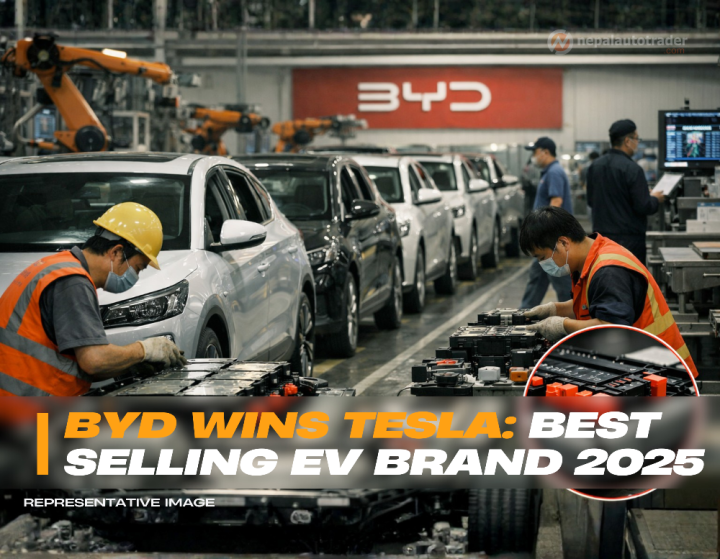
BYD sold around 2.26 million battery electric vehicles in 2025, overtaking Tesla globally
Tesla deliveries dropped to about 1.63 million units, marking a second straight annual decline
BYD exports crossed 1 million vehicles, expanding fast in Europe, Asia, and Latin America
Affordable EV pricing and a wider model range drove BYD’s growth
China now leads the global EV market in both production and sales
Analysts expect BYD to widen its lead in 2026 as global EV demand shifts toward value
If you follow electric cars, this moment matters.
For the first time in modern EV history, Tesla is no longer the world’s top electric vehicle seller.
In 2025, BYD officially took the lead, selling more battery electric vehicles than any other brand on the planet.
This shift did not happen overnight. It came from pricing pressure, changing buyer habits, and China’s growing grip on the global EV supply chain. If you are watching the future of electric mobility, this is the clearest signal yet that the market has changed.
| Brand | 2024–2025 BEV Sales | Year-on-Year Change |
|---|---|---|
| BYD | ~2.26 million | +28 percent |
| Tesla | ~1.63 million | -8 to -9 percent |
BYD’s growth came from volume, not hype. Tesla’s slowdown came from price fatigue, limited model updates, and stronger competition.
You are now seeing a global EV market where price, availability, and charging practicality matter more than brand image.
BYD sells everything from small city EVs to large electric SUVs. That gives buyers more choice at more price points.
Tesla still relies heavily on the Model 3 and Model Y.
BYD dominates the affordable EV space. In many markets, its cars undercut Tesla by thousands of dollars while offering similar range and features.
BYD builds its own batteries. That keeps costs down and supply steady. Tesla still depends on external battery partners in many regions.
“BYD’s vertical integration gives it a cost advantage Tesla cannot easily match,” says Felipe Munoz, Global Analyst at JATO Dynamics.
BYD focuses on real-world efficiency instead of headline numbers.
| Feature | BYD Strategy | Tesla Strategy |
|---|---|---|
| Battery Tech | In-house blade batteries | Mixed suppliers |
| Range Focus | Practical daily use | Long-range variants |
| Charging | Expanding regional networks | Strong but region-specific |
For you as a buyer, this means lower ownership costs and fewer compromises.
China now leads the global EV race.
Over 60 percent of global EV sales come from China
Government incentives remain strong through 2025
Domestic brands scale faster than Western rivals
BYD benefits directly from this ecosystem. Tesla competes inside it.
“The EV battle is no longer about innovation alone. It is about scale and pricing,” says Tu Le, Founder of Sino Auto Insights.
| Brand | Strength | Weakness |
|---|---|---|
| BYD | Price, range, scale | Brand prestige in premium markets |
| Tesla | Software, charging | Narrow lineup |
| Hyundai Kia | Design, quality | Limited EV volume |
| Volkswagen Group | Brand spread | Slow EV rollout |
If you want value and availability, BYD wins.
If you want brand recognition, Tesla still holds ground.
You should expect three things next.
More affordable EVs globally
Faster expansion of Chinese brands outside China
Pressure on Tesla to refresh models and pricing
BYD is no longer chasing Tesla. It is setting the pace.
BYD did not win because Tesla failed.
BYD won because the market changed.
If you care about the future of electric cars, this shift tells you one thing clearly. The next phase of EV growth will favor brands that deliver value, scale, and practicality.
Right now, BYD does that better than anyone else.
Yes. BYD sold more battery electric vehicles globally than Tesla in 2025.
Yes. BYD exports to over 110 countries across Europe, Asia, and Latin America.
In most markets, yes. BYD focuses heavily on affordable EV pricing.
Yes. Tesla remains profitable, but growth has slowed.
Yes. Analysts expect aggressive expansion through 2026.
BYD leads in cost-efficient battery production. Tesla leads in software integration.

Nepal Auto-Trader is one-stop platform for all automotive needs. We provide unbiased and unparalleled news/reviews of all auto-motives being launched in Nepalese Auto-Industry. Find recent updates and price of bikes/cars, compare and review recently launched bikes/cars, buy/sell/trade reconditioned cars/bikes and all government news about changing rules and regulation, road safety by subscribing us.

Subscribe to our Newsletter
© Copyright 2026, Nepal Autotrader


.png)
.png)