

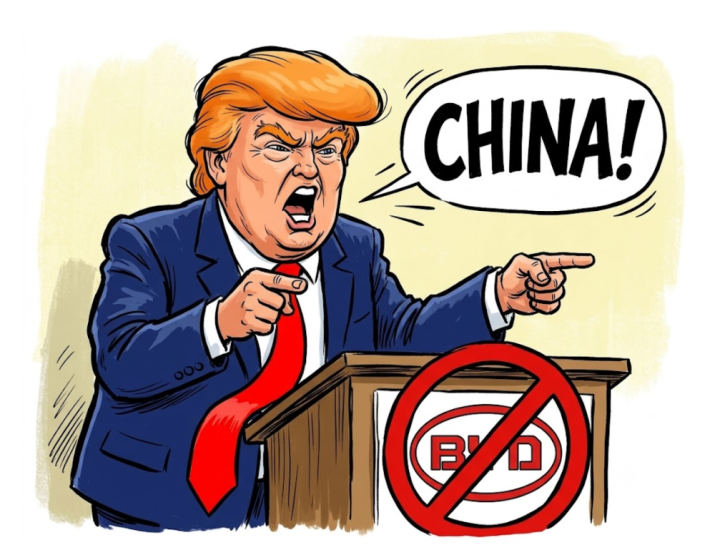
The latest flashpoint in the increasingly complex US-China technology rivalry now includes the world's largest electric vehicle manufacturer.
BYD has been added to a list maintained by the US Department of Defense that identifies companies the Pentagon believes are linked to China's military establishment. The updated roster also includes major Chinese names such as Alibaba, Baidu, and several technology and manufacturing firms. The designation falls under Section 1260H of US law, which requires the Pentagon to identify entities considered part of China's military industrial ecosystem.
For automotive observers, the inclusion of BYD stands out. This is not a defense contractor. It is the company that has become synonymous with China's EV rise, building everything from compact city cars to premium electric SUVs and batteries at massive scale.
That matters.
The move arrives at a time when Chinese automakers are pushing aggressively into overseas markets while facing growing political resistance in North America and parts of Europe.
The reaction from BYD was swift.
In statements issued following the Pentagon's decision, the company said it is neither a Chinese military company nor a participant in military-civil fusion activities connected to China's defense sector. BYD argued that there is no justified basis for its inclusion on the list and emphasized that the designation does not constitute a sanctions measure.
The company further stated that normal business operations would remain unaffected and indicated it would pursue available administrative and legal channels to protect its interests. Reuters reported that BYD firmly opposed the designation and planned to use feasible legal and administrative means to challenge the decision.
| Issue | Pentagon Position | BYD Response |
|---|---|---|
| Military designation | Included on Chinese military company list | Rejects the classification |
| Business impact | Restrictions tied to Pentagon procurement rules | Says operations remain unaffected |
| Future action | Companies may petition for removal | Considering legal and administrative remedies |
Here's the thing. Being placed on the list carries reputational consequences even when direct operational effects remain limited.
The phrase 'blacklist' often creates confusion.
Being added to the Pentagon's Chinese military company list does not automatically trigger broad economic sanctions. Companies named on the list can continue many commercial activities. However, US law prevents the Department of Defense from contracting directly with listed firms, and additional procurement restrictions are scheduled to expand over time.
For investors and industry stakeholders, the designation can still carry weight.
Not everyone will notice it immediately. Corporate procurement teams and policymakers certainly will.
This story would look different if it involved a niche manufacturer.
BYD has become one of the defining forces in the global EV market. The company has expanded rapidly across Asia, Latin America, Australia, and Europe while building an integrated business that includes batteries, semiconductors, and vehicle manufacturing.
Its growing scale has made it impossible for governments to ignore.
Industry analysts increasingly view BYD as a symbol of China's broader industrial ambitions, particularly in sectors tied to electrification and advanced manufacturing. That helps explain why security concerns and industrial policy debates are becoming intertwined with discussions about electric vehicles.
| Key Context | Current Situation |
|---|---|
| Company | BYD |
| Sector | Electric vehicles and batteries |
| US Action | Added to Pentagon Chinese military company list |
| Company Position | Denies military affiliation |
| Immediate Sanctions | None announced through the designation itself |
Electric vehicles were once discussed mainly through the lens of range, charging speed, and battery chemistry.
Those days feel distant.
Today, conversations around EVs increasingly intersect with trade policy, national security, industrial strategy, and supply chain control. BYD's inclusion on the Pentagon list is another example of how automotive manufacturing has become part of a much larger geopolitical contest.
For consumers, nothing changes overnight. For governments and manufacturers, however, the implications are broader.
The battle for leadership in electric mobility is no longer confined to showrooms and charging networks. It is being fought in boardrooms, courtrooms, and government agencies as well.
And that's important.
The next chapter will likely play out through administrative reviews and potential legal challenges.
The Pentagon's framework allows companies to seek removal from the list. BYD has already signaled its intention to defend its position and challenge what it considers an unfounded designation.
Whether the classification remains in place or is ultimately reversed, the episode highlights a reality that every major global automaker now faces. Success in the EV era is not just about building better vehicles. It is also about navigating an increasingly political global marketplace.
Q: Has BYD been sanctioned by the United States?
A: No. The Pentagon designation itself does not automatically impose broad sanctions. It primarily affects US defense procurement rules and increases scrutiny.
Q: Why was BYD added to the Pentagon list?
A: The US Department of Defense believes certain companies contribute directly or indirectly to China's military industrial capabilities. BYD disputes that assessment.
Q: Did BYD accept the Pentagon's decision?
A: No. BYD publicly rejected the designation, stating that it is not a military company and that the inclusion lacks factual basis.
Q: Will this affect BYD vehicle sales globally?
A: BYD says the designation will not affect its normal business operations. No immediate restrictions on global vehicle sales were announced.
Q: Can BYD challenge the designation?
A: Yes. Companies included on the Pentagon list can seek removal through administrative procedures and legal avenues.
Q: Why is this important for the EV industry?
A: The case highlights how electric vehicle manufacturing is increasingly tied to trade policy, supply chains, and national security concerns across major markets.

Nepal Auto-Trader is one-stop platform for all automotive needs. We provide unbiased and unparalleled news/reviews of all auto-motives being launched in Nepalese Auto-Industry. Find recent updates and price of bikes/cars, compare and review recently launched bikes/cars, buy/sell/trade reconditioned cars/bikes and all government news about changing rules and regulation, road safety by subscribing us.

Subscribe to our Newsletter
© Copyright 2026, Nepal Autotrader


.png)
.png)