

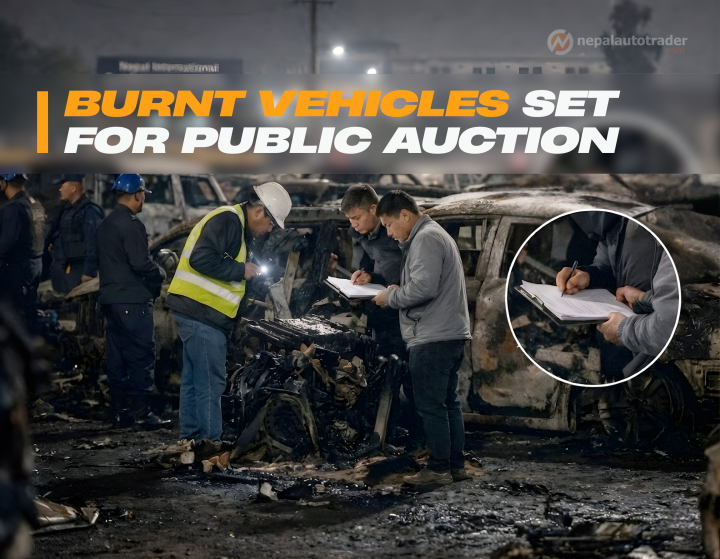
Government begins formal process to sell and dispose of burnt vehicles damaged during Gen Z protests
Both government and private vehicles included in the assessment
Disposal to happen through transparent auction and tender mechanisms
Focus on salvage value recovery, accountability, and legal compliance
In the aftermath of the Gen Z protests in Nepal, hundreds of vehicles were either fully burnt or severely damaged across Kathmandu and other regions. These vehicles, many of them owned by government bodies, are no longer operational. Instead of letting them decay in open spaces, the government has initiated a structured process to officially sell burnt vehicles and recover remaining value through regulated channels.
This move also clears public spaces, prevents environmental hazards, and ensures financial accountability.
Authorities have classified damaged vehicles into multiple categories based on condition and ownership.
| Vehicle Type | Ownership | Condition |
|---|---|---|
| Cars | Government | Fully burnt |
| Motorcycles | Government | Partially burnt |
| Buses | Government | Total loss |
| Cars and bikes | Private | Burnt during protests |
Private vehicle owners may independently manage insurance claims and salvage decisions, while government vehicles follow formal disposal rules.
Each ministry and government office was instructed to:
Prepare a detailed inventory of damaged vehicles
Record registration numbers, ownership, and damage level
Submit reports to the central authority for verification
Only verified vehicles move to the next stage.
Burnt vehicles are moved to designated holding areas such as government premises in New Baneshwor. Here, officials:
Physically inspect each vehicle
Confirm damage classification
Prepare vehicles for valuation
This step prevents duplication and ensures transparency.
Technical teams assess vehicles to determine salvage and scrap value. Factors considered include:
Remaining metal and reusable parts
Market scrap rates
Feasibility of repair versus scrap
Vehicles are then grouped as repairable, scrap only, or total loss.
Most vehicles will be sold through open public auctions where:
Registered bidders participate
Vehicles are sold on an as is basis
Highest bidder wins ownership
This method maximizes value recovery and maintains fairness.
For vehicles unsuitable for auction:
Government invites sealed tenders from scrap dealers
Sales are based on weight and material value
Environmental disposal standards are enforced
Every sale follows Nepal’s financial and administrative regulations.
| Requirement | Status |
|---|---|
| Secretary level approval | Mandatory |
| Financial Procedure Act compliance | Required |
| Ownership transfer documentation | Enforced |
| Audit trail | Maintained |
Vehicles sold for scrap are officially deregistered.
In some cities, local mechanics have proposed repairing burnt government vehicles at lower costs. While this option exists, authorities prioritize:
Safety standards
Cost effectiveness
Long term reliability
Final decisions are taken case by case.
For buyers:
Opportunity to purchase vehicles or scrap legally
Clear documentation and ownership transfer
For the public:
Faster clearance of damaged assets
Reduced environmental and visual pollution
Improved accountability of public property
The government’s move to sell burnt vehicles after the Gen Z protests is not just cleanup. It is a structured attempt to recover value, enforce transparency, and close a turbulent chapter responsibly. With auctions and tenders on the way, this process sets a clear precedent for handling damaged public assets in Nepal.
Expect official notices and auction announcements to follow soon.

Nepal Auto-Trader is one-stop platform for all automotive needs. We provide unbiased and unparalleled news/reviews of all auto-motives being launched in Nepalese Auto-Industry. Find recent updates and price of bikes/cars, compare and review recently launched bikes/cars, buy/sell/trade reconditioned cars/bikes and all government news about changing rules and regulation, road safety by subscribing us.

Subscribe to our Newsletter
© Copyright 2026, Nepal Autotrader


.png)
.png)