

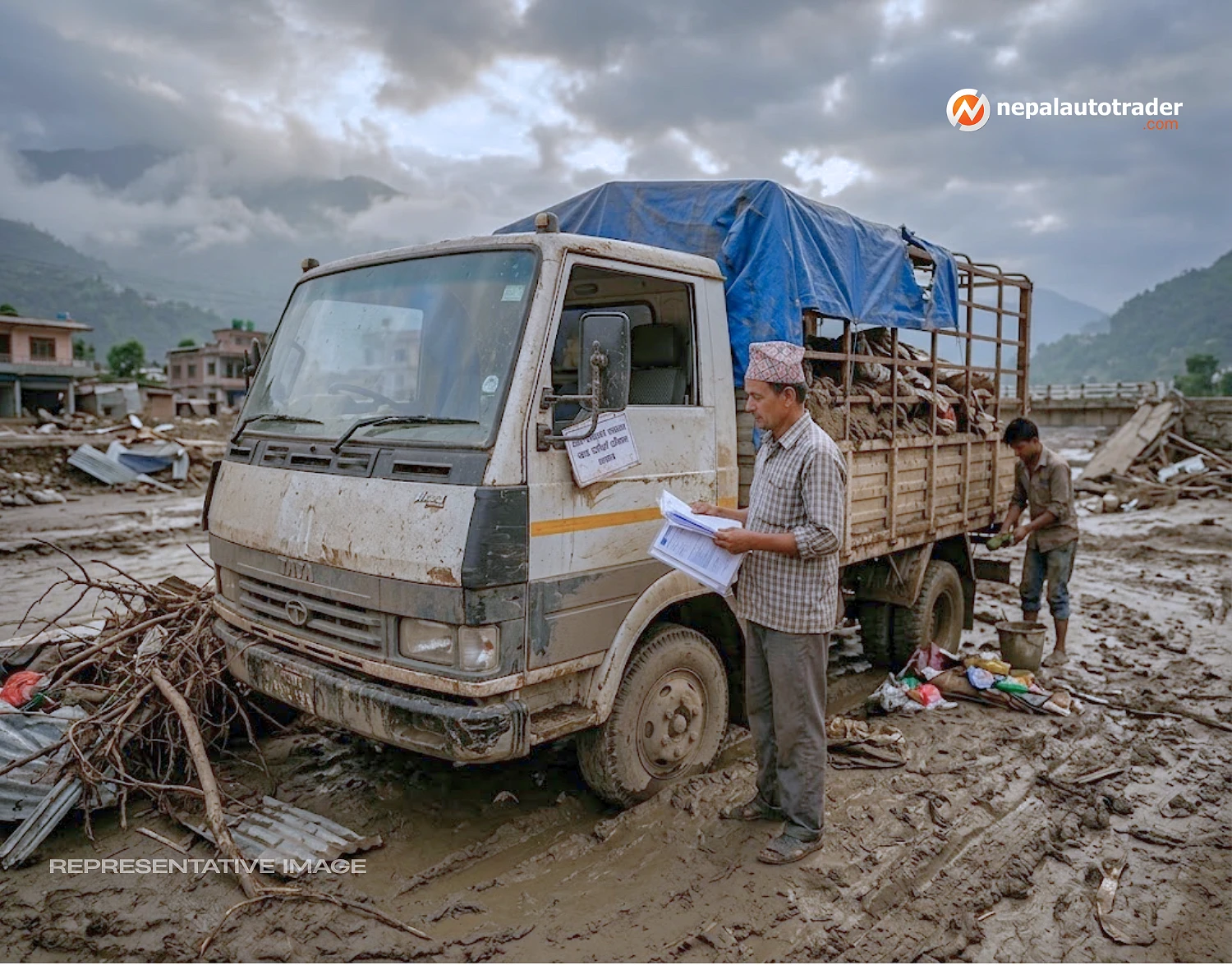
For an operator whose income depends on a truck or commercial vehicle, a flood-damaged machine is not simply a wrecked asset. It is a stalled business.
The Cabinet meeting on Bhadra 18, 2083 announced a recovery package for Bhotekoshi flood victims. A central measure covers commercial transport vehicles lost or damaged beyond repair.
This is not a blanket vehicle tax cut. The relief is designed for businesses that lost productive transport assets and now have to rebuild their fleets.
Eligible owners can cancel the registration of a lost or beyond-repair vehicle without paying the cancellation fee. They can then seek a replacement of the same type, with all applicable customs duties waived at the customs point.
| Policy area | Measure | Impact |
|---|---|---|
| Registration | Cancellation fee waived | Removes an administrative cost |
| Replacement import | Customs duties waived | Lowers eligible replacement cost |
| Financing | Base rate plus prescribed minimum premium, with LTV review | Supports access to credit |
Customs is a major part of the import-cost equation for vehicles in Nepal. Removing those duties for an eligible replacement can have an immediate financial effect when an owner is already dealing with physical losses.
The boundary is clear. The decision is tied to vehicles that were lost or damaged beyond repair, cancellation of registration, and a replacement of the same type. It does not describe a general exemption for ordinary passenger-vehicle buyers.
A preliminary Department of Roads assessment found at least 40 kilometers of roads and 19 bridges damaged after the flood. Commercial vehicles are part of the recovery machinery. Trucks move goods. Transport operators reconnect markets.
Tax relief cannot solve the problem when a replacement vehicle still has to be financed. Banks can provide replacement loans after assessing vehicle damage and insurance payments, using the bank's base rate plus the prescribed minimum premium. The applicable loan-to-value ratio will also be reviewed.
Flood-affected borrowers will receive a one-year interest measure. The applicable rate will be whichever is lower between a rate based on the bank's base rate plus 0.5 percentage points and the rate produced by adding the existing premium.
| Borrower support | Duration | Key detail |
|---|---|---|
| Replacement loan | Not separately specified | Linked to damage and insurance assessment |
| Interest relief | 1 year | Lower of the two specified calculations |
| LTV review | Not separately specified | Ratio reconsidered for relevant loans |
For a business with little cash left after a flood, this could be decisive. The issue is surviving long enough to put the replacement back to work.
Insurers can provide an advance claim payment of up to 50 percent based on the initial assessment, while reinsurers can provide insurers with the same level of advance support. The government has also directed insurers to create a simplified claim-settlement procedure.
The policy is clear on paper. The real test will be coordination between insurers, banks and customs authorities.
The measure arrives while Nepal's automotive sector is absorbing the flood's impact on roads, bridges and northern trade routes. The NADA Auto Show 2026 continued in Kathmandu despite the disaster, reflecting the industry's effort to keep economic activity moving. NADA Auto Show 2026 coverage reported continued business activity despite transport concerns.
The next step is implementation, connecting loss assessment, registration, insurance settlement and customs clearance. The same-type replacement requirement will be important, although the source decision does not yet publish a full document checklist.
Speed will determine the real value of the package. A customs waiver that takes too long, or an insurance advance that arrives after months of lost income, will weaken the recovery effect.
The significance emerges when viewed in a broader context. In flood-affected areas, commercial vehicles are economic infrastructure. This policy is less about making vehicles cheaper and more about putting working assets back into a disrupted economy.

Nepal Auto-Trader is one-stop platform for all automotive needs. We provide unbiased and unparalleled news/reviews of all auto-motives being launched in Nepalese Auto-Industry. Find recent updates and price of bikes/cars, compare and review recently launched bikes/cars, buy/sell/trade reconditioned cars/bikes and all government news about changing rules and regulation, road safety by subscribing us.

Subscribe to our Newsletter
© Copyright 2026, Nepal Autotrader


.png)
.png)