

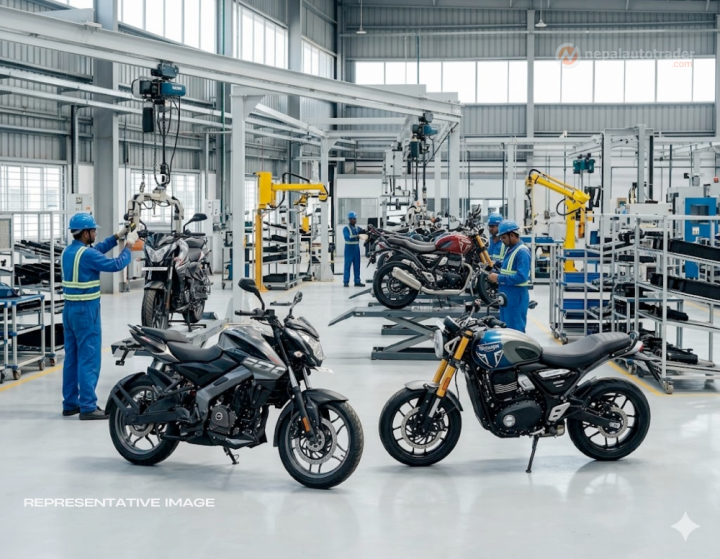
Bajaj Auto and Triumph Motorcycles are not just building motorcycles together, they are reshaping supply chains. The latest phase of their partnership confirms something bigger, India is now a central export hub for Triumph’s mid-capacity lineup.
This is not a trial run. It is structured, deliberate, and global in intent. Production in India feeds multiple markets, reducing costs while maintaining brand positioning. That matters.
The collaboration, which initially focused on product development, has now matured into a full-scale manufacturing and export strategy. Motorcycles developed under this alliance are being shipped to regions across the globe, carrying the Triumph badge but built on Indian soil.
This changes things. For India, for Bajaj, and for how premium motorcycles are priced worldwide.
The partnership blends two distinct strengths. Triumph Motorcycles brings heritage, design, and brand equity. Bajaj Auto contributes manufacturing scale, cost control, and deep supply chain integration.
It is a clean division of labor, but tightly integrated.
The result is a lineup that feels authentically Triumph, but is competitively priced thanks to Indian manufacturing efficiency.
That balance is hard to achieve. Here, it is becoming repeatable.
The motorcycles produced under this alliance are not limited to one region. They are being exported globally, targeting both mature and emerging markets.
| Region | Market Type | Strategic Importance |
|---|---|---|
| Europe | Developed | Brand credibility, premium positioning |
| Asia | Mixed | Volume growth and expanding middle class |
| Latin America | Emerging | High demand for mid-capacity motorcycles |
| Africa | Emerging | Long-term growth opportunity |
This spread tells you everything. The strategy is not reactive, it is proactive. India is supplying the world, not just serving local demand.
And it allows Triumph to enter price-sensitive markets without diluting its brand.
There is a reason this partnership leans heavily on India. In fact, several.
Bajaj Auto has spent decades refining this ecosystem. Now, Triumph Motorcycles is leveraging it to expand globally without building new factories elsewhere.
This is not outsourcing. It is strategic integration.
The shift also aligns with a broader industry trend, where global brands are increasingly turning to India for high-volume, high-quality production.
That matters. Because it signals trust.
The mid-capacity motorcycle segment is heating up. Brands are fighting for relevance between entry-level and premium categories.
With this partnership, Bajaj Auto and Triumph Motorcycles are positioning themselves aggressively against rivals.
Competitors like Royal Enfield Himalayan 450 and other global players now face a new equation, premium branding combined with aggressive pricing.
This is where the India advantage becomes critical. Lower production costs allow sharper pricing without compromising margins.
And that shifts competitive dynamics.
Expect more brands to respond. Expect more alliances. The playbook is out.
The current phase is only the beginning. The partnership is expected to expand its portfolio, targeting a broader range of customers.
More models. More markets. More volume.
There is also room for deeper integration in areas like electric mobility and advanced technologies, though no specific details have been confirmed.The trajectory is clear. This is not a short-term collaboration. It is a long-term strategic alignment.
And it positions India not just as a manufacturing base, but as a global nerve center for motorcycle exports.
That shift is already underway. Quietly. Efficiently. Relentlessly.
Q: What is the main goal of the Bajaj Triumph partnership?
A: The partnership aims to develop, manufacture, and export mid-capacity motorcycles globally, using India as the primary production hub while leveraging Triumph’s global brand network.
Q: Are these motorcycles only sold in India?
A: No, the motorcycles are manufactured in India but exported to multiple international markets including Europe, Asia, and other regions.
Q: Why is India chosen as the export hub?
A: India offers cost efficiency, a skilled workforce, and a strong supplier ecosystem, making it ideal for large-scale, high-quality motorcycle production.
Q: Does this affect pricing globally?
A: Yes, manufacturing in India allows more competitive pricing while maintaining premium brand positioning, which can influence global pricing strategies.Q: Will more models be launched under this partnership?
A: The partnership is expected to expand its product lineup, though specific future models have not been officially detailed.

Nepal Auto-Trader is one-stop platform for all automotive needs. We provide unbiased and unparalleled news/reviews of all auto-motives being launched in Nepalese Auto-Industry. Find recent updates and price of bikes/cars, compare and review recently launched bikes/cars, buy/sell/trade reconditioned cars/bikes and all government news about changing rules and regulation, road safety by subscribing us.

Subscribe to our Newsletter
© Copyright 2026, Nepal Autotrader


.png)
.png)