

Key Highlights:
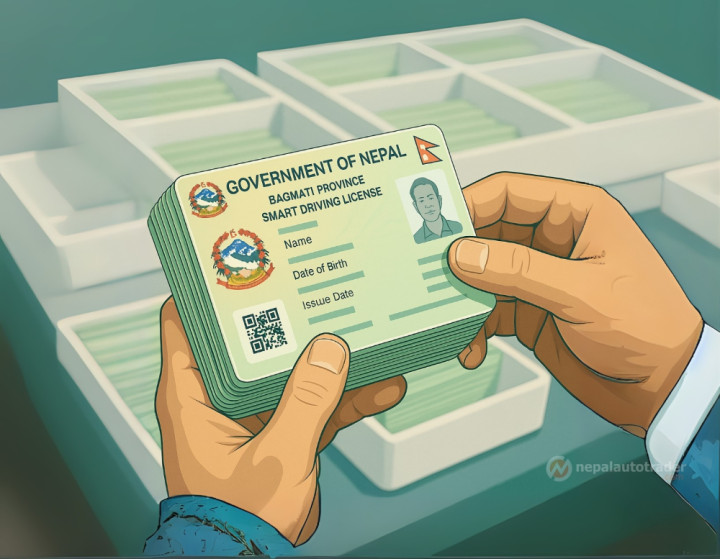
Bagmati Province has officially launched a bold plan to print smart driving licenses within the province. This move comes as a direct response to long-standing delays from the central Department of Transport Management (DoTM), which has been struggling to deliver licenses on time due to limited printing capacity and supply issues.
The provincial government has already purchased five high-capacity printers—each capable of printing 150 licenses per hour, giving the province a combined capacity of 750 licenses per hour. That’s a potential 18,000 smart licenses per day if run continuously across multiple shifts.
| Printer Count | Rate per Printer | Total Hourly Output | Potential Daily Output* |
|---|---|---|---|
| 5 Printers | 150 licenses/hr | 750 licenses/hr | Up to 18,000 licenses |
*Assumes continuous operation across multiple shifts
To bring this system online, Bagmati Province set aside NPR 67.5 million in the 2082/83 fiscal year, specifically for smart license printing. This includes the cost of the printers (already procured) and smart cards (currently in the procurement phase).
While the first attempt to acquire smart cards through a tender failed, officials have confirmed that the process will be relaunched within Saun (July/August). Smart card costs are estimated to be between NPR 130 to NPR 150 per piece, and the province will purchase as many as the budget allows.
Getting a smart license in Nepal has long been a frustrating experience. The central system, managed by DoTM, prints just 4,000 licenses a day for the entire country. This leads to massive backlogs and wait times stretching into months.
Bagmati’s new local printing system is designed to cut the dependency on the center and get licenses into the hands of citizens faster and more efficiently.
While the printers are ready, the system won’t be fully operational until the smart cards are delivered. Once the tender is completed, Bagmati Province will begin mass production and distribution of QR-enabled smart licenses.
These licenses will be integrated into the Nagarik App, allowing for easy verification by traffic police and government systems, reducing fraud and improving convenience.
Koshi Province has already begun printing smart licenses locally, and other provinces are expected to follow. This decentralization marks a turning point in how government services are delivered in Nepal—faster, smarter, and closer to the people.
PREVIOUS NEWS

Nepal Auto-Trader is one-stop platform for all automotive needs. We provide unbiased and unparalleled news/reviews of all auto-motives being launched in Nepalese Auto-Industry. Find recent updates and price of bikes/cars, compare and review recently launched bikes/cars, buy/sell/trade reconditioned cars/bikes and all government news about changing rules and regulation, road safety by subscribing us.

Subscribe to our Newsletter
© Copyright 2026, Nepal Autotrader


.png)
.png)